Burst power of electromagnetic catapult on China’s aircraft carrier Fujian shown in official media program
By Published: Dec 25, 2025 11:17 AM

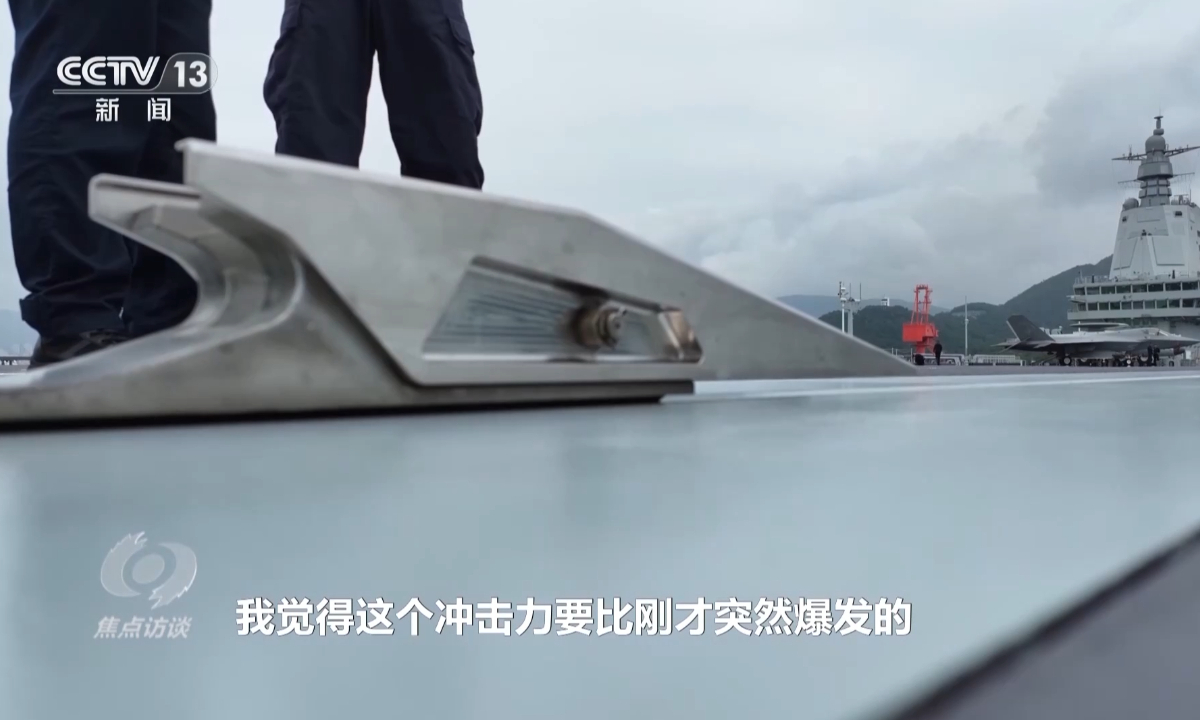
An electromagnetic catapult on the aircraft carrier Fujian stops at the end of the track after completing a regular test, shown on a program by China Central Television on December 24, 2025. Photo: Screenshot from China Central Television
A recent official Chinese media program provided a detailed up-close look at the electromagnetic aircraft launch system on the newly commissioned aircraft carrier Fujian, showing its high burst power.
A Chinese expert said on Thursday that China has taken a leap forward by opting for the more advanced electromagnetic catapults and bypassing the traditional steam ones - an achievement made possible by China's technological advancements.
The program was aired on China Central Television (CCTV) on Wednesday evening, showing a regular test of one of the electromagnetic catapults of the Fujian. Video clip showed that the mover achieved high-speed explosive acceleration and an instantaneous deceleration to zero speed on the relatively short catapult track.
Such large force caused only a small noise compared with what would be caused by a steam catapult, a CCTV reporter noted in the program after witnessing the test right beside the electromagnetic catapult.
Bao Yu, a crew member of the Fujian, told the reporter in the program that the electromagnetic catapult can meet the demands for aircraft acceleration at a relatively short distance, and then decelerate the mover at an extremely short distance.
The greatest advantage of the electromagnetic catapult system is that it can accelerate aircraft to takeoff speed over a relatively short distance. Its most prominent feature is that it is capable of meeting the takeoff requirements of a wider variety of carrier-based aircraft under all types of operating conditions. With the catapult system in place, the sortie efficiency of carrier-based aircraft has been greatly improved, enabling the carrier to launch carrier-based aircraft continuously and uninterruptedly, Bao said.
The CCTV program noted that China's third aircraft carrier, the Fujian, has bypassed the conventional steam catapult system adopted by foreign aircraft carriers, and achieved a direct leap forward to the more advanced electromagnetic catapult system. Compared with steam catapults, electromagnetic catapults deliver greater thrust and higher efficiency, and are capable of precisely regulating the ejection force. This enables carrier-based aircraft to conduct short-distance takeoffs and rapid sorties with a full fuel load and a full weapons load. The more fighter jets that can be launched in a given time frame, and the faster they can be sent out, the greater the combat advantage will be.
Chinese military affairs expert Song Zhongping told the Global Times that the Chinese aircraft carrier has achieved a technological leap by choosing electromagnetic catapults instead of steam catapults, significantly boosting the carrier's combat performance.
But this leap is based on the development of China's development in scientific technologies, Song stressed, noting that the Fujian, as only one of the few aircraft carriers in the world that are equipped with electromagnetic catapults, represents a top level of China's advanced technologies.
The CCTV program also introduced the support and emergency response capabilities of the carrier Fujian, as well as its medical support systems.
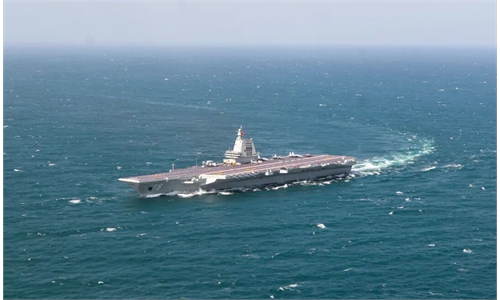
With a full-load displacement of over 80,000 tons, the Fujian is China's first domestically designed and built aircraft carrier equipped with an electromagnetic aircraft launch system. It has not only debunked the myth that only nuclear-powered aircraft carriers can support electromagnetic catapults, but also achieved the electromagnetic catapult launch of heavy fighter jets and stealth fighter jets for the first time, the program said.
The aircraft carrier Fujian officially entered service on November 5, marking China's entry into an era with three aircraft carriers, significantly boosting the far seas defense capabilities and the modernization level of the Chinese People's Liberation Army Navy.
Shortly after its commissioning, the Fujian formed a carrier formation with other warships including the Yan'an and Tongliao and completed a maritime training mission, in which multiple types of aircraft, including the J-35 stealth fighter jet, J-15T heavy fighter jet, J-15DT electronic warfare aircraft, and KJ-600 early warning aircraft, completed multiple takeoff and landing training sessions, effectively tested the Fujian's capabilities of electromagnetic catapult launch, arrested recovery and deck operations, further verifying its ship-aircraft compatibility, according to the program.
RELATED ARTICLES