Zhuque-3 reusable rocket may realize ‘successful recovery’ in 2026, says chief designer
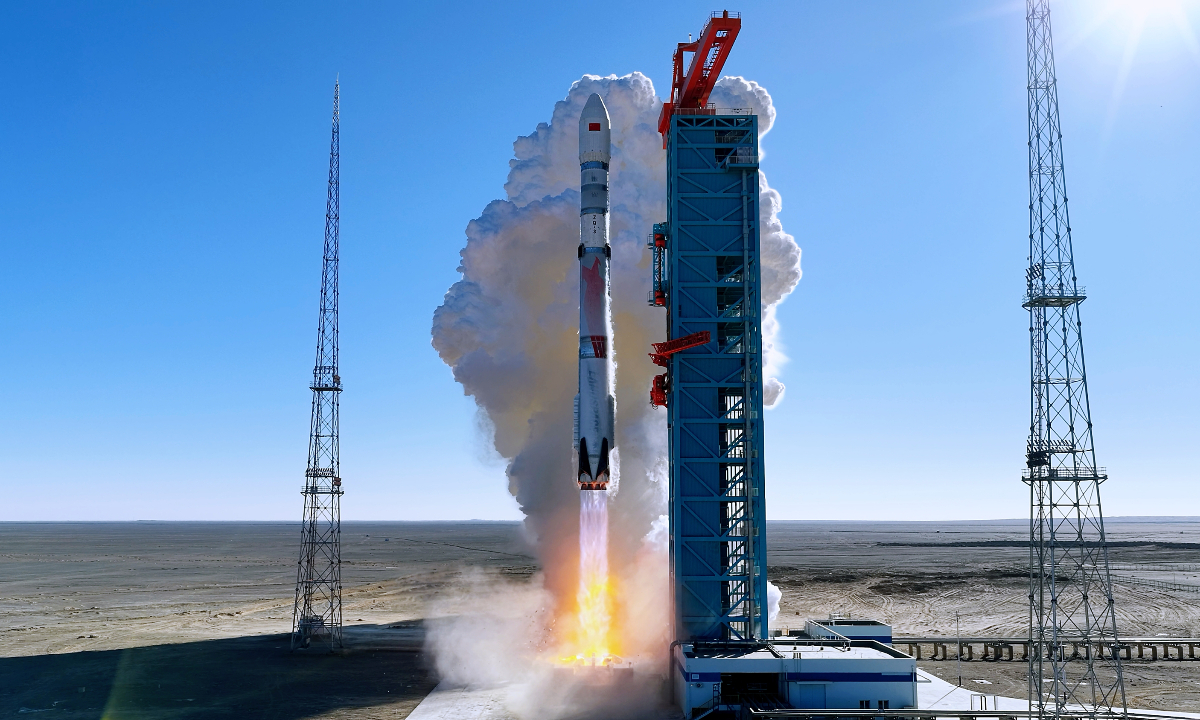
ZQ-3 Y1 rocket took off for maiden flight from the Dongfeng Commercial Aerospace Innovation Test Zone at noon time on December 3, 2025. Photo: courtesy of LandSpace
Dong Kai, deputy chief designer of the Zhuque-3 reusable rocket operated by Chinese private aerospace firm LandSpace, told the Global Times on Thursday that the rocket is expected to achieve a successful recovery by mid-2026, with plans to evolve into its "full configuration" within the same year.
After that, the company's research and development focus will shift toward shortening the launch cycles and increasing launch frequency, Dong said.
Dong's remarks came after the maiden flight of Zhuque-3 -- a liquid oxygen-methane-powered rocket engineered for low-cost, high-capacity and frequent launches - on December 3. The second stage entered the designated orbit, but recovery of the first stage failed, the Xinhua News Agency reported.
As the recovery ultimately failed due to a braking issue during the landing phase, according to the chief commander of the test flight project, the mission was widely viewed by industry observers as a "valuable test" with important reference significance for China's commercial aerospace sector.
Compared with the "full configuration," the maiden-flight rocket was slightly shorter, according to Dong. The full version of Zhuque-3 will be 76 meters tall, featuring nine engines on the first stage and one engine on the second stage, with roughly 80 percent of the rocket body made of stainless steel.
Dong said that while the maiden-flight rocket shared the same structural configuration, it was powered by Tianque-12A engines with a thrust of 83 tons. The full version will be equipped with Tianque-12B engines, each delivering more than 100 tons of thrust, resulting in a rocket body that is about 10 meters taller.
For safety reasons during the maiden flight, the recovery range was set at 390 kilometers, Dong said, noting that under a design-optimized configuration, the recovery distance could be extended to 550 to 600 kilometers to fully unleash the rocket's payload.
Speaking of Zhuque-3's maiden flight, the team considered the outcome "acceptable," Dong said, while noting that all preparations and expectations before launch were aimed at achieving "complete success."
Regarding the unsuccessful recovery, the deputy chief designer said that the overall performance was in line with expectations. "As long as the rocket could persist until the re-entry ignition phase, at about 80 kilometers in altitude during the return segment, it is a major step of progress," he said.
Dong said that the pace of rocket iteration is tied to production capacity, adding that LandSpace has made corresponding preparations, with plans to manufacture 10 rockets and 100 engines in 2026.
Dong said that the company will strictly comply with national safety regulatory requirements. "This is the prerequisite and safeguard for the steady and long-term development of the industry, and it is also a responsibility that enterprises must shoulder," he said.
RELATED ARTICLES