Phrase ‘US kill line’ sparks debate on American ordinary people’s economic fragility and social safety nets on Chinese social media
By Published: Dec 25, 2025 06:49 PM


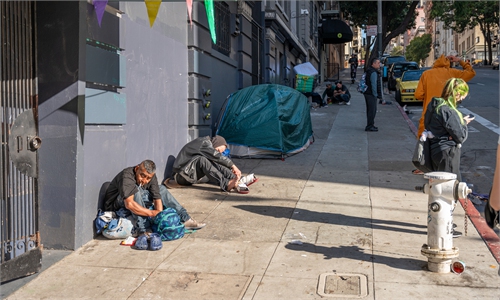
Homeless people sit on the streets in California, the United States. Photo: VCG
The phrase "the US kill line" has gone viral on Chinese social media in recent days, igniting extensive discussion about economic vulnerability and systemic risk within American society. The term is now used among netizens to describe a precarious financial state in which individuals or households have virtually no margin for error—where a single shock can trigger rapid and potentially irreversible collapse.
The expression "kill line" itself originates from video games, where a "kill line" refers to a health threshold below which a character can be instantly defeated, regardless of remaining defenses or abilities.
The newly aroused attention among Chinese netizens follows a video uploaded on December 8 to the Chinese online video-sharing platform bilibili.com by Chinese content creator "Sikuiqidawang," titled Cutting Flesh with a Dull Knife and the Kill Line. In the video, he discusses the heavy burden of medical expenses on ordinary Americans and uses the phrase "kill line" as a metaphor for what he describes as a slow, grinding economic pressure. The creator also shared other videos with one depicting the difficult lives of homeless people and people from lower-income groups he encountered in Seattle.
The phrase "the US kill line," along with the content of the videos, has sparked online discussion for the past several days. A WeChat account affiliated with the Beijing Youth Daily noted that the term "kill line" could be used to describe a precarious financial reality for many Americans: after covering essential expenses, households are left with little margin for error. A sudden shock—such as illness, an accident, or job loss—can push their finances below a critical threshold, triggering a chain reaction within the broader social system that drives people into homelessness.
Online discussions quickly expanded around the concept on Chinese social media, with some netizens sharing videos of Americans describing the burdens of student debt and medical expenses, while others examined what they see as the structural roots of homelessness in the US. Some users also compared the so-called "kill line" with China's social safety-net mechanisms, referring to China's policies for poverty alleviation.
One netizen, using the handle "Caizhongxin" commented that, in policy terms, what some online commentators call the "kill line" corresponds to the ALICE threshold in the US—short for Asset Limited, Income Constrained, Employed. Once households slip below the line, they face a persistent risk of financial collapse triggered by even minor shocks.
The discussion has resonated beyond Chinese platforms. On Reddit, under a post asking whether such a "kill line" actually exists, many users who identified themselves as living in the US or Canada responded in the affirmative, sharing personal experiences and observations.
A netizen named "crimbusrimbus" wrote that "I've never heard that phrase but that is 100% accurate. I consider myself financially 'okay,' with a good job, but if I was out of work for one month or so I'd have $0.00 liquid assets. The social safety nets that exist are flimsy and once something like this happens it's very hard to recover and very easy to fall through the cracks."
User "BreadDaddyLenin" wrote that the idea of being "one accident away from homelessness" is "incredibly true." "I make an okay amount of money, enough to be comfortable, but I have debt, and a single accident would probably completely ruin me," the user wrote.
Another user wrote, "As an American, yes, it is that bad. We've all been brainwashed into thinking that this is just the way things are. I have multiple coworkers who are burdened with such heavy medical debt that they are maxing out credit cards to cover it, forgoing vital medical care, or taking second jobs to afford care for their families."
Chinese scholar Shen Yi, a professor at Fudan University, has participated in recent discussions on the "US kill line" on Sina Weibo, wrote on Thursday that the concept reflects "the core mechanism of American capitalism."
"In the US, this is not a concealed phenomenon but a tacitly accepted one, embedded in the fundamental rules of American-style capitalism," Shen wrote. "The logic of social Darwinism—survival of the strongest—operates openly within the system. Yet for a long time, this underlying mechanism remained largely invisible. Only recently has this underlying logic of American capitalism entered public view."
Global Times
RELATED ARTICLES