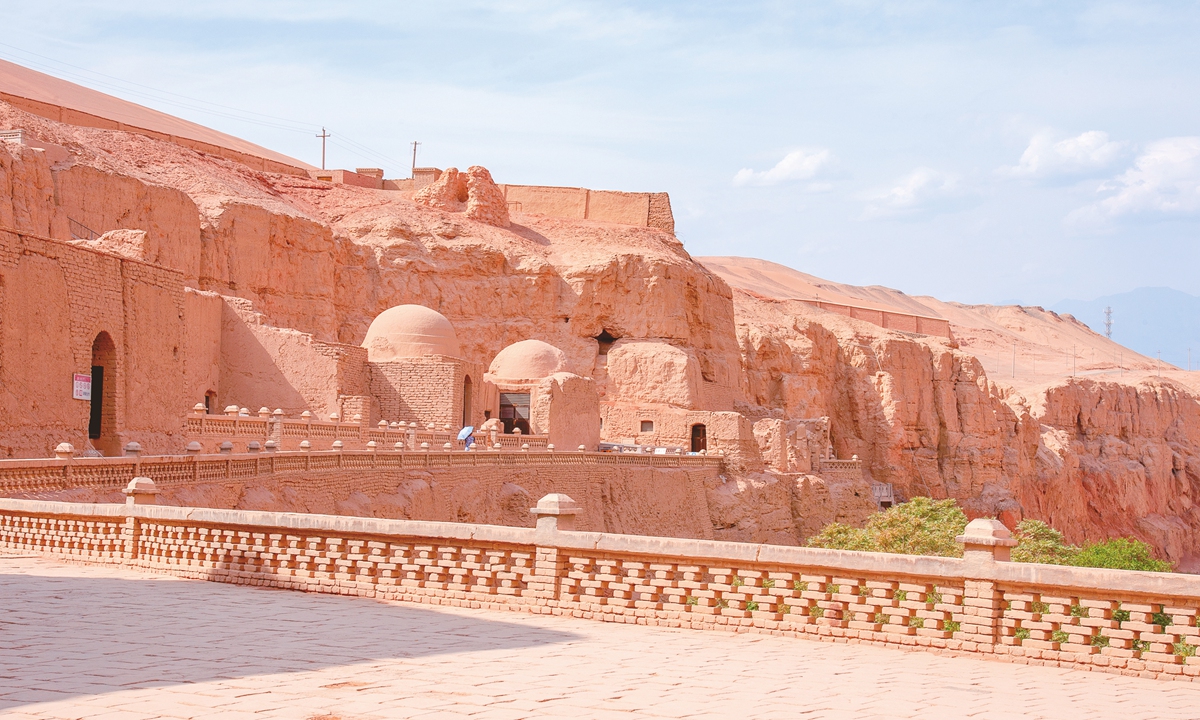
The Bezeklik Thousand Buddha Caves in Turpan, Northwest China's Xinjiang Uygur Autonomous Region. Photo: VCG
Editor's Note:Despite some Western political forces continuing to run smear campaigns against Northwest China's Xinjiang Uygur Autonomous Region, they won't deter the people in the region from embracing peace and prosperity, nor will they halt Xinjiang society's steady development. Seeing is believing, and facts and truth will eventually debunk all lies. In the "Xinjiang Upclose" series, the Global Times will publish conversations with and articles from scholars and observers from around the world who have visited the region, sharing their firsthand experience of traveling to Xinjiang and observing the daily lives of its people. Through their insights and experiences, we aim to present an authentic perspective on Xinjiang.
This is the 12th article of the series.
As a professor of Chinese studies at the University of Tehran, specializing in China-Iran relations, my fascination with the Silk Road has always been more than academic. It represents the invisible threads that have woven together the fates of our two ancient civilizations - Iran and China - for millennia.
In the fall of 2023, I embarked on a two-week journey to the Xinjiang Uygur Autonomous Region in northwestern China. This trip was not just a scholarly pursuit (the Visiting Program for Young Sinologists) but also a personal pilgrimage to witness the historical sites, museums and modern developments that embody the cultural dialogue and tolerance between our peoples.
From Urumqi to Kashgar and Turpan, I traced the footprints of our shared past along the Silk Road, observing Persian-Iranian artistic motifs and reflecting on the civilizational similarities that highlight the road's immense potential for fostering global harmony.
My adventure began in Urumqi, the bustling capital of Xinjiang, a city that strikes a perfect balance between ancient heritage and contemporary dynamism. Flying into Urumqi Diwopu International Airport, I was immediately struck by the city's modern infrastructure - a testament to China's rapid development in the region. Over the past decade, Xinjiang has seen an explosion in economic growth, with investments in transportation, energy and urban planning transforming it into a key hub of the Belt and Road Initiative (BRI).
High-speed railways now connect Urumqi to major Chinese cities, while expansive highways cut through the Tianshan Mountains, facilitating trade that echoes the ancient caravans. The city's skyline, dotted with sleek skyscrapers and efficient public transport systems, reflects GDP growth driven by the oil, gas, coal and renewable energy sectors, among others. Yet, amid this progress, Urumqi preserves its multicultural soul, home to Uygurs, Han people, Kazakhs and others living in relative harmony - a modern example of cultural tolerance that harkens back to the Silk Road's ethos.
In Xinjiang Museum in Urumqi, a sprawling institution that houses artifacts spanning over 4,000 years of history, I was captivated by the Loulan mummies. These mummies, dating back to 1,800BC, wear textiles with patterns reminiscent of Persian weaves, hinting at early cultural exchanges. One particularly moving display featured Sogdian murals - Sogdia being an ancient Iranian civilization in Central Asia - depicting banquets and dances that blend Persian motifs with Chinese elements, such as lotus flowers and dragons.
This fusion exemplifies the "dialogue among civilizations," a concept popularized by former Iranian president Mohammad Khatami, where cultures engage in mutual enrichment rather than conflict.
I also visited Kashgar, a city often called the "Pearl of the Silk Road," which feels like a bridge between the East and West. The Id Kah Mosque in Kashgar, China's largest mosque, was built in 1442. The famous Iranian poet Saadi Shirazi visited Kashgar and beautifully described the story of his meeting with a young man from Kashgar in his book Golestan. Persian murals in various parts of Kashgar, especially in the Afaq Khoja Mausoleum and the surrounding cemeteries, along with the works of Persian art in this city and its beautiful bazaar, reminded me, as an Iranian, of the close ties between the peoples of Iran and China in ancient times, which today can provide the best basis for the growth of relations between the two countries.
At the Kashgar Museum, I encountered artifacts that vividly illustrated the close ties between the peoples of Iran and China. A collection of ancient manuscripts in Sogdian script detailed trade agreements with Chinese silk merchants. Persian miniatures influenced local art. One exhibit showcased a Khotanese carpet, woven in the ancient kingdom of Khotan (now Hotan in Xinjiang), blending Persian knotting techniques with Chinese silk threads - a tangible symbol of cultural integration.
In addition, Kashgar's modern facelift, with new airports and industrial parks, has boosted employment and trade with neighboring countries, including Iran, reviving the Silk Road's economic spirit.
Visiting the site of the Bezeklik Thousand Buddha Caves in Turpan was the highlight of my trip. These grottoes, which began construction in the fifth century, house murals that blend Buddhist iconography with Persian artistic elements: elongated figures, vibrant blues from lapis lazuli (traded from Afghanistan through Iran) and scenes of musicians playing lutes akin to the Iranian barbat. One mural depicted a Sogdian merchant offering gifts to Buddha, symbolizing the cultural tolerance in Xinjiang.
Nearby, the Karez Wells - an underground irrigation system - invented by ancient Persians and adapted here, showcase shared ingenuity in taming arid landscapes.
Turpan's Emin Minaret, with its geometric patterns, further evokes Persian mosque minarets, underscoring architectural parallels.
After the 13th century, Iranian astronomers collaborated with their Chinese counterparts at the Maragheh Observatory, advancing shared knowledge in science. Today, joint exhibitions and BRI cultural programs continue this legacy, as seen in recent China-Iran heritage shows. These exchanges embody the "dialogue of civilizations," where Iran and China have historically promoted mutual respect.
Throughout my journey, I observed how Xinjiang's development invests in infrastructure to bridge peripheries with city centers, fostering inclusive growth. Wind power stations near Urumqi and solar farms in Turpan highlight a commitment to sustainability. This progress has not erased history but amplified it; museums and sites are now digitized, attracting global scholars and tourists.
As I departed Xinjiang, I marveled at the Silk Road's civilizational capacities. It was not merely a trade route but a conduit for ideas, fostering tolerance amid diversity. In an era of global tensions, reviving its spirit through the BRI could bridge divides and promote peace and prosperity. My journey reaffirmed that Iran and China, bound by history, hold the keys to a collaborative future.
The author is chair of Chinese Language and Literature at the University of Tehran. opinion@globaltimes.com.cn
RELATED ARTICLES