Laboratory in Central China’s Hubei sets world record with 800 km/h maglev breakthrough, boosting transport technology
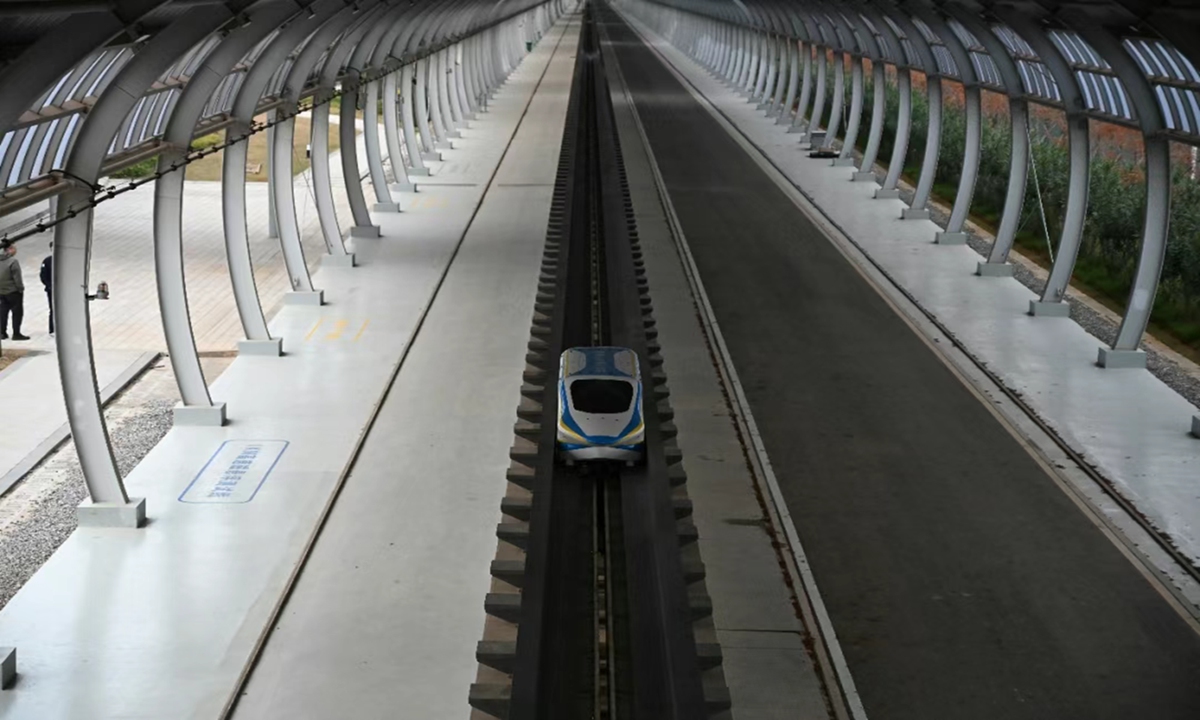
Researchers at East Lake Laboratory in Central China's Hubei Province accelerate a 1,110-kilogram high-speed rail model to 800 km/h in just 5.3 seconds using levitation support and electromagnetic propulsion on December 25, 2025, breaking a world record. Photo: Courtesy of East Lake Laboratory
Researchers at East Lake Laboratory in Central China's Hubei Province accelerated a 1,110-kilogram high-speed rail model to 800 km/h in just 5.3 seconds using levitation support and electromagnetic propulsion, breaking a world record, according to a statement the lab sent to the Global Times on Friday.
It marks the third world record the lab has set on a similar platform in the past six months, per the statement.
An official from Hubei's East Lake Laboratory said the team raised the world record to 700 km/h on July 14 and achieved another major breakthrough on November 24, accelerating a 1,110-kilogram high-speed rail model to 800 km/h in 5.3 seconds. Subsequent month-long tests verified the platform's speed-control accuracy, high-speed levitation stability, efficiency and overall system reliability, with all indicators meeting design requirements.
On June 16, the independently developed high-speed maglev electromagnetic propulsion innovation center at East Lake Laboratory staged the first public demonstration of its one-kilometer high-speed maglev test line, where a 1,030-kilogram test vehicle reached 650 km/h under electromagnetic propulsion, setting a world record.
After the milestone, Li Weichao, director of the center, said the test line is designed for 800 km/h and is expected to complete construction by year-end, meeting acceptance requirements.
Li said in the statement that once completed, the one-kilometer high-speed maglev test line will serve as an open, cooperative and shared platform, supporting tests in open-air conditions such as dynamic model aerodynamics, speed calibration and resistance to overload impacts. He added that it will provide strong technical backing for next-generation high-speed maglev transit, ultra-high-speed electromagnetic sleds, electromagnetic launch systems for space applications, and the low-altitude economy.
Bian Yongzu, executive deputy editor-in-chief of Modernization of Management magazine told the Global Times that the latest breakthrough by East Lake Laboratory shows that China has moved to the forefront of maglev transportation technology. As global transport systems undergo rapid transformation, high-speed, high-capacity maglev is expected to play a growing role in cross-regional travel, driving more efficient and integrated mobility.
He added that maglev technology, with its potential to significantly boost speed, passenger capacity and freight efficiency, has become a strategic focus for major economies. China's achievement highlights its strengths in cutting-edge transport technology and infrastructure, and points to continued leadership as such innovations move toward real-world application.
Wang Peng, an associate researcher at the Beijing Academy of Social Sciences, told the Global Times the breakthroughs in levitation support and electromagnetic propulsion have moved beyond traditional approaches, offering new pathways for high-speed acceleration. The underlying principles have the potential to be applied to real-world high-speed rail, helping raise future operating speeds, further compress travel time and improve transport efficiency.
He added that safety research is an integral part of the scientific process. The new results provide a foundation for safety verification and are expected to help refine safety standards, supporting the high-speed transport sector's shift toward greater safety and reliability.
High-speed maglev technology has broad application prospects in areas including ultra-high-speed electromagnetic sleds, maglev rail transit, the low-altitude economy, electromagnetic launch systems for space applications, and amusement facilities, per the statement.
Hubei East Lake Laboratory is a new-type research institution approved by the Hubei provincial government with independent public-institution legal status. Since its establishment in 2021, it has achieved a series of major technological breakthroughs in areas including new-energy vessels, intelligent marine equipment, energy-efficient rail transit and smart microgrids.
RELATED ARTICLES