Japan’s record defense budget for 2026 speeds its shift to a war-capable state, posing deep risks to regional security: expert
By Published: Dec 26, 2025 09:28 PM

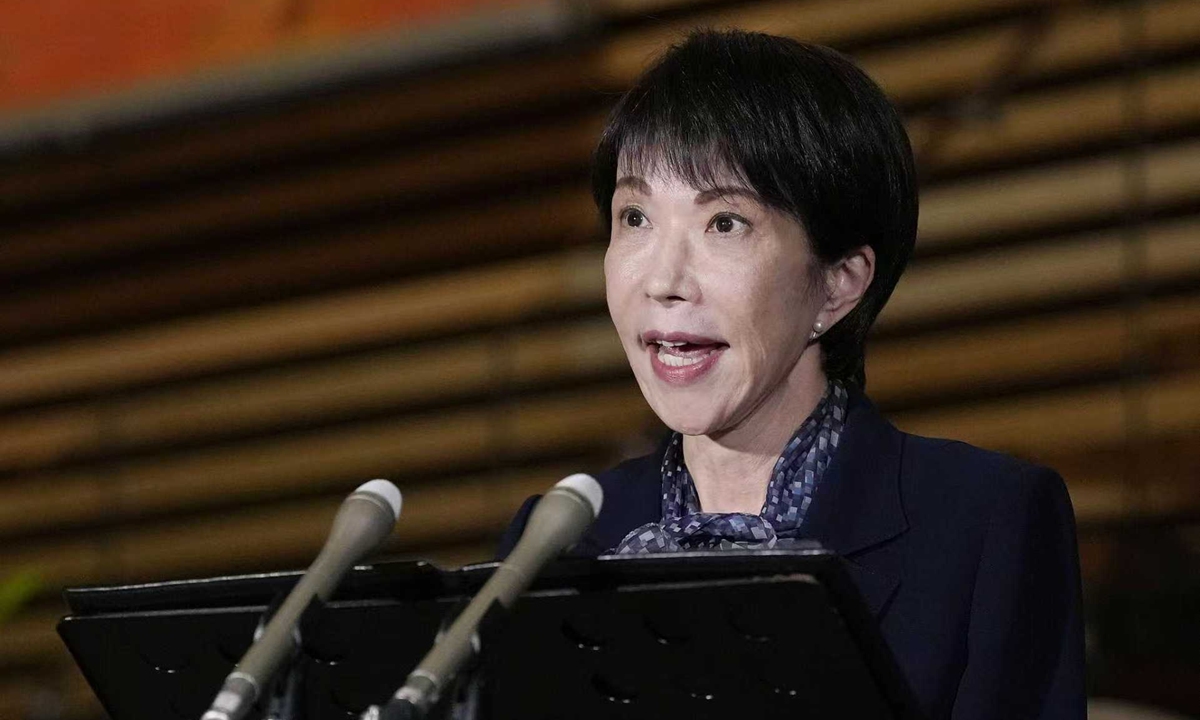
Japanese Prime Minister Sanae Takaichi meets the press at the premier's office in Tokyo on Dec. 26, 2025, following the Cabinet's approval of a record 122.31 trillion yen ($783 billion) draft initial budget for fiscal 2026.
Japan's draft defense budget was set at a record 9.04 trillion yen ($58 billion) for fiscal 2026, Japan's Kyodo News cited the Japanese government as saying on Friday. The draft budget will be submitted to the ordinary Diet session in January 2026 for deliberation. If passed, Japan's defense budget will see its 14th consecutive year of growth.
Experts interviewed by the Global Times noted that this budget not only signifies a qualitative shift in Japan's defense strategy from "exclusive defense-oriented policy" to "proactive deterrence," but also further pushes the country toward becoming a "war-capable state" with blue-water operational and long-range strike capabilities. Such developments, they argued, fundamentally shake Japan's post-war military positioning and will have a profound impact on the regional security landscape. "This once again exposes Japan's narrow and hazardous strategic mindset of seeking security at the expense of its neighbors," experts said.
The Japanese government officially adopted the new "three security documents" at the end of 2022, stating that it would increase the total amount of Japan's defense expenditures to about 43 trillion yen for fiscal years 2023 to 2027. Since fiscal year 2023, Japan's defense budget has successively exceeded 6 trillion yen, 7 trillion yen, 8 trillion yen, and 9 trillion yen, according to media reports.
The Cabinet of Japanese Prime Minister Sanae Takaichi approved the same day a draft initial state budget for the year starting next April worth 122.3 trillion yen, also a record high, including defense and other expenditures, according to the Kyodo news.
Under the defense budget, 100.1 billion yen has been earmarked for building the "Shield" layered coastal defense system, which requires numerous aerial, surface and underwater vehicles, according to the report.
A total of 1.1 billion yen has been set aside to assess the use of long-endurance drones as a measure against airspace violations, the report said.
Japan's defense ministry has decided to rename the air self-defense force as the "aerospace self-defense force" in the next fiscal year. The air self-defense force's space operations squadron, which is responsible for space monitoring and currently has a staff of about 310 personnel, will be upgraded within the current fiscal year to the provisional "space operations group" (approximately 670 personnel), and is expected to become the "space operations command" (around 880 personnel) in the next fiscal year, according to the Yomiuri news.
The draft initial budget for the next fiscal year also includes funding related to these organizational changes.
Japanese Defense Minister Shinjiro Koizumi said at a press conference on Friday that "this budget is, after all, the minimum necessary for our country to fully carry out the defense of Japan as it faces the most severe and complex security environment in the postwar period."
Moreover, Koizumi has also publicly called for Tokyo to consider acquiring nuclear-powered submarines (SSN). "There are new developments, and all the surrounding countries are set to possess (nuclear submarines)," Koizumi said during an appearance on a Tokyo Broadcasting System Television Inc. program on November 6, according to Naval News.
RELATED ARTICLES