2025 Yearender: From infant car seats to DeepSeek, China’s high-quality goods offer shared benefits to the world
Nation’s new development philosophy offers increasing shared benefits to the world
By Published: Dec 26, 2025 09:40 PM
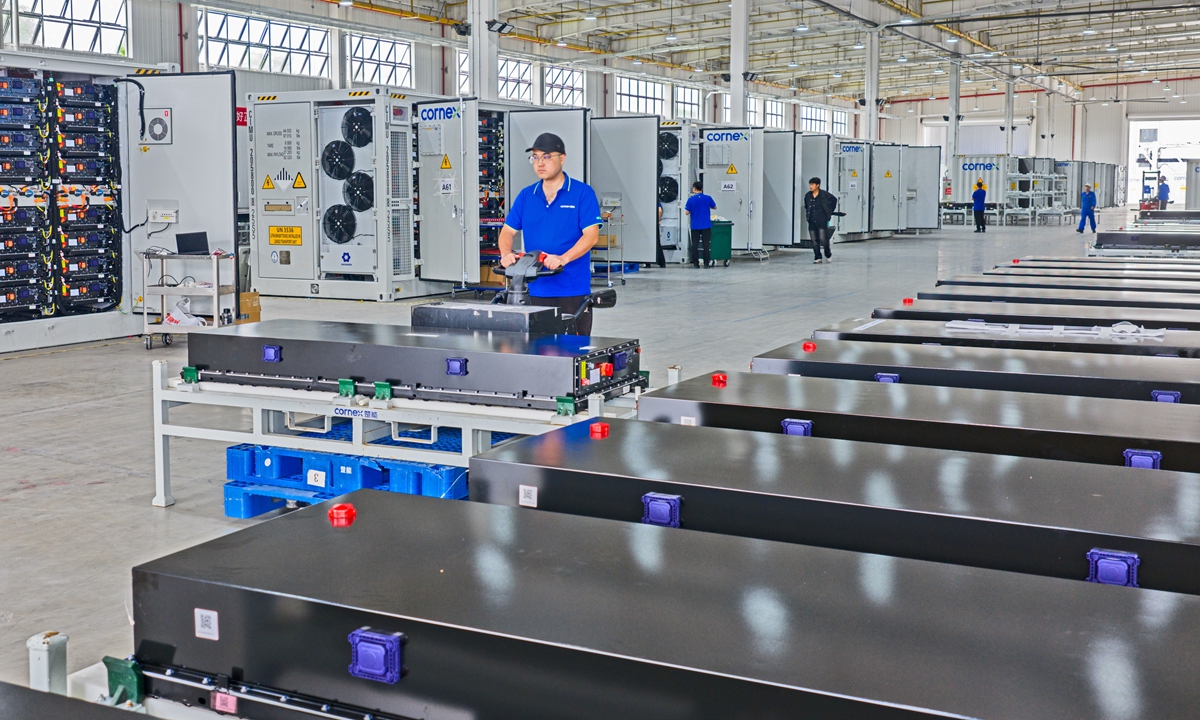
Workers inspect and test newly produced power batteries destined for export to Bulgaria inside a plant in Yichang, Central China's Hubei Province, on September 22, 2025. File photo: VCG
Editor's Note:
As 2025 draws to a close, the Global Times is releasing a series of in-depth reports focusing on China's economic governance. Through concrete case studies and data analysis, it explores the broader macroeconomic trends reflected in micro-level narratives, showcasing China's new achievements and insights in 2025 through stories reflecting the new development philosophy of innovation, coordination, green development, openness and shared benefits. The series reviews key hot-button issues of the year while reflecting on long-term strategic thinking: How China's governance offers the world solutions and an anchor of stability. This is the fourth installment of the series.
Inside a research facility in Ningbo, East China's Zhejiang Province, a group of designers study a computer screen attentively, as a computer-generated 3D image of a smart infant car seat rotates slowly.
Overseeing the design team, Jeffrey Chen, general manager of Ningbo Welldon Infant And Child Safety Technology Co, a leading infant car seat brand in China, told the Global Times that sales of the company's branded infant car seats in overseas markets have grown rapidly since 2020.
"Our business has expanded in Japan, South Korea, Southeast Asia and the Middle East in recent years," Chen said. "We see this as a win-win. As our brands go abroad and diversify beyond our traditional markets such as the EU market, more customers can access our value-for-money products."
Global win-win business
China dominates the infant car seat production market, and reportedly about 99 percent of imported child safety seats in the US come from China.
Overseas markets are largely reliant on the Chinese supply chain for this product. When US government imposed sweeping tariffs on Chinese-made goods this summer, it had to consider exempting infant car seats from the tariffs simply because it is hard to find an alternative supplier, according to US industry portal Baby Safety Alliance.
Behind this dominance is a decades-long story of how Chinese manufacturing started as a supplier or original equipment manufacturer (OEM) for global brands and the industry tenaciously climbed the value chain by focusing on research and development (R&D) and product development amid a highly competitive domestic market.
Observers noted that China's integrated supply chain advantage, highly competitive market, skilled labor force, and many businesses' ambition to offer the best products to their customers have contributed to their expanding market share in the world.
"Our R&D capability, honed through years of competition, is the key strength. Today, we can efficiently develop products according to our customer needs," Chen said. "If they want high-quality and relatively inexpensive products, we can deliver. If they are not price-sensitive, such as some clients from the Middle East, we can also premium and even luxurious options. The world's highest-priced and most technologically advanced infant car seat, which automatically turns outward when the car door opens, is now produced in China," Chen said
"Through continuous research and product improvement, we have surpassed many global brands. Our products are now in a different league in terms of intelligence," Chen added.
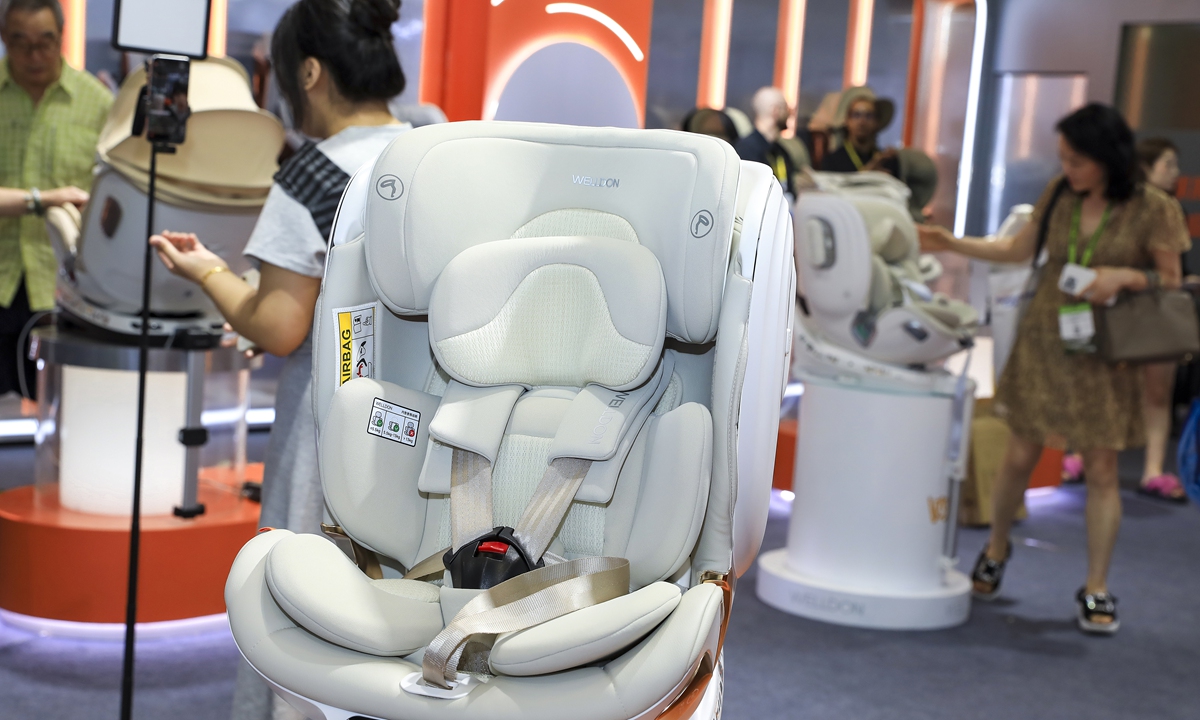
An infant car seat is on display at an industry show in Shanghai on July 17, 2025. File photo: VCG
Chen acknowledged that the car seat industry is relatively low-tech and labor-intensive, but China is also capable of high-tech innovations, citing the country's electric vehicles (EVs) as a good example.
Along with rapid technological advances over the past decade, EVs - along with solar, wind, hydropower, and batteries - have become examples of high-tech global public goods from China that help meet worldwide demand for solutions to mitigate climate change.
Powering green transition
Leveraging advances in EV technology and cost efficiency, Chinese automakers have established a strong presence overseas, helping drive the global green transition. In 2024, China exported 1.28 million new energy vehicles (NEVs), marking a year-on-year increase of 6.7 percent.
Like infant car seats, the rise of China's NEVs was not sudden, but rather the result of decades of planning and implementation.
Erik Solheim, former UN under-secretary-general and former executive director of the UN Environment Program, said at the Global Times Annual Conference 2026 on December 20 that "government guidance and an effective market have formed a unique formula" for the success of China's green industries.
"In both the green economy and the digital economy, China can do very well for the people of China. But it can also make a massive contribution to the rest of us, to the rest of the world," Solheim said.
According to the former UN official, China is now a leading nation in everything green, and its "contribution to the renewable economy is essential for the world."
And, the International Energy Agency (IEA) noted in a report released in May that China is playing a vital role in global green development.
In 2024, global electric car sales surpassed 17 million units, accounting for over 20 percent of total vehicle sales. Sales continued to set records, particularly in China and other emerging markets.
According to the China Energy Transition Review 2025 report, released in September by UK energy consultancy Ember, China's rapid expansion of renewables and sweeping electrification across its economy are reshaping global energy landscape.
The report noted that accelerating the deployment of renewables, grids, and storage solutions in China, combined with the electrification of transport, buildings and manufacturing, is bringing the country toward a peak in electricity use. At the same time, it is reducing costs and accelerating the uptake of clean energy technologies. This shift has brought about structural decline in dirty fossil fuel use, Ember said.
Striving for shared benefits
In Pakistan's Arifwala-Sahiwal region, the Hi-Tech Feed solar photovoltaic project has a total capacity of 3 megawatts.
"In addition to LONGi solar panels, we also used Huawei inverters. Overall, our project effectively reduces local fossil fuel consumption and helps address the climate challenge," Usama Shahid, a Pakistani engineer in charge of maintaining the solar plant, told the Global Times.
Shahid said electricity shortages occurred frequently in Pakistan in the past, but Chinese investment has enabled the photovoltaic industry to grow rapidly in the past years. "In urban areas, nearly 60 percent of the power shortage problem has been alleviated after photovoltaic systems were connected to the national grid," he said.
"It is very meaningful to bring electricity to more people," Shahid said.
"China is the leader in the photovoltaic industry, so the prospects for cooperation between our two countries in this field are bright. Through the China-Pakistan Economic Corridor, we could strive to achieve technology transfer and the localization of PV power generation systems," Shahid said.
According to a statement sent to the Global Times by Chinese solar giant LONGi, Pakistan is one of 160 overseas markets the company supplies. In 2024, shipments to Pakistan surged by 136 percent year-on-year. "Looking ahead, markets in Central and East Africa and Latin America are expected to register rapid growth," the company stated.
China's pursuit of shared benefits with the world has yielded concrete results worldwide. From high-quality daily products to green goods that support the global fight against climate change, and to artificial intelligence tools such as DeepSeek that empower users and businesses around the world -- many of them are free to use -- this increasingly fruitful partnership is driven by strong complementarities, analysts said.
These examples vividly demonstrate China's new development philosophy - featuring innovation, coordination, green development, openness and shared benefits.
Global cooperation initiatives such as the Belt and Road Initiative, and other platforms such as the China International Import Expo, have become pathways to modernization and shared prosperity for countries around the world, Wan Zhe, a professor at Beijing Normal University, told the Global Times.
As many economies around the world pivot toward digital infrastructure, renewable energy and sustainable growth, China is set to provide an expanding array of high-quality, cost-efficient products and solutions to the world, the analysts said.
RELATED ARTICLES