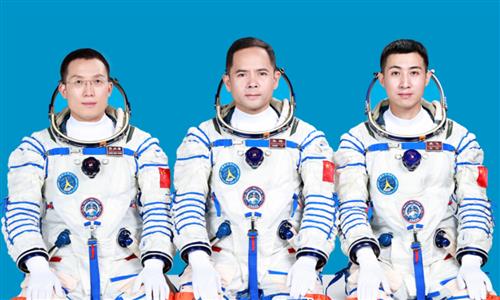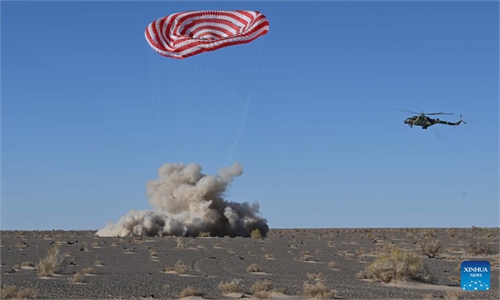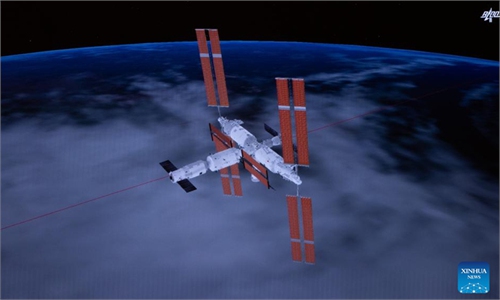
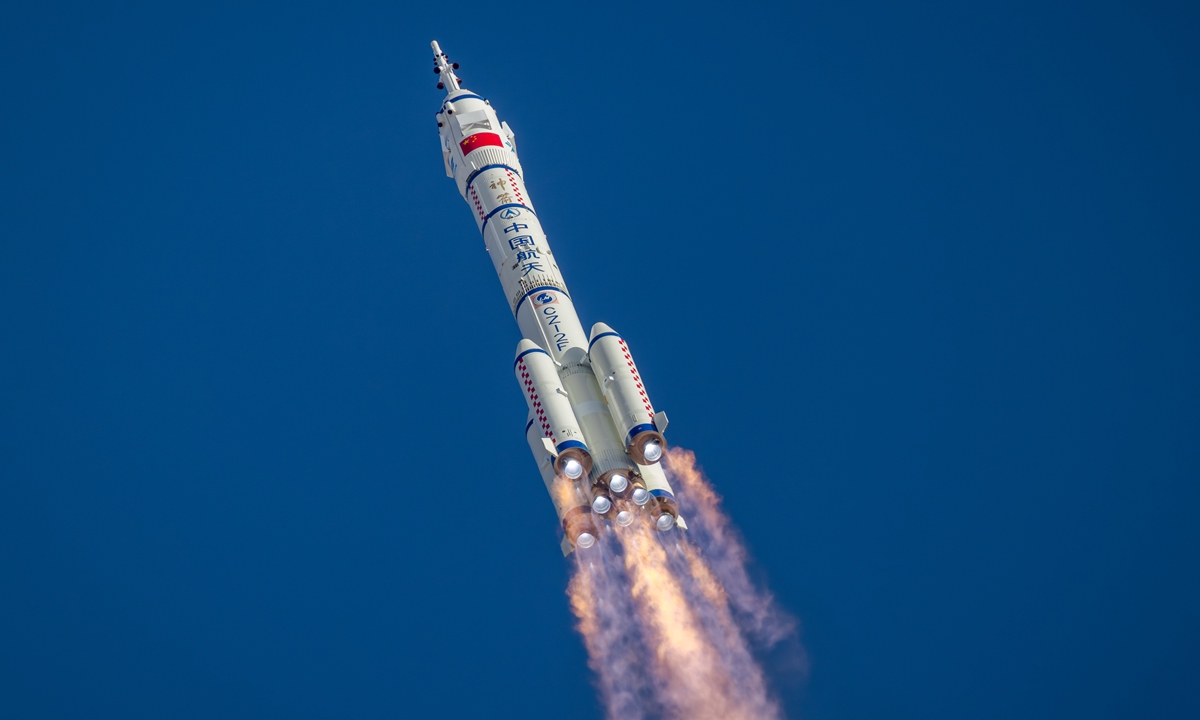
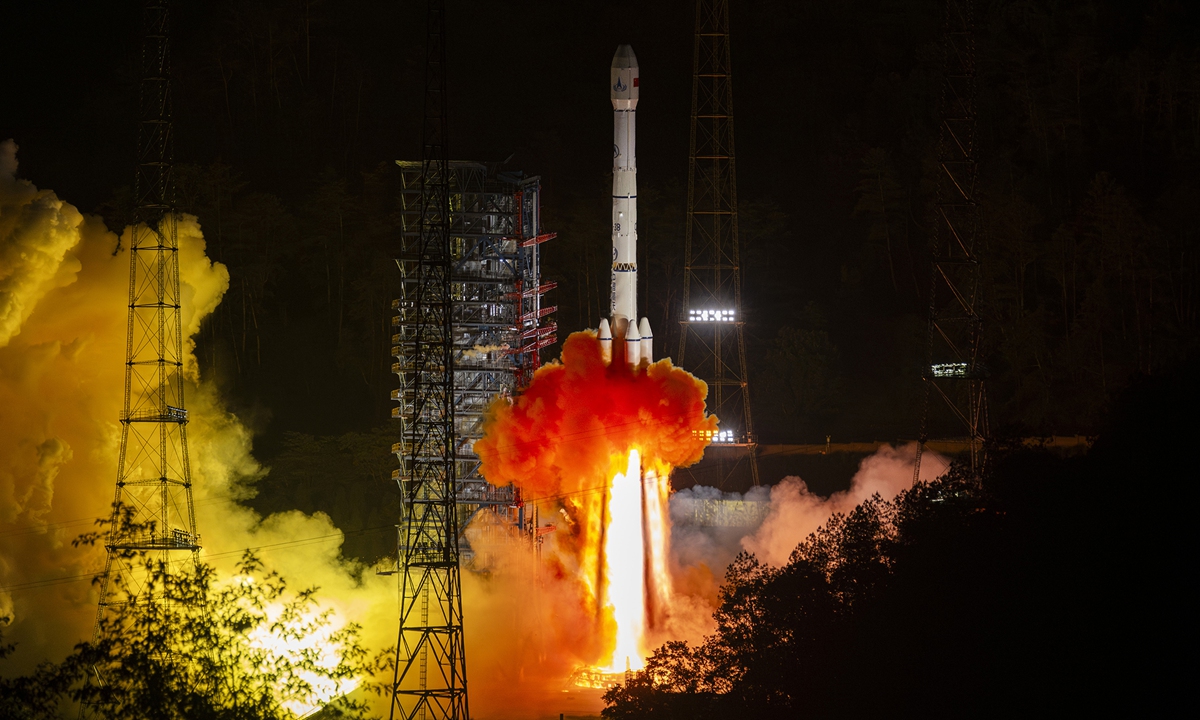
The Long March-2F Y20 carrier rocket carrying the Shenzhou-20 manned spacecraft lifts off from the Jiuquan Satellite Launch Center on April 24, 2025. Photo: VCG
"It is like standing in Beijing and throwing a basketball into a fixed hoop in Shanghai; the level of precision required is similarly demanding," Wei Yuanming of China Aerospace Science and Technology Corporation (CASC) told the Global Times when he was illustrating the exciting and highly challenging Tianwen-2 mission in Xichang, Southwest China's Sichuan Province, in May, ahead of the launch of the first asteroid probe and sampling mission.
Riding a Long March-3B carrier rocket from the Xichang Satellite Launch Center, the Tianwen-2 probe was successfully launched on May 29 early morning. "When an object moves at a higher speed, it inevitably becomes more difficult to control. The probe launched this time is the fastest among all known probes China has ever sent into space so far," Wei said. "At the same time, it also has the highest precision requirements, twice as high as those of previous missions. These are the main challenges for the launch period of Tianwen-2," Wei said at the Xichang center.
Fruitful year
The launch of the Tianwen-2 mission was one of the highlights of China's space development in 2025, which has proven to be yet another year of remarkable developments. Just as netizens often say: China's aerospace endeavors are forever full of anticipation and excitement.
China's Tianwen-2 probe, atop a Long March-3B carrier rocket, lifts off from the Xichang Satellite Launch Center in southwest China's Sichuan Province, May 29, 2025. Photo: Xinhua
In June, Tianzhou-9, the fourth cargo mission at the application and development stage of the China Space Station, was successfully launched via the Long March 7 carrier rocket at the Wenchang Space Launch Site in South China's tropical Hainan Province.
In the delivery run to the China Space Station, Tianzhou-9 shipped a total upmass of 776.5 kilograms, including experimental payloads, experiment units, samples, critical spare parts, and consumable materials, covering 23 scientific experiments in fields such as space life science and biotechnology, space materials science, microgravity fluid physics, and combustion science.
The Tianzhou-9 cargo vessel brought over 1.5 tons of food for the crew aboard the Tiangong space station. The food manifest includes more than 190 varieties, among which are over 90 types of side dishes - 20 more than in previous missions.
New additions to the menu include homestyle Chinese favorites such as mapo tofu, tomato and egg stir-fry, stewed water chestnuts, vegetable medley, lotus root stir-fry, and cumin potatoes. "These dishes may seem ordinary on a typical family dinner table, but incorporating them into an astronaut's space menu requires extensive technological research," Liu said.
Speaking of constantly improving cuisine for taikonauts in space, the first-ever space BBQ was staged at the China Space Station on November 5, which amazed the world.
Using a new oven installed on the China Space Station, crew members of the Shenzhou-20 and -21 manned space flight mission enjoyed a space barbecue, video clips provided by the Astronaut Center of China (ACC) to the Global Times showed.
The video footage showed that the taikonauts grilled chicken wings for 28 minutes. Wang Jie and Wu Fei, from Shenzhou-20 and -21 crew respectively, also cooked the black peppered steak for Chen Dong, the mission commander of the Shenzhou-20 mission.
The addition of an "oven" to the "space kitchen" is a heartwarming initiative to enhance the quality of life for taikonauts in orbit, the ACC said.
While the International Space Station once baked chocolate chip cookies in orbit as an experiment, China's oven appears to be far more powerful and practical, the New York-based tech site Interesting Engineering reported.
Times of India noted that the oven also marks the rapid improvement in China's in-orbit living standards, from simple pre-packaged meals during the Shenzhou-5 era to a diverse menu of 190 items today. After long hours of scientific work, sharing a hot meal gives astronauts a sense of normalcy and connection to Earth.
The Shenzhou-21 crew returned to Earth with invaluable biological subjects - "mice astronauts," which were the first mammalian test subjects in the station. The mice, which were monitored throughout their time in orbit, will provide critical data on behavioral and physiological adaptations. Scientists will analyze the data to study the subjects' acute responses and adaptive changes to space conditions, contributing to space biology research.
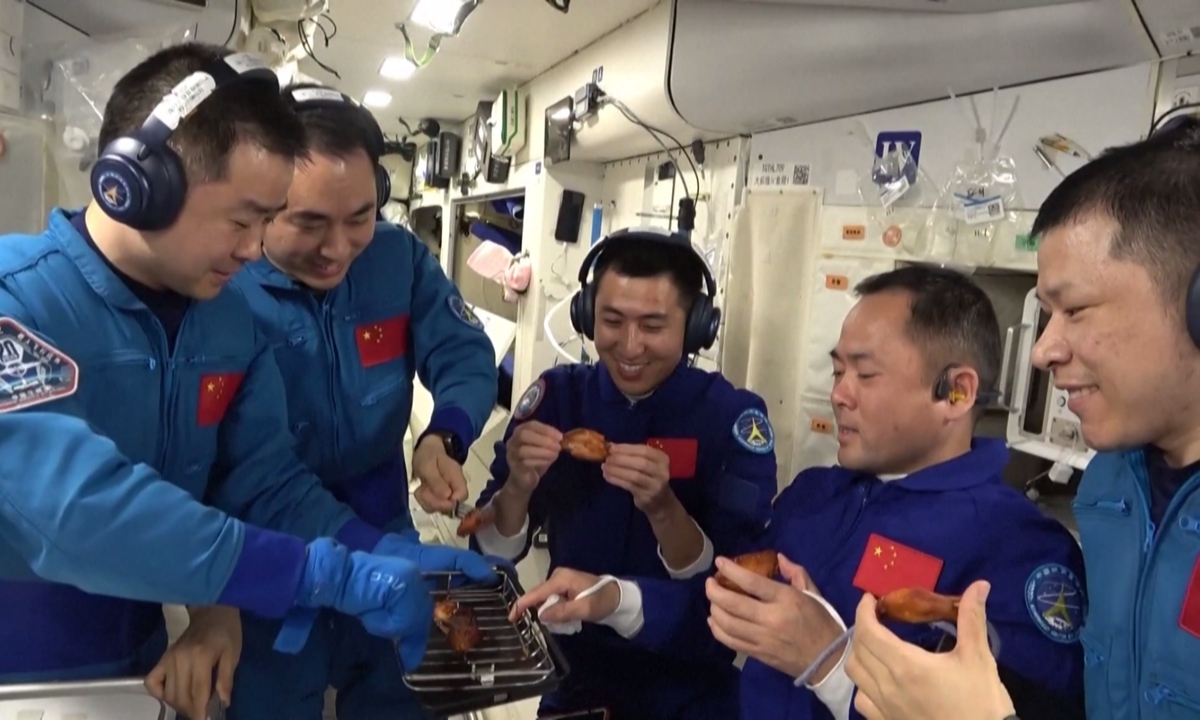
Image captured by the Beijing Aerospace Control Center recently shows crew members of the Shenzhou-20 and Shenzhou-21 manned space flight mission enjoying a "space barbecue" inside the Tiangong space station, using a new oven installed on the orbiting facility. Photo: VCG
Lunar research has also yielded crucial results this year. The first experimental "lunar soil bricks" were returned to Earth aboard the Shenzhou-21 spacecraft after a year of exposure to the harsh space environment.
This was a step forward in engineering for China's long-term lunar program, which includes plans to land astronauts on the moon by 2030 and construct a basic model of the International Lunar Research Station by 2035.
Apart from the domains of deep space exploration and the manned space missions, which are mainly carried out by state-owned space contractors, the commercial space sector also advanced robustly in 2025.
One of the most courageous moments was the maiden flight of Beijing-based rocket start-up Landspace's Zhuque-3 on December 3, as the mission marked the country's first attempt at recovering a stage from an orbital launch.
The second stage of this rocket managed to enter the designated orbit, but recovery of its first stage failed.
The mission indicates China is close to obtaining a key capability for lowering launch costs and enabling rapid commercial cadence, according to a report published in SpaceNews, a US-based outlet covering the global space industry.
Represented by the ZQ-3, China's reusable rockets are gaining global attention.

ZQ-3 Y1 rocket took off for maiden flight from the Dongfeng Commercial Aerospace Innovation Test Zone at noon time on December 3, 2025. Photo: courtesy of LandSpace
Elon Musk, CEO of US private space firm SpaceX, said in October that several Chinese reusable carrier rockets have added aspects of Starship to a Falcon 9 architecture, which would enable it to beat SpaceX's Falcon 9 rocket.
Musk made the comment in a social media post containing a video clip that showed the fueling rehearsal and static ignition test of the ZQ-3 reusable rocket conducted from October 18 to 20 at the Dongfeng Commercial Aerospace Innovation Test Zone.
Future endeavors
Although the annual blue paper by China's state-owned space giant China Aerospace Science and Technology Corporation has yet to release, there are traces of new excitements to be anticipated in 2026.
The China Manned Space Agency (CMSA) unveiled on November 1 that the agency would organize four flight missions, involving the Tianzhou-10 cargo spacecraft, Shenzhou-23, -24 manned spacecraft, and the new-generation manned spacecraft Mengzhou-1.
Mengzhou is developed through a comprehensive upgrade from the Shenzhou crewed spaceship. It adopts a modular design, comprising a return capsule and a service capsule, and it will provide transport between Earth and the space station, according to the Xinhua News Agency.
The Mengzhou-1 crewed spaceship will make its maiden flight atop the Long March-10A carrier rocket from the Wenchang Space Launch Site in southern Hainan Province, and dock with the radial port of the space station's core module.
It will verify the performance of the spaceship's overall systems, while delivering environmental assessment instruments and supplies, technology demonstration payloads, crew necessities, and experiment devices for applied-science tests.
The Qingzhou, China's new-generation cargo spacecraft, designed to be smaller in size and lighter in weight, compared to the existing Tianzhou craft, will also carry out inaugural flight by the Lijian-2 rocket developed by CAS Space.
In 2025, China's space program has witnessed fruitful achievements, sending new probes and gaining fresh experience in the cosmos—pushing the boundaries of scientific exploration and humanity's quest for stars. In the upcoming year, the Global Times will continue to cover China's steps in pursuit of its dreams and aspirations into space.