2025 Yearender: From desert barriers to plateau leopards, GT follows nation’s ecological efforts, building of Beautiful China
By ans Published: Dec 26, 2025 11:43 PM


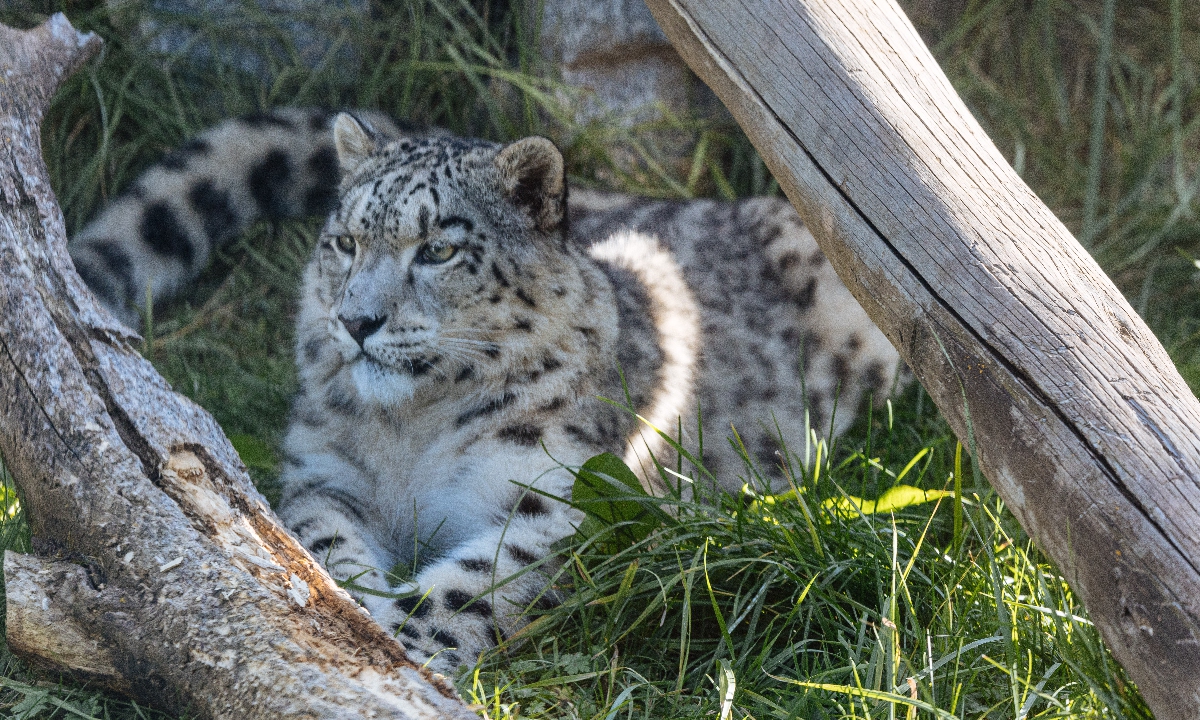
Rescued leopard Ling Xiaozhe Photo: Li Hao/GT
From combating desertification to rescuing injured wildlife, from day-to-day conservation efforts to China's growing profile at global climate summits, Global Times reporters followed China's ecological progress throughout 2025 - from the deserts of the north-western frontier to the biodiverse Qinghai-Tibet Plateau - to observe first-hand China's steady steps toward building of Beautiful China.
On November 28, the Taklimakan Desert sand-blocking green belt project in Northwest China's Xinjiang Uygur Autonomous Region celebrated its first anniversary. Over the past year, through unwavering efforts, local people in 21 key counties and cities along the desert edge increased the width of the green great wall by 110 meters to 7,500 meters, according to Xinhua.
In 2025, the Global Times had the opportunity to dig into the story of a fighter against desertification.
In the heart of Haermodun village of Hejing County, within the Mongolian Autonomous Prefecture of Bayingolin in Xinjiang Region, a striking transformation unfolds against the backdrop of white sands. Towering white poplar trees, standing resolutely like soldiers in formation, create a dense forest that defies the arid landscape. It is hard to imagine that decades ago this region was an utter desert, then one man changed it.
"These poplar forests, when connected, have a total length of 34 kilometers. They were all planted by my father together with the villagers before his passing," said Fu Guoxi.
It was in this desert plagued by sandstorms that, over the past 41 years, his father, Fu Zhizhou, had planted a total of 800,000 trees. Fu had brought 12,000 mu (800 hectares) of land under desertification under control and protected 105.33 square kilometers of cultivated land.
After decades battling sandstorms, Fu Zhizhou and his wife Chen Ailian passed away due to illness. But Fu Guoxi, in an interview with the Global Times, vowed to fulfill his father's wish: "There are still 200,000 trees left to reach my father's goal of planting one million trees … My siblings and I may be able to accomplish that within five years or so."
Guards of biodiversity
While people such as Fu labor to turn a yellow desert to green, rangers like Adro Drakpa Dorje brave icy winds to rescue snow leopards in peril on China's roof top.
In March, icy winds still gripped the Hoh Xil. As usual, ranger Adro Drakpa Dorje was patrolling the highlands of Sokya Township in Zhidoi County of Yushu Tibetan Autonomous Prefecture in Qinghai Province.
The ground beneath him was dry and strewn with stone. From the base of the mountain, his home was already in sight, but something caught his eye: a faint gray shadow among the rocks and sands.
He brushed away the frost - it was a small snow leopard, soaked and frozen stiff, body curled tight. Only its eyes still moved, barely. "When I got close, it didn't try to flee, it just followed me with its eyes," the 42-year-old Tibetan herdsman told the Global Times.
He hurried home and sent photos and the location to the township government via WeChat. That night, a rescue convoy set off, braving wind and snow, and after a 15-hour drive, delivered the cub to Xining, Qinghai, 1,000 kilometers away.
Qi Xinchang, deputy director of the Qinghai Wildlife Rescue and Breeding Center, still vividly remembers the moment. "It was around 2 am when it arrived. The cub was paralyzed, its body temperature had plummeted, it was like a rain-soaked rag. But it could still swallow and struggled slightly. That's when we knew it wanted to live."
With oxygen, fluids and nerve-stimulating therapy, the cub lifted its head by the third day, stretched its paw by the ninth, and attempted walking after 40 days.
Qi and his colleagues named it "Ling Xiaozhe." The rescue took place just before Jingzhe, or the "Awakening of Insects," a solar term marking spring's arrival.
The Global Times learned that medical equipment and facilities have steadily improved at the center. Now, rescued snow leopards and other wildlife no longer need to be transferred elsewhere for tests, and we can monitor their health more precisely.
The life miracle of Ling Xiaozhe is resulted from those who did not give up rescuing it, but also explains China's efforts to protect biodiversity, particularly in eco-sensitive areas.
Collective efforts
The collective efforts of people such as Fu, Dorje and Qi have helped propel China's recent strides in environmental protection.
Since the start of the 14th Five-Year Plan (2021-25), the Three-North Shelterbelt Forest Program (TSFP), the world's largest afforestation project has carried out comprehensive desertification control over more than 200 million mu (about 13.3 million hectares), the Global Times learned at the 10th Kubuqi International Desert Forum which was held in Ordos, North China's Inner Mongolia Autonomous Region, in September. Both desertified and sandy land areas have continued to shrink, and the country has also taken the lead in realizing the 2030 goal of zero net land degradation.
In Sanjiangyuan National Park, grasslands are turning green 10-20 days earlier than before, lake areas have expanded by 11.5 percent, and the number of snow leopards has surpassed 1,200. All vividly illustrate ecological-civilization progress in the new era.
China's progress in environmental protection has won plaudits at home and abroad.
After visiting China's desertification projects in Bayannur, Inner Mongolia, Nora Berrahmouni, a deputy director of the FAO Land and Water Division, told the Global Times on site that "each part, each area we visited has been really amazing and eye opening, for example, where we are here, which is how it is called the Mengneng 850 megawatt photovoltaic base. It's really impressive because not only the government and the company have been really integrating or developing this, for both like power, energy, production but it has also integrated ecological, protection and stabilization of the sandy area,"
During this year's COP30, which concluded in Belem, Brazil, in November, China's constructive role as a steward of global climate change was also highlighted.
Ma Jun, director of the Institute of Public and Environmental Affairs, who attended the event, told the Global Times that China pavilion at COP30 saw a striking rise in prominence and influence this year.
In previous years, China's booth was relatively marginal - modest in size, tucked away and lightly visited. This year, by contrast, it occupied a prime central location for the first time, with a larger and more prominent presence that attracted unprecedented crowds, Ma said. He added that whenever he was identified as an environmental scholar from China, visitors were keen to ask about the country's path to achieving its climate gains.
"This year's COP summit underscored for me how China has shifted from being a follower or active participant to a leader in the global effort to tackle climate change," Ma said.
China's environmental protection and ecological progress is measured less by slogans than by accumulation of actions. Forests advance meter by meter, wildlife survives because someone intervenes, and once-marginal voices are now heard at the center of global climate debates. The transition remains incomplete and costly, but its direction is clear. From deserts checked by human resolve to plateaus protected by science and patience, China is showing that the beauty of nature can accompany development—and, increasingly, define it.
RELATED ARTICLES