With its defense spending skyrocketing, emergence of Japan’s ‘neo-militarism’ accelerates: Global Times editorial
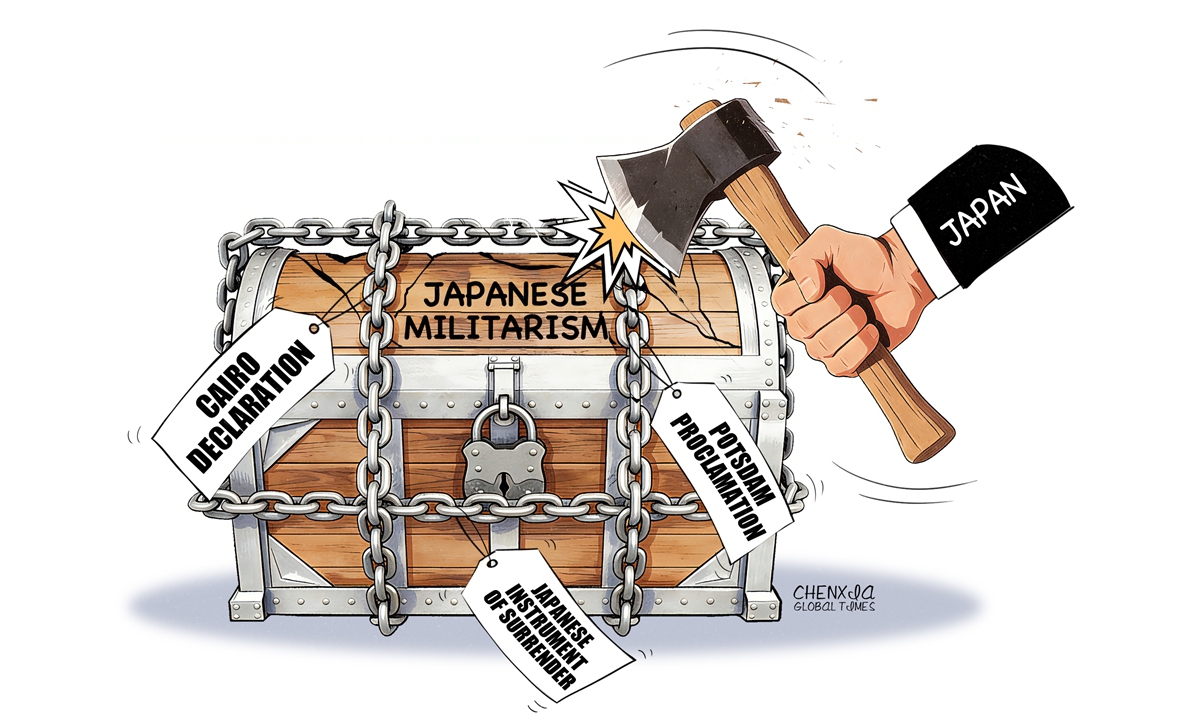
Illustration: Chen Xia/GT
On Friday, the Japanese cabinet approved the defense budget for fiscal year 2026, totaling 9.0353 trillion yen ($57.8 billion), once again breaking historical records. This marks the 14th consecutive year of increase in Japanese military spending. The 9 trillion yen is only the initial budget; by the end of 2025, with related expenses and supplementary budget funds, Japan's total defense spending will reach approximately 11 trillion yen, accounting for 2 percent of GDP. This record-breaking defense budget is not an isolated phenomenon, but rather a concentrated manifestation of Japan's series of aggressive military actions in recent years. One question cannot be avoided: Japan is heading toward "neo-militarism."This combative budget proposal is more like a "critical condition notice" for Japan's postwar pacifism. It means that Japan is systematically overturning its "exclusively defensive defense" principle, undermining the substantive constraints of Article 9 of the "pacifist constitution," and accelerating its transformation into a "war-capable nation." In recent years, Japan has been pushing for an increase in the ratio of defense spending to GDP. A notable feature of its budget structure is its highly aggressive nature, with newly added resources being concentrated on long-range strike capabilities, strengthening naval and air power, unmanned combat systems, and forward deployments in the southwestern islands. This clearly demonstrates that Japan is no longer pursuing merely an increase in the size of its military spending, but rather a comprehensive leap in the "quality level" of its military capabilities.
For a long time, "exclusively defensive" meant that Japan could only use force after being attacked and limited to the minimum necessary extent. However, in recent years, Japan has been continuously promoting the development of the so-called "counterattack capability," which is essentially a shift in strategic focus from passive defense to active deterrence, and even provides capability and institutional support for preemptive military operations. When long-range missiles capable of reaching deep into neighboring countries are systematically deployed, and related military forces are densely positioned on the southwestern islands near China's Taiwan, the nature of the Japan Self-Defense Forces has undergone a fundamental change. This not only signifies a resurgence of military interventionist tendencies but also represents a crucial step in propelling Japan toward becoming a major military power with the capabilities for long-range operations and strikes.
Of particular concern is Japan's rapidly expanding military ambitions in the fields of space and cyberspace. In the latest budget, Japan increases its investment in space. Earlier, it boasted of substantial progress in its satellite-jamming technology. It plans to formally reorganize the Air Self-Defense Force into the "Air and Space Self-Defense Force," and even proposes the astonishing plan to construct a spacecraft carrier. This move not only seriously threatens the security of other countries' space assets but also sets off a new round of space arms race. As a defeated country in World War II, Japan made explicit self-restraints on military development under the postwar order, and its military technology research and development was supposed to be subject to strict limits. Today, however, Japan is expanding recklessly in some of the most sensitive strategic frontier areas, amounting to a dangerous test of the international community's security red lines.
This headlong rush in Japan's military domain is, in essence, a dual violation of postwar historical commitments and the established legal order. Documents such as the Potsdam Proclamation clearly required the eradication of Japanese militarism, while Article 9 of Japan's "pacifist constitution" legally renounces the nation's right to engage in war or to resort to military force to resolve international conflicts.
Yet in reality, Japan's defense spending has surged year after year, offensive weapons are being continuously deployed, and it has even sought strike capabilities against other countries' territory and control over strategic frontier domains, steadily hollowing out its peace commitments. A country that has never fully reflected on its historical issues and continues to breach its own pledges in current policy begs the question: where is its international credibility? A Japan that constantly manufactures security anxiety, exploits it to expand armaments, and stirs up geopolitical confrontation raises a further question: what exactly is it seeking to achieve?
It must be clearly recognized that the radical shift in Japan's defense policy is not an impulsive move, but the result of careful planning and step-by-step advancement by right-wing forces in Japan. By repeatedly promoting crisis narratives such as the so-called "China threat," they exaggerate a sense of "survival-threatening situation," fueling security anxiety at home while turning the tables internationally and demonizing neighboring countries. This logic closely resembles the rhetoric Japan's militarists used during their outward expansion before World War II.
History is the best textbook and the most sobering wake-up call. The wars of aggression launched by Japanese militarism brought profound suffering to the people of Asia and ultimately rebounded on Japan itself.
Today, Japan's ruling authorities continue down the path of excessive militarization and abandonment of commitments. The choices Japan makes today concern not only its own future but also peace and stability in East Asia. Will it pull back from the brink and return to the path of peaceful development, or persist in its course and continue to challenge the regional order? This is a question Japan must give a correct answer.
RELATED ARTICLES