Patient with cerebral palsy completes Chinese chess match via non-invasive BCI, marking world’s 1st application in national-level sports event
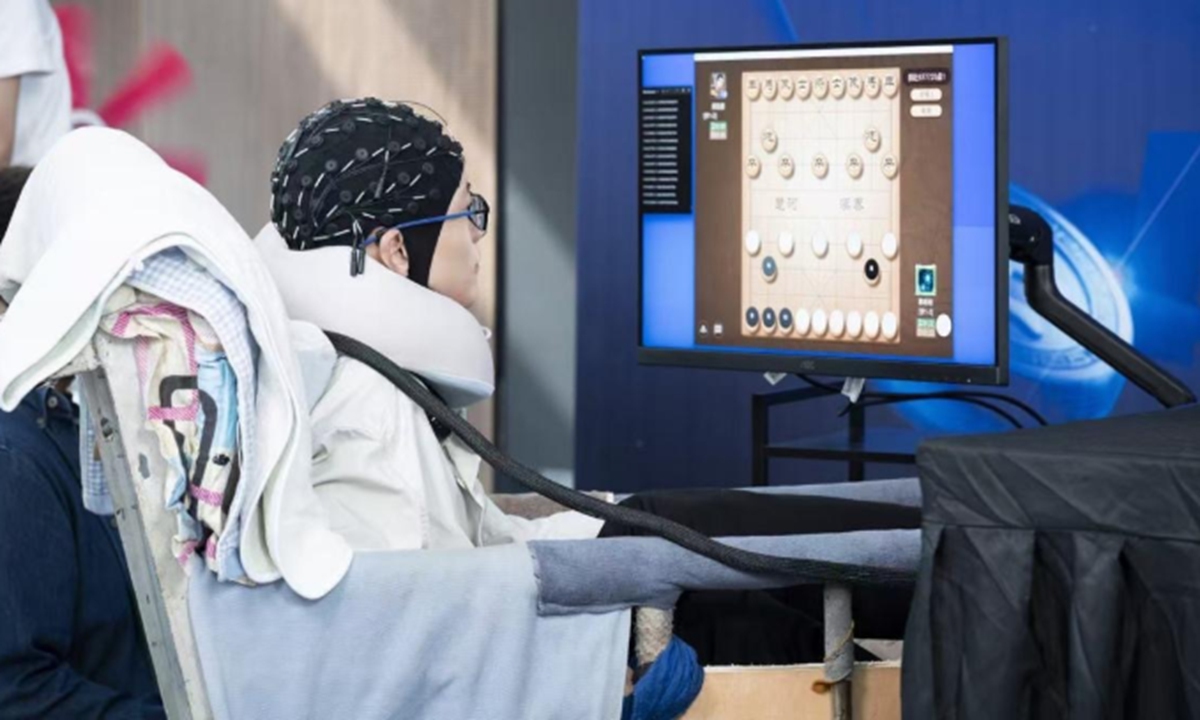
Han Binbin competes against Meng Chen while wearing a non-invasive brain-computer interface (BCI) device in an annual Chinese chess final. Photo: Jiemian News
A cerebral palsy player competed in a Chinese chess competition while wearing a non-invasive brain-computer interface (BCI) device, marking the world's first competitive application of non-invasive BCI technology in a national-level public sports event, domestic media outlet Jiemian News reported on Tuesday.The competition took place during an annual finals event organized by the Chinese Chess Association in South China's Hainan Province, the report said.
The cerebral palsy player, named Han Binbin, was able to control chess pieces through mind control by wearing the non-invasive BCI device, thereby competing against a Chinese chess grandmaster Meng Chen, Jiemian News reported.
The technical model used by Han is trained on human intracranial electroencephalography (EEG) data, boasting generalization capabilities across systems, users, tasks, and scenarios, the report said.
The model also enables rapid adaptation and requires no months of specialized training, according to the report.
Han was born with congenital cerebral palsy, suffering severe impairments in motor function and verbal communication, financial media outlet 36Kr reported.
Over the past decade and more, Han has relied on the tip of his nose to interact with his phone's touchscreen, enabling him to study, compete in chess matches, and even livestream online, becoming a skilled chess enthusiast.
"This is the first time I've been able to play chess without using my nose, and it's even a face-to-face match against my idol Meng," Han said after the game, per the report.
"It feels like my thoughts are directly connected to the chessboard, as if I've gained a pair of invisible hands, allowing me to focus more fully on savoring the joy of this intellectual sport itself," Han added.
From "nose-tip control" to "mind control," the intervention of BCI technology has opened a brand-new gateway for Han to express himself, Jiemian News reported.
This is not an isolated achievement for China in non-invasive BCI technology. In 2025, China has also made additional breakthroughs in the field, including enabling a patient with high-level paraplegia to reliably control smart devices.
Earlier in December, the Global Times learned from Shanghai-based Center for Excellence in Brain Science and Intelligence Technology (CEBSIT) of the Chinese Academy of Sciences that, in collaboration with the Fudan University's Huashan Hospital, the center has successfully carried out a second in-human clinical trial of its independently developed invasive BCI device.
The trial enables a patient with high-level paraplegia to reliably control a smart wheelchair and a robotic dog using brain EEG, achieving autonomous mobility and object retrieval in real-world scenarios.
"It's just like controlling a character in a video game - you don't have to consciously think about which way to push the joystick; you naturally think about the direction you want to go, and it just goes there. The signal transmission is quite stable, with very little delay," said the patient.
The research team also identified the patient's deeper social need for "re-employment." They worked with a local disabled persons' federation on a "technology-assisted disability" project, enabling the patient to participate in online work, such as verifying the accuracy of AI recognition in vending machines.
Previously, the center and the hospital carried out the country's first clinical trial of an invasive BCI device and in June they announced that the trial was successful, with a tetraplegic patient being able to control electronic devices with his mind, skillfully operating racing games, chess, and other programs.
Global Times
RELATED ARTICLES