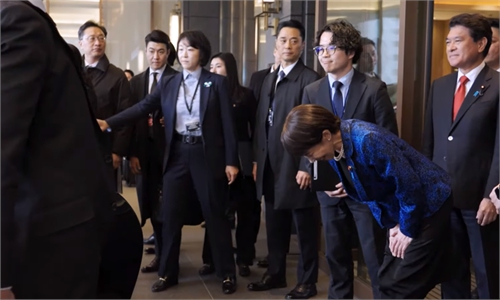
S.Korean President Lee receives interview with Chinese media at Cheong Wa Dae, reaffirms one-China stance on Taiwan question ahead of China visit
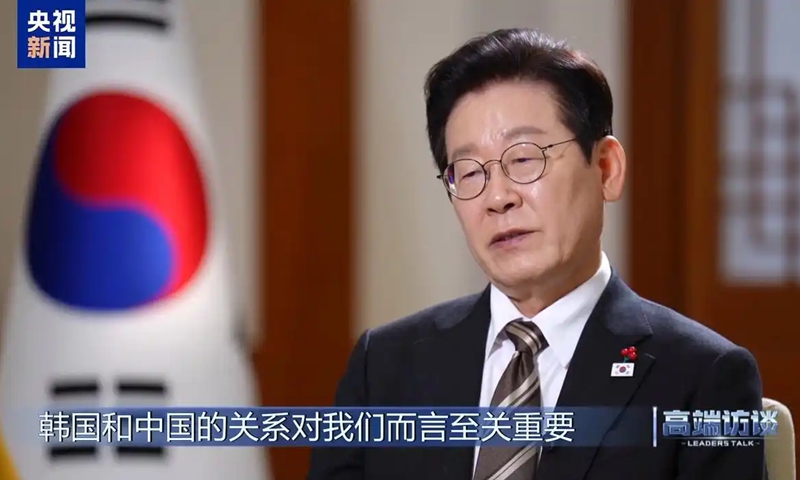
South Korean President Lee Jae-myung gives an interview with CCTV News that aired on January 2, 2026. Photo: screenshot from CCTV
Before starting his visit to China, South Korean President Lee Jae-myung gave an interview with CCTV News that aired on Friday, during which he said deeper cooperation between South Korea and China can open a broad gateway of opportunity for South Korea. Regarding the Taiwan question, Lee said South Korea will, as always, uphold its position of respecting for the one-China stance.
President of the Republic of Korea (ROK) Lee will pay a state visit to China from January 4 to 7, 2026, a Chinese Foreign Ministry spokesperson announced Tuesday.
In a nearly 20-minute-long interview with the program Leaders Talk, Lee shared his expectations for his first visit to China, his perspectives on trade development and bilateral ties between the two countries, the current South Korean government's stance on the Taiwan question, and its pragmatic diplomacy.
At the beginning of the interview, Lee said that this is the first formal interview he has given since the presidential office returned to the Blue House. "It is not only my first interview with foreign media, but also the first with any media outlet, including those in South Korea. I hope this interview conveys the importance the South Korean government attaches to South Korea-China relations. The decision to move the presidential office back to Cheong Wa Dae and to raise the Phoenix Flag once again is meant to restore what had become abnormal to a state of normalcy," Lee said in Korean, according to CCTV's translation.
When asked about his expectations for his first state visit to China since taking office and the message he hopes to convey during the visit, Lee said that amid a volatile international environment and rising frictions among some countries, South Korea-China relations are more important than ever. The two countries are deeply connected across history, economics, geography, politics, and security, and share a common stake in peace, stability, mutual respect, and prosperity in Northeast Asia.
It is true that misunderstandings and differences have emerged in recent years, creating obstacles to bilateral ties. This visit to China is intended to reduce and, where possible, resolve those issues, advance South Korea-China relations to a new stage of development, and firmly position the two countries as partners that support each other's growth and long-term development, said Lee, per CCTV.
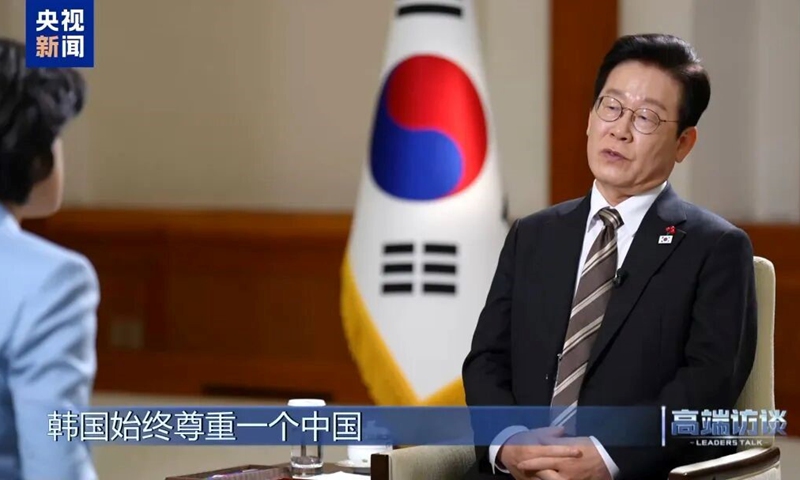
Photo: screenshot from CCTV
While the previous South Korean government showed a series of negative tendencies on the Taiwan question that seriously affected the development of bilateral relations, when asked the current South Korean government's position on the Taiwan question, and how it plans to uphold the one-China principle, Lee said that the consensus reached between the South Korean and Chinese governments at the time of establishing diplomatic relations remains the core guiding principle governing bilateral ties, and its validity has never changed.
Lee said that he can state clearly that South Korea has always respected the one-China stance. In Northeast Asia, and on surrounding issues including cross-Straits relations, maintaining peace and stability is of vital importance. The fundamental positions underpinning China-South Korea relations were established at the outset of diplomatic ties and are principled and foundational.
He also noted that it can be stated unequivocally that the South Korean government has always adhered to this position and has never deviated from it. Lee said he believes that the healthy development of China-South Korea relations depends on both sides fully respecting each other's core interests and showing mutual understanding toward their respective positions. In this context, regarding the Taiwan question, South Korea will, as always, uphold a position of respecting the one-China stance, said Lee.
During the interview, Lee also discussed trade exchanges between China and South Korea, noting that he will lead a trade delegation of more than 200 members to China. Lee said that South Korea and China are deeply interconnected in economic and trade terms, with cooperation that brings significant benefits to both sides. The priority should be to forge new forms of equal cooperation -particularly in cutting-edge fields such as artificial intelligence and high-tech industries - to build a mutually beneficial, cooperation-oriented economic relationship that supports shared development, said Lee.
Lee also noted that China has devoted significant resources to high-tech investment, R&D, and the training of talent in fundamental sciences - and South Korea has taken a similar path. As a result, the two countries' growth strategies share important common ground. While this inevitably entails competition, it also opens wide avenues for cooperation.
By identifying opportunities to cooperate within a competitive landscape - and leveraging cooperation to enhance their respective strengths - China and South Korea can forge a complementary partnership that supports China's sustainable development goals while advancing South Korea's growth strategy, Lee said.
Lee also noted that China has shown a remarkable ability to turn challenges into opportunities by mobilizing national resources to drive innovation and lead industrial development. This momentum is expected to remain strong going forward. He said that in this context, he believes deeper cooperation between South Korea and China can open a broad gateway of opportunity for South Korea.
As 2025 marked the 80th anniversary of the Chinese people's victory in the War of Resistance Against Japanese Aggression, as well as the 80th anniversary of Korea's liberation, when asked how China and South Korea can work together to better commemorate and carry forward the shared memory of having fought side by side for national independence, Lee said that while every country seeks to safeguard its own national interests, this must never come at the expense of others.
Lee stressed that peaceful coexistence is essential, and that acts of aggression or the killing of civilians in the name of national interest must never be repeated. He noted that history shows humanity is prone to repeating its mistakes, making it all the more imperative to draw lessons from the past.
In this respect, Lee said, the shared historical experience of China and South Korea in resisting aggression and fighting alongside each other is especially valuable. Yet remembrance alone is not enough. Beyond honoring history, both countries must continue to explore new ways to move forward together to build a more peaceful and prosperous future for the peoples of both nations.
When talking about South Korea's pragmatic diplomacy, Lee said that there is a well-known saying in China - "seeking truth from facts." Some people express concern about South Korea-China relations because of existing frictions or differences, but he does not share that concern. Strategic autonomy is essential for South Korea. Our ultimate purpose as a nation is to improve the well-being of our people and safeguard our national interests, and all policy choices should be guided by that objective, said Lee.
In the security domain, cooperation with the US is an undeniable reality, given our alliance. At the same time, South Korea's economic ties with the US continue to deepen. This, however, does not mean that relations with China should slide into confrontation or conflict - such an outcome would not serve South Korea's interests. On the contrary, South Korea should, to the greatest extent possible, pursue coexistence and cooperation with China and actively seek areas of mutually beneficial, win-win collaboration, according to Lee.
Achieving this requires more dialogue and the continuous exploration of new forms of cooperation. At a time when the international environment is growing more complex and challenging, frequent dialogue is all the more necessary. Through closer communication, we can jointly explore new pathways and pursue better prospects for development, Lee said, noting that he is confident that, with such efforts, South Korea-China relations can move to a new stage - higher in quality and deeper in substance - than they are today.
Global Times
RELATED ARTICLES