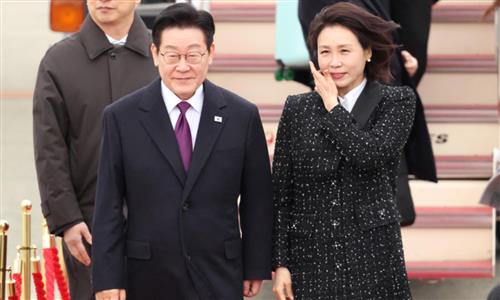
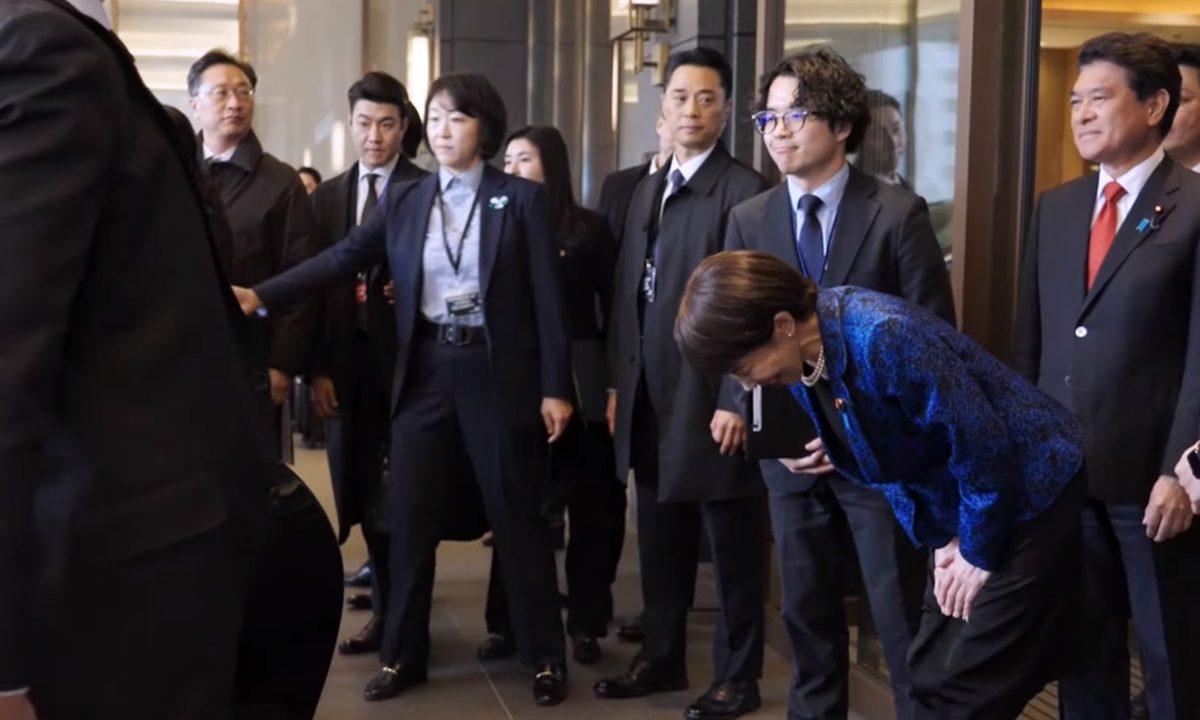
In a video of Takaichi welcoming Lee ahead of their summit, Takaichi is seen greeting Lee with a loud "Hello" in Japanese and a 90-degree bow. Photo: screenshot from video by MBC News on Youtube
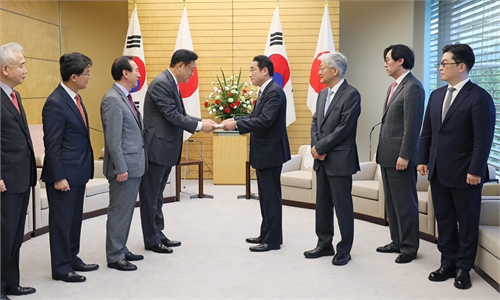
During South Korea-Japan summit in Nara city, Japan, on Tuesday, South Korean President Lee Jae-myung and Japanese Prime Minister Sanae Takaichi emphasized the importance of bilateral cooperation, and reaffirmed their commitment to coordination, both bilaterally and through the Japan-South Korea-US trilateral framework, according to media reports.
However, although they seemingly showed warm attitudes during the meeting, some Chinese experts have observed that while Takaichi expressed her hope for Japan-South Korea relations to reach "new heights," President Lee, in response, underscored the need to "properly manage the negative factors and keep them to a minimum." Chinese experts commented this revealed a "temperature gap" in the two leaders' perspectives on bilateral relations.
The difference in rhetoric between the two leaders reflects that Japan appears keen to downplay historical burdens and focus resources on strategic and economic collaboration, whereas South Korea remains acutely aware of the risks posed by structural issues such as history and territory, prioritizing the prevention of regression in ties over Japan's ambitions, Chinese experts commented. They believe this reveals the fragility of the relationship's foundation and the absence of deep strategic alignment, noting that their cooperation is destined to remain limited in scope and incapable of achieving genuine strategic synergy.
In a video of Takaichi welcoming Lee ahead of their summit, Takaichi is seen greeting Lee with a loud "Hello" in Japanese and a 90-degree bow. Many South Korean viewers questioned the sincerity of Takaichi's gesture in the comment section of MBC YouTube channel. The top-rated comment read, "This is the attitude and expression one adopts when they have something they wish for from South Korea."
Asahi Shimbun reported that Lee met with Takaichi on Tuesday for the summit in the Japanese prime minister's hometown Nara as the two leaders aim to improve the sometimes-strained relationship as Tokyo faces a deepening row with China.
However, their summit appeared to avoid talking about China-related issues with only Lee mentioning the need for the three Northeast Asian countries—China, South Korea and Japan—to "find as many common grounds as possible, communicate closely, and cooperate together," at Lee-Takaichi joint press conference after their summit. 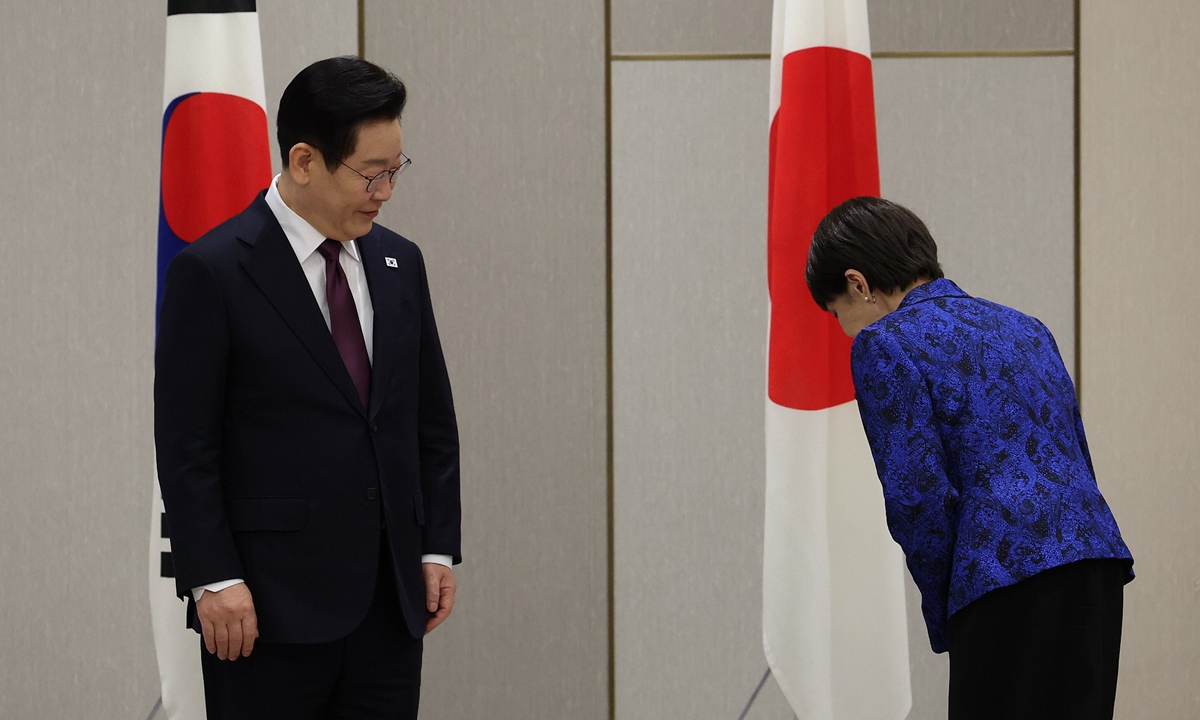
Japanese Prime Minister Sanae Takaichi bows to national flags next to South Korean President Lee Jae-myung at the start of their meeting in Nara, Japan on January 13, 2026. Photo: VCG
NHK reported, at the opening of their summit, Takaichi stated with all smiles, "I am delighted to welcome President Lee to my hometown of Nara. Meeting with President Lee has renewed my conviction that we should advance Japan-South Korea relations while working together to contribute to regional stability. I hope to make this year, starting with the President's visit, one in which Japan-South Korea relations develop to new heights."
In his opening remarks, Lee stated "Although we experienced a painful period in the past, over sixty years have passed since the normalization of diplomatic relations, marking a full cycle," stressing the importance of their bilateral cooperation.
He added, "If we can move forward hand in hand, we can create a bright future," Nikkei Shimbun reported.
Commenting on the differences between their statements, Xiang Haoyu, a research fellow at the China Institute of International Studies, told the Global Times on Tuesday that the "proactive" posture in Takaichi's rhetoric is essentially an attempt by the right-wing government to strengthen Japan-South Korea security collaboration and incorporate it into a US-Japan-led framework of bloc confrontation, trying to use South Korea as leverage to achieve Japan's geopolitical strategic breakthrough. In contrast, Lee's emphasis on "management" reflects the defensive pragmatic strategy of the Lee administration.
"This reveals the fragile foundation of South Korea-Japan relations and the lack of deep mutual trust," Xiang said. He noted that the limits of cooperation lie in South Korea's unwillingness to sacrifice flexibility in its relations with China or make principled concessions on territorial and historical issues for the sake of South Korea-Japan collaboration.
Da Zhigang, director of the Institute of Northeast Asian Studies at the Heilongjiang Provincial Academy of Social Sciences, told the Global Times on Tuesday that this difference in rhetoric stems fundamentally from the two sides' divergent perceptions of the realistic foundation of South Korea-Japan relations. Japan is more inclined to downplay historical burdens and focus resources on advancing strategic and economic cooperation, while South Korea is more concerned with preventing "structural contradictions" such as history and territory from causing another regression in relations.
According to the expert, the current realistic basis for South Korea-Japan relations is not "high mutual trust". The limits of their cooperation depend on whether historical issues are managed appropriately, not on whether they are genuinely resolved, the expert believes.
According to NHK, during their talks, Lee and Takaichi confirmed the continuation of leader-level mutual visits, known as "shuttle diplomacy."
"Amid a complex and turbulent international order, the cooperative relationship between South Korea and Japan is more important than ever before, and more important than anything else," Lee said, Yonhap News Agency reported.
They agreed to advance discussions among relevant authorities on cooperation in the field of economic security. Also, they reaffirmed their commitment to closely coordinate, both bilaterally and through the Japan-South Korea-US trilateral framework, in addressing matters related to North Korea. Additionally, they welcomed the progress in cooperation regarding DNA analysis of human remains discovered at the "Chosei Coal Mine," an undersea mine in Ube City, Yamaguchi Prefecture, where 183 individuals, including those from the Korean Peninsula, lost their lives during the war.
The greatest uncertainties in South Korea-Japan ties and cooperation still stem from the structural presence of historical and sovereignty issues, Da commented.
"These include matters such as forced labor, comfort women, the territorial dispute, and tendencies toward historical revisionism within Japan. Any of these could trigger strong backlash in South Korean society at any time. Coupled with long-standing domestic divisions in South Korea regarding perceptions of Japan, bilateral relations are highly susceptible to cycles of 'improvement-regression-reimprovement,' making it difficult to achieve genuinely stable development," Da said.
On the heel of the China-South Korea summit last week, the South Korea-Japan summit from Tuesday to Wednesday has drawn high attention from mainstream Japanese media against the backdrop of rising tensions between China and Japan.
Asahi Shimbun claimed that relations between Seoul and Tokyo have begun improving in recent years in the face of shared challenges such as growing China-US competition and North Korea issues.There were early concerns about Takaichi's ability to work with Lee, fed by her reputation as a security hawk and an assumption by some that the South Korean leader would tilt toward China.
NHK claimed that for Takaichi, she aims to solidify the momentum of bilateral relations based on the trust between the leaders. Given the deterioration of relations with China, Japan seeks to advance cooperation with South Korea across a wide range of areas, including the economy and culture.
Ahead of their summit, Lee stressed the importance of peace and stability in Northeast Asia and his stance on the Taiwan question that "On matters beyond our own country, it is best to uphold mutual respect and avoid unnecessary deep involvement," when interviewed by the Japanese media outlet NHK on Monday at the South Korean presidential office.
China-Japan tensions have been triggered since Japanese Prime Minister Sanae Takaichi claimed at a Diet meeting on November 7, 2025 that the Chinese mainland's "use of force on Taiwan" could constitute a "survival-threatening situation" for Japan. She refused to retract her remarks which imply the possibility of armed intervention in the Taiwan Straits.
The erroneous and provocative remarks of Takaichi have sparked ongoing backlash within Japan and abroad.
During the recent China-South Korea summit in Beijing on January 5, Lee emphasized that South Korea respects China's core interests and major concerns, and adheres to the one-China principle, according to the Xinhua News Agency. Also, Lee said the South Korea and China are close neighbors with long-standing relations, noting that the two countries fought together against Japanese militarist aggression.
Lee's choice of "China first, Japan second" in his trips is a strategically symbolic sequencing Xiang said. It indicates that in South Korea's diplomatic calculus, repairing the strategic mutual trust with China—damaged by the previous administration—holds priority, the expert noted.
"His emphasis on shared historical memories against Japanese militarist aggression in China essentially establishes South Korea's diplomatic independence and national foundation in legal and emotional terms, creating a form of self-protection for the subsequent talks in Japan," Xiang said.
In response to a question regarding talks between Lee and Takaichi on Tuesday, Chinese Foreign Ministry spokesperson Mao Ning stated that "This is a bilateral engagement between South Korea and Japan."