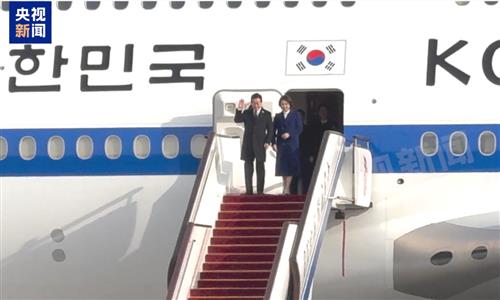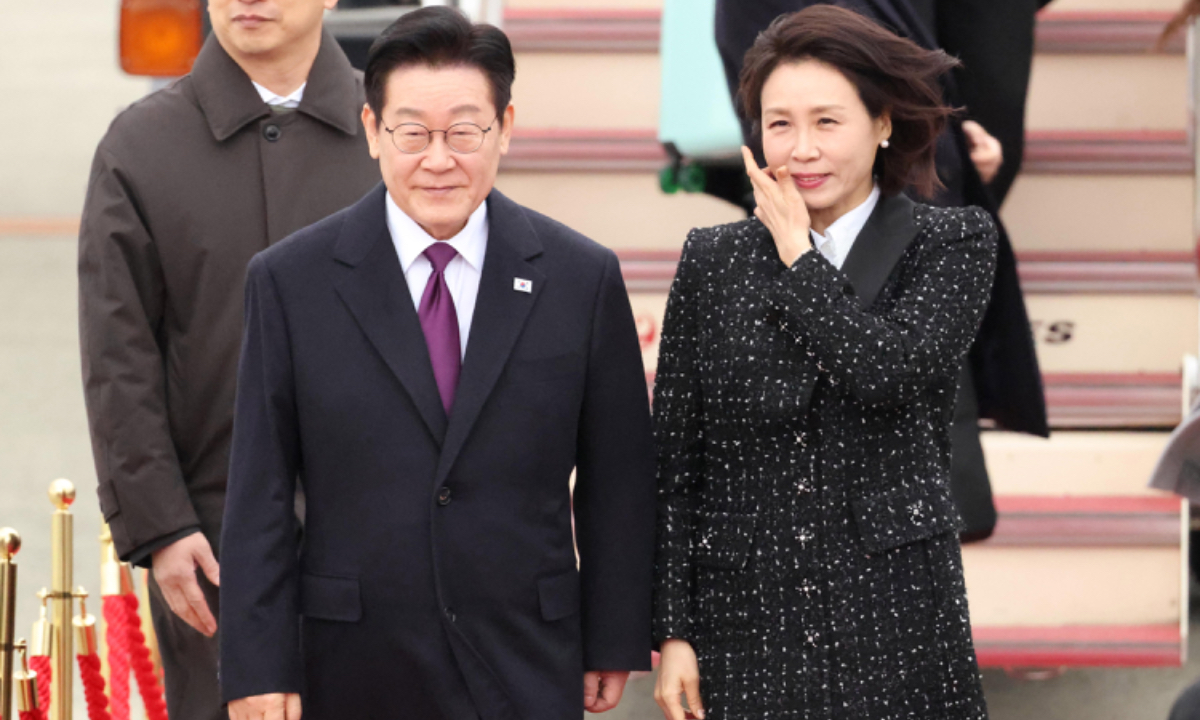
South Korean President Lee Jae-myung arrives at Kansai International Airport in Osaka Prefecture, Japan, on January 13, 2026. Lee will visit the Japanese Prime Minister Sanae Takaichi's hometown in Nara Prefecture for a two-day visit to meet Takaichi. Photo: VCG
South Korean President Lee Jae-myung arrived at Kansai International Airport in Osaka Prefecture, Japan on Tuesday for a summit with the Japanese Prime Minister Sanae Takaichi in Nara city.
Ahead of the summit, Lee stressed the importance of peace and stability in Northeast Asia and his stance on the Taiwan question that "On matters beyond our own country, it is best to uphold mutual respect and avoid unnecessary deep involvement," when interviewed by the Japanese media outlet NHK on Monday at the South Korean presidential office.
According to the full text of the Q&A interview released by NHK on Tuesday, the interview delved into the Lee administration's Japan policy, how to advance South Korea-Japan cooperation and address related challenges, as well as issues on relations between China, South Korea and Japan.
According to NHK, in response to a question regarding relations between China, South Korea and Japan, as well as Seoul's stance on the Taiwan question and historical issues, Lee stated that each country has its own core interests and fundamental existence, which are extremely vital, stressing that mutual respect—and the assurance of being respected—is crucial. For South Korea, relations with Japan are as important as those with China, he noted.
"I believe peace and stability in Northeast Asia are extremely important, and such peace and stability must be addressed not from a short-term perspective but with a long-term vision," Lee said.
Regarding the Taiwan question, Lee stated that "For us, South Korea's better future and the improved livelihoods of its people are the most critical agenda. On matters beyond our own country, it is best to uphold mutual respect and avoid unnecessary deep involvement."
According to Lee, while the South Korea-US-Japan relationship is important, intraregional relations among China, South Korea and Japan are equally significant. "If there were any room for us to make efforts and play a role, we would do so," he added.
China-Japan tensions have been triggered since Japanese Prime Minister Sanae Takaichi claimed at a Diet meeting on November 7, 2025 that the Chinese mainland's "use of force on Taiwan" could constitute a "survival-threatening situation" for Japan. She refused to retract her remarks which imply the possibility of armed intervention in the Taiwan Straits.
The erroneous and provocative remarks of Takaichi have sparked ongoing backlash within Japan and abroad.
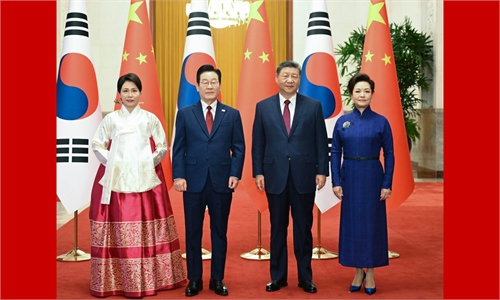
During the recent China-South Korea summit in Beijing on January 5, Lee emphasized that the South Korea respects China's core interests and major concerns, and adheres to the one-China principle, according to the Xinhua News Agency.
Also, Lee said the South Korea and China are close neighbors with long-standing relations, noting that the two countries fought together against Japanese militarist aggression, Xinhua reported.
Before wrapping up his China visit on January 7 afternoon, President Lee visited the site of Provisional Government of the Republic of Korea to mark the 100th anniversary of the building's construction in Shanghai.
The provisional government, established during Japan's 1910-45 colonial rule of the Korean Peninsula, stayed in the building from 1926-1932 after being formed on April 13, 1919, as the Korean government-in-exile, a month after Korea launched an independence movement against Japan, according to Yonhap.
On the heel of the China-South Korea summit, the South Korea-Japan summit from Tuesday to Wednesday has drawn high attention from mainstream Japanese media against the backdrop of rising tensions between China and Japan.
Asahi Shimbun reported Tuesday that Takaichi is scheduled to hold talks with Lee on Tuesday afternoon in Nara, her hometown. This marks the first time in approximately 14 years that a South Korean president has visited a regional city in Japan for bilateral talks.
Citing deteriorating Japan-China relations triggered by the Japanese prime minister's remarks on Taiwan, Asahi Shimbun reported that Takaichi "appears intent on demonstrating both domestically and internationally that Japan-South Korea relations are developing steadily in a future-oriented manner, underpinned by strong mutual trust between the leaders."
Sankei Shimbun on Monday focused on "practical diplomacy" advocated by Lee who is advancing stronger ties with both China and Japan against the backdrop of Takaichi's Taiwan-related claim that has caused a rapid deterioration in China-Japan relations. Lee's visit to Nara, shortly after meeting with the Chinese leader, is seen as "a critical test of his diplomatic approach," the report noted.
In response to a question regarding China's view of Lee's remarks that he wanted a new phase in relations with China, as well as China's expectation for the relationship with South Korea, Mao Ning, spokesperson for the Chinese Foreign Ministry, stated on January 6 when Lee was paying a state visit to China that China and South Korea are neighbors and cooperation partners. The sound and steady development of China-South Korea relations serves the fundamental interests of the two countries and peoples. We would like to work with South Korea for more tangible achievements in the development of our relations in the new year.