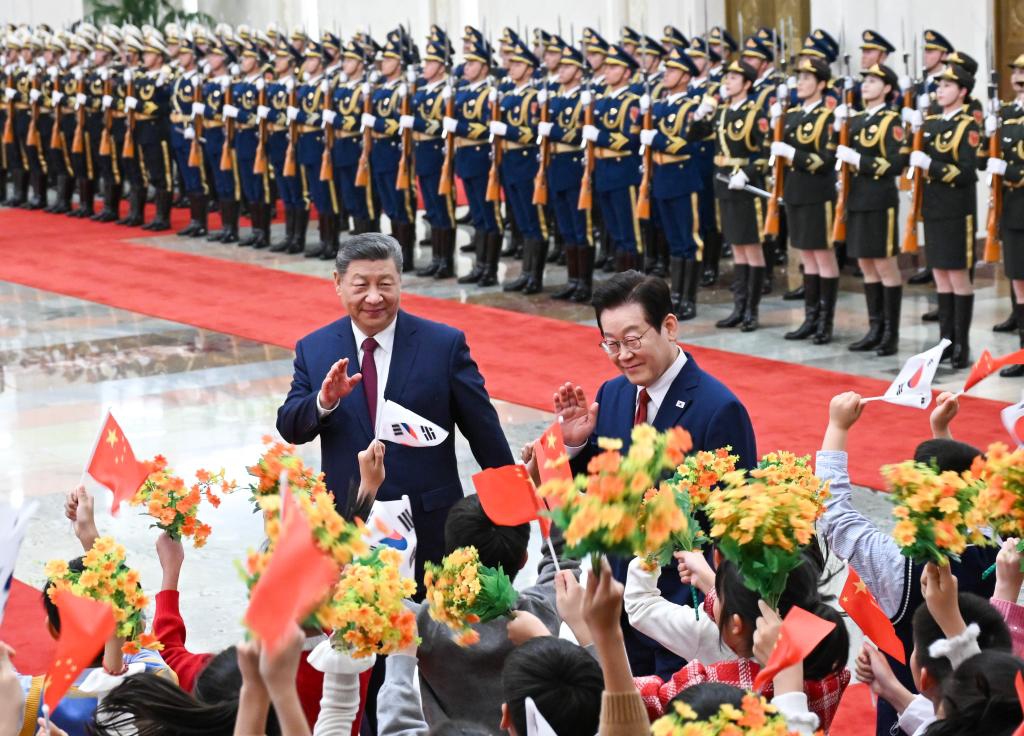
Chinese President Xi Jinping holds a welcome ceremony for President of the Republic of Korea (ROK) Lee Jae Myung in the Northern Hall of the Great Hall of the People prior to their talks in Beijing, capital of China, Jan. 5, 2026. Xi held talks with Lee, who is on a state visit to China, at the Great Hall of the People in Beijing on Monday. (Photo: Xinhua)
Chinese President Xi Jinping held talks with President of the Republic of Korea (ROK) Lee Jae-myung in Beijing on Monday.
Xi said he and President Lee have met twice and conducted reciprocal visits, reflecting the importance both sides attach to China-ROK relations. As both friends and neighbors, China and the ROK should increase exchanges and maintain frequent communication, according to Xinhua News Agency.
China has consistently placed relations with the ROK high on its regional diplomatic agenda and maintained continuity and stability in its policy toward the ROK, Xi said, adding that China is willing to work with the ROK to firmly uphold the direction of friendly cooperation, adhere to the principle of mutual benefit and win-win outcomes, promote bilateral strategic partnership along a healthy path, effectively enhance the well-being of both peoples, and contribute positively to regional and global peace and development.
China and ROK should join hands to safeguard the fruits of the victory in World War II and protect peace and stability in Northeast Asia, Xi said on Monday.
More than 80 years ago, the two peoples made tremendous national sacrifices and won the victory against Japanese militarism, Xi said when holding talks with ROK President Lee in Beijing.
China and the ROK shoulder important responsibilities in maintaining regional peace and promoting global development, and share a wide range of common interests, Xi said, noting that the two countries should firmly stand on the right side of history and make the right strategic choices.
Lee extended his New Year wishes to the Chinese people. He stated that South Korea and China are close neighbors, and their relationship has a long history. Both countries once fought together against Japanese militarist aggression, and South Korea appreciates China's protection of historical sites related to Korea's independence movement in China, according to Xinhua.
Lee said South Korea attaches great importance to its relationship with China and, with the first summit diplomacy of the New Year as an opportunity, is willing to consolidate the momentum of the comprehensive recovery and development of China-South Korean relations, seeking common ground while reserving differences, deepening strategic cooperative partnership, and opening up a new chapter in bilateral relations. South Korea respects China's core interests and major concerns and adheres to the one-China stance, per Xinhua.
Xi and Lee witnessed the signing of 15 cooperation documents in fields including scientific and technological innovation, ecological environment, transportation, and economic and trade cooperation after their talks on Monday, according to Xinhua.
Xi and his wife Peng Liyuan hosted a welcoming banquet for Lee and his wife in the Great Hall of the People, per Xinhua.
Lee posted on X on Monday, saying that a selfie with the Chinese President and his wife "taken with Xiaomi I received as a gift in Gyeongju.. Thanks to that, I managed to get the perfect life shot … The closer we meet, the more the Korea-China relations ease up. We will communicate more often and cooperate even more in the future."
Policy recalibration
On Monday, Chinese Vice Premier He Lifeng, also a member of the Political Bureau of the Communist Party of China Central Committee, jointly attended a China-ROK business forum in Beijing with ROK President Lee.
Approximately 400 representatives from the governments and business communities of both countries participated in the event, according to Xinhua.
"The Republic of Korea and China are ships that sail on the same sea in the same direction," Lee said at the event. "The two countries have helped each other grow through interconnected industrial supply chains and led the global economy," according to a report from the Yonhap News Agency.
President Lee's China visit, the first state visit by a South Korean leader in nine years and the second meeting between the two leaders in about two months, signals a full normalization of China-South Korea relations, Xiang Haoyu, a distinguished research fellow at the China Institute of International Studies, told the Global Times on Monday. Following a period of strain under the previous Yoon Suk-yeol administration, marked by expanded US-Japan-ROK military cooperation, the visit reflects Lee Jae-myung's broader recalibration of South Korea's foreign policy and China approach, he said.
Designating China as the first destination for a state visit in 2026 underscores South Korea's efforts to broaden its diplomatic flexibility amid growing global uncertainty. It also highlights a clear shift in the Lee administration's approach to China-South Korea relations, moving away from the previous government's orientation and toward a more pragmatic, interest-driven framework centered on concrete cooperation and national priorities, Lee Sang-man, a professor from the Institute for Far Eastern Studies of the Kyungnam University in South Korea, told the Global Times.
On Monday, Lee wrote in a post on X, "I recall visiting Beijing during my time as Mayor of Seongnam. Now, as time has passed and I return to this place as President of the Republic of Korea to meet with our overseas compatriots in China, I feel a fresh wave of emotion."
"For a while, we endured the painful period of a diplomatic vacuum and have since run tirelessly to achieve the normalization of diplomacy. In that process, we achieved several meaningful outcomes, and among them, the comprehensive restoration of Korea-China relations, which had been stagnant for a long time, can be said to be the greatest accomplishment above all," Lee wrote.
South Korean media widely reported the meeting between the two leaders. Yonhap News TV noted in a report on Monday that "the Chinese government extended high-level courtesies to President Lee, including a ministerial-level reception upon his arrival at the airport."
A report from The Korea Herald said in a report that Lee's visit to China is "less a deal-making summit than an exploration of how Seoul and Beijing can steady their relationship under the growing constraints of US-China strategic competition and an increasingly volatile regional security landscape."
On Chinese social media platform Sina Weibo, several video clips of Lee arriving in China and attending events in Beijing with his wife, who was dressed in hanbok, have attracted attention. A topic under the hashtag "Lee Jae-myung talks about South Koreans heading to Shanghai after work on Friday" has garnered more than 28.93 million views.
History of fighting militarism
South Korea's Yonhap published an article on Monday saying that Japan is wary of the China-South Korea summit. Yonhap noted that meanwhile, in Japan, voices of caution are being raised about Lee's visit to China. The Yomiuri Shimbun covered President Lee's state visit to China on the same day, stating that this would be an opportunity to confirm the improvement of the bilateral relationship."
Yonhap also quoted NHK as reporting that, "while continuing to criticize Japan, China seems to want to strengthen its relationship with South Korea to align on Taiwan question and issues about historical recognition."
Lee's arrangement to visit China ahead of Japan demonstrated South Korea's sincerity, Hwang Jae-ho, director of the Institute for Global Strategy and Cooperation and a professor at Hankuk University of Foreign Studies, told the Global Times in a previous interview.
Lee will travel to Shanghai on Tuesday before returning home on Wednesday, presidential spokesperson Kang Yu-jung said in a briefing earlier, according to a Yonhap report.
In Shanghai, one of the hubs for Korea's independence fighters during Japan's 1910-45 colonial rule, Lee will mark key historical milestones — the 150th anniversary of the birth of independence fighter Kim Koo and the 100th anniversary of the establishment of the Shanghai Provisional Government building, reflecting on their historical significance, according to The Korea Times.
"Revisiting this shared history not only revives memories of joint resistance against foreign aggression, but also reinforces emotional resonance on historical issues and reaffirms to the international community a shared commitment to opposing militarism and upholding historical justice," said Xiang, noting the move also sends a clear signal responding to Japan's right-wing tendencies to deny wartime aggression, promote constitutional revision and military expansion.
"It underscores South Korea's firm stance against any revival of militarism," he said, adding that revisiting this shared past helps strengthen people-to-people ties, embed emotional foundations into strategic trust, and consolidate the social basis of bilateral relations, while setting an example for regional cooperation in resisting historical revisionism and safeguarding peace and stability.
RELATED ARTICLES