Full Text: S.Korean President Lee Jae-myung receives interview with Chinese media at Cheong Wa Dae, highlights importance of bilateral ties and shares his impressions of President Xi
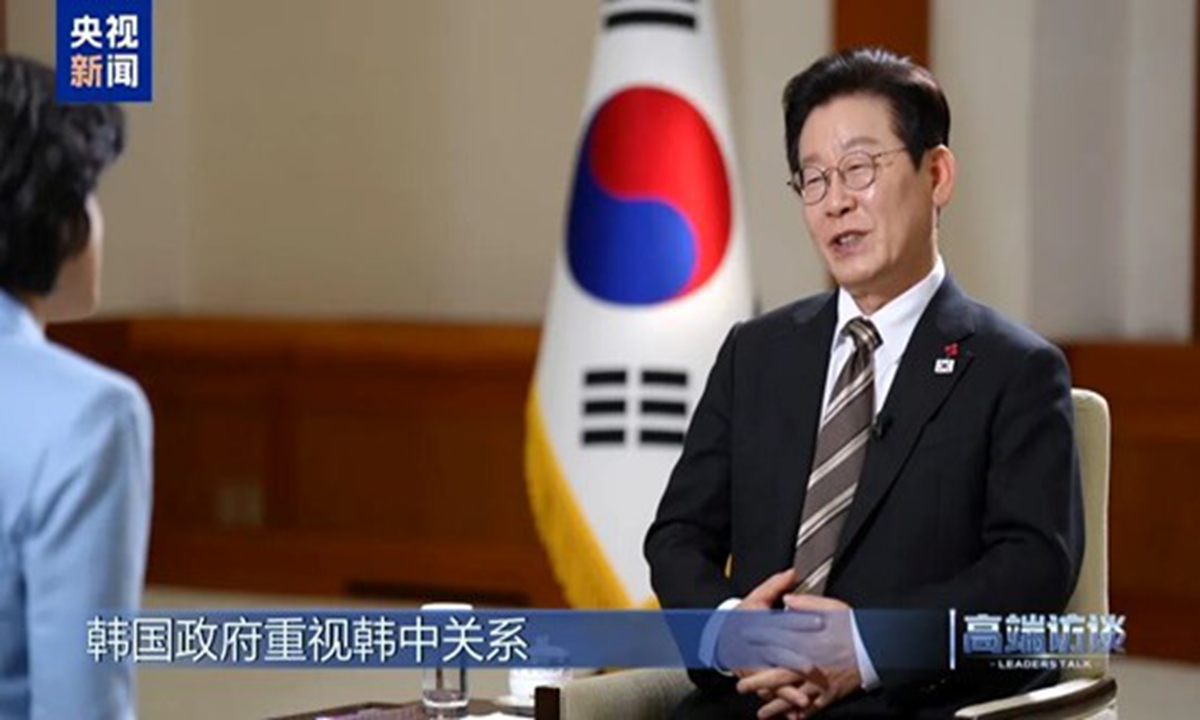
S.Korean President Lee Jae-myung receives interview with Chinese media at Cheong Wa Dae Photo: Screenshot from CCTV
Editor's Note:President of the Republic of Korea (ROK) Lee Jae-myung will pay a state visit to China from January 4 to 7, 2026, a Chinese Foreign Ministry spokesperson announced Tuesday. Before his visit, Lee received an exclusive interview with the Leaders Talk program on China Media Group at Cheong Wa Dae. Global Times translated the whole text into English.
On the eve of his visit to China, South Korean President Lee Jae-myung gave an exclusive interview with the Leaders Talk program at Cheong Wa Dae. Ahead of his first visit to China since taking office, Lee said, "I firmly believe that, taking my visit to China and President Xi Jinping's previous state visit to South Korea as opportunities, relations between South Korea and China will surely enter a new stage of development."
Looking forward to meeting President Xi again, he said, "President Xi Jinping is an outstanding leader with broad vision." Reflecting on the consensus reached at the time of the establishment of diplomatic relations, Lee said, "I can state clearly that South Korea has always respected one-China."
Zou Yun: Focusing on global hotspots and gaining insight into world affairs. Today, we are at Cheong Wa Dae, where we will soon engage in a dialogue with South Korean President Lee Jae-myung. By choosing China as the destination of his first overseas visit in the New Year of 2026, how does President Lee hope to advance China-South Korea relations? Leading an economic and trade delegation of around 200 members to China, in which areas does he hope to explore new opportunities for cooperation? And how does he plan to guide South Korea in responding to the changes of the times? Let us seek the answers together in this conversation.
Zou Yun: Mr. President Lee Jae-myung, hello. Thank you for accepting an exclusive interview with Leaders Talk on China Media Group. It is also a great honor for me to be the first journalist to interview you since the South Korean presidential office returned to Cheong Wa Dae. We noted that on December 29, 2025—the day you resumed work at Cheong Wa Dae—the Phoenix Flag, a symbol of South Korea's presidency, was raised here. To begin today's interview, could you share with us how you felt at that moment when you returned to Cheong Wa Dae?
Lee Jae-myung: This is the first formal interview I have given since the presidential office returned to Cheong Wa Dae. It is not only my first interview with foreign media, but also the first with any media outlet, including those in South Korea since the presidential office returned to Cheong Wa Dae. I hope this interview conveys the importance the South Korean government attaches to South Korea-China relations. The decision to move the presidential office back to Cheong Wa Dae and to raise the Phoenix Flag once again is meant to restore what had become an abnormal situation to a state of normalcy.
Zou Yun: Let us now turn to your upcoming visit to China. This will also be your first state visit to China since assuming office as South Korean president. What key messages do you hope to convey through this visit? And what expectations do you have for this trip to China?
Lee Jae-myung: The current international situation is volatile, with tensions among some countries intensifying. Against this backdrop, relations between South Korea and China are of vital importance to us. The two countries are closely intertwined across history, the economy, geography, politics, and security. Peace and stability in Northeast Asia, mutual respect, and shared prosperity are key issues for both China and South Korea.
It must be acknowledged that in recent years there have indeed been some misunderstandings or differences between our two countries, which to a certain extent have hindered the development of bilateral relations. This visit to China is therefore aimed at minimizing or eliminating those past misunderstandings or differences, promoting an upgrade of South Korea-China relations to a new stage, and firmly establishing the two countries as partners that support each other's development.
Zou Yun: Mr. President, we have noted that you will lead an economic and trade delegation of around 200 members during this visit to China, including representatives of major South Korean companies. By leading such a large delegation, which new areas of cooperation do you hope to expand through a series of exchanges? And how do you view the development of economic and trade relations between the two countries?
Lee Jae-myung: South Korea and China share very close economic and trade ties, with many factors that are highly beneficial to each other's economic development. In the past, China-South Korea economic cooperation was largely based on a vertical structure, combining South Korea's advanced technology and capital with China's labor force. Today, however, under the outstanding leadership of President Xi Jinping, China has achieved substantial economic growth and development, and in many areas of technology and capital has caught up with or even surpassed South Korea.
As a result, there is a need to reshape bilateral economic cooperation toward a more horizontal structure based on equality and partnership. I believe the top priority is to build new, equal cooperative relationships—particularly in technology-intensive fields such as artificial intelligence and high-tech industries—to create a cooperation-oriented economic partnership that benefits both sides.
Zou Yun: We have noticed that in your inaugural address in June 2025, you mentioned the word "growth" 22 times, and in your policy speech to the National Assembly in November last year, you referred to "artificial intelligence" 28 times. Does this mean that a series of industries centered on artificial intelligence will become major drivers of growth for South Korea in the period ahead?
Lee Jae-myung: At present, South Korean society faces a number of challenges, the most severe of which is economic polarization. As polarization deepens, inequality is becoming normalized. Not only are people's lives growing more difficult, but social tensions are also intensifying. While there are multiple contributing factors, the core problem lies in a shortage of opportunities caused by stagnant economic growth. Therefore, I believe that to minimize social conflicts and restore hope for the public—our top priority—we must ultimately promote economic growth.
Such growth should not be short-lived; rather, it should be built into an economic system capable of sustained, long-term development. Among the many factors that drive sustainable growth, under current conditions the most practical path is to increase investment in high-tech sectors, thereby comprehensively enhancing productivity.
Zou Yun: At the same time, China's 15th Five-Year Plan focuses on high-quality development and clearly identifies areas such as artificial intelligence as new growth drivers. What kind of cooperation do you hope China and South Korea can carry out in these fields?
Lee Jae-myung: To my knowledge, the Chinese government has made tremendous efforts in high-tech investment, research and development, and the cultivation of talent in basic sciences—and South Korea has done the same. From this perspective, the economic growth strategies of South Korea and China share significant similarities. This naturally creates competition, but it also leaves ample room for cooperation. I believe that if we can identify areas for cooperation within a competitive environment, and use cooperation to enhance our respective strengths, we can build a complementary relationship that both supports China's sustainable development strategy and advances South Korea's growth strategy.
Zou Yun: Mr. President, we have noted that during your tenure as mayor of Seongnam and governor of Gyeonggi Province, you visited China on multiple occasions, traveling to cities such as Chongqing and Dalian. At the time, you also spoke highly of China's innovation capacity and high-quality development. How do you view Chinese-style modernization? And which developments or changes in China have left the deepest impression on you?
Lee Jae-myung: Although my visits to China have been intermittent, each time I have witnessed China's development at an astonishing pace—it has felt as if I were entering a completely new world on every visit. China has rapidly shifted toward renewable energy. In the renewable energy sector, particularly in solar photovoltaics, hasn't China already taken a global lead?
I believe China has demonstrated exceptional ability to turn challenges into opportunities, to mobilize national resources to drive new technological research, and to lead industrial development. This momentum is likely to remain strong in the future. In this regard, I look forward to South Korea-China cooperation opening a vast gateway of opportunity for South Korea.
Since the establishment of diplomatic relations, friendship and cooperation have consistently been the main theme of exchanges between China and South Korea. China has long been South Korea's largest trading partner, and South Korea is also an important economic and trade partner for China.
In November 2025, President Xi Jinping paid a state visit to South Korea for the first time in 11 years, where he was warmly received by the South Korean side with the highest level of protocol. In the city of Gyeongju in autumn, the two heads of state held in-depth exchanges in a friendly atmosphere, reached important consensus, and reaffirmed the China-South Korea strategic cooperative partnership. President Xi noted that after 33 years of development, China-South Korea relations should be more mature and steady, and demonstrate a new outlook while opening up new prospects.
Lee Jae-myung's current visit to China is not only the first overseas trip by a South Korean president in 2026, but also marks reciprocal visits by the two heads of state within a two-month period.
Zou Yun: In November 2025, President Xi Jinping paid a state visit to South Korea for the first time in 11 years and held talks with you. President Xi noted that China and South Korea are important neighbors that cannot be moved away and cooperation partners that cannot be separated. We would like to know what key words you would use to summarize China-South Korea relations. And what are your expectations for advancing the China-South Korea strategic cooperative partnership?
Lee Jae-myung: Through my interactions with President Xi Jinping, I have felt that he is a truly reliable neighbor and a partner with whom we can move forward together and support each other. What surprised me was President Xi's sense of humor. At the time, I half-jokingly talked about a mobile phone gift, and he responded very readily. Such interactions also left the South Korean public with a very positive impression of President Xi's personal charisma. In my view, this is exactly how China-South Korea relations should be.
On the surface, there are indeed many difficulties at present, but these challenges can be resolved through sustained communication. At the same time, both sides should make every effort to identify areas of cooperation that benefit each other, and build a relationship based on mutual trust, mutual cooperation, and mutual support. This serves the interests of both China and South Korea. I perceive that President Xi has a deep understanding of this, and I therefore believe that such expectations can indeed be turned into reality. I firmly believe that, taking my visit to China and President Xi's previous state visit to South Korea as opportunities, relations between South Korea and China will surely enter a new stage of development.
Zou Yun: In your view, what kind of leader is President Xi?
Lee Jae-myung: I believe President Xi Jinping is an outstanding leader with broad vision. Not only has he successfully driven China's leapfrog development in the economy and technology in a relatively short period of time in line with a clear blueprint, he has also demonstrated extremely prudent major-country governance capabilities amid today's complex and volatile international environment.
Zou Yun: The year 2025 marks the 80th anniversary of the Chinese people's victory in the War of Resistance Against Japanese Aggression, as well as the 80th anniversary of Korea's liberation. Mr. President, at such an important historical juncture, how do you think China and South Korea should work together to better commemorate and carry forward the shared historical memory of fighting side by side for national independence?
Lee Jae-myung: While countries seek to maximize their own national interests, they must not do so at the expense of others; instead, they should coexist peacefully. Acts of invading other countries and massacring their people in the name of national interest must never be allowed to happen again.
Humanity often repeats its mistakes, which makes it essential to draw lessons from history. In this regard, the shared historical experience of China and South Korea in resisting aggression and struggling together is especially valuable. Of course, while historical experience is important, we cannot remain confined to the past. For a better future for the peoples of both countries, we must continue to explore ways to move forward together.
Zou Yun: The year 2025 marks the 33rd anniversary of the establishment of diplomatic relations between China and South Korea. If we revisit the original intent behind the establishment of ties, the Joint Communiqué clearly stated that the government of the Republic of Korea recognizes the government of the People's Republic of China as the sole legitimate government of China, and respects China's position that there is only one China and that Taiwan is part of China. You will also have noticed that the previous South Korean administration showed a series of negative tendencies on the Taiwan question, which seriously affected the development of bilateral relations. What position does the current South Korean government take on the Taiwan question, and how does it plan to uphold the one-China principle?
Lee Jae-myung: The consensus reached by the governments of South Korea and China at the time of establishing diplomatic relations remains the core principle governing bilateral ties, and its validity has never changed. I can state clearly that South Korea has always respected the one-China stance. In Northeast Asia—and on surrounding issues, including cross-Straits relations—maintaining peace and stability is of vital importance to us.
From the very beginning of diplomatic relations, the two countries established principled and foundational positions for their relationship. It can be stated unequivocally that the South Korean government has consistently adhered to this position and has never deviated from it. I believe that the healthy development of South Korea-China relations depends on both sides fully respecting each other's core interests and showing mutual understanding toward their respective positions. In this context, with regard to China's most fundamental concern—the Taiwan question—we will, as always, uphold a position of respecting for the one-China stance.
Zou Yun: Mr. President Lee Jae-myung, since taking office you have repeatedly emphasized that South Korea pursues a "pragmatic diplomacy" centered on national interests. Could you share with us how you define "pragmatic diplomacy"?
Lee Jae-myung: I have heard that China has a saying: "seeking truth from facts." In international relations, every country naturally strives to maximize its own national interests. But if this pursuit is achieved by harming the interests of others, conflict becomes inevitable. If, while faithfully pursuing their own interests, all sides can show the greatest possible understanding of one another's positions, coordinate within reasonable bounds to manage conflicts of interest, and at the same time gain greater benefits through cooperation, then coexistence among countries becomes possible.
In the context of South Korea-China relations, some people feel concerned because of certain frictions or opposing factors, but I am not worried. In the past there was the notion of "security with the US, economy with China," meaning reliance on the US for security and on China for economic development. I believe South Korea's strategic autonomy is particularly important. Ultimately, the purpose of South Korea is to enable our people to live better lives and to safeguard national interests, and all actions should serve this objective.
In the security realm, cooperation with the US is an unavoidable reality for us, given that we are military allies, and our economic ties with the US are indeed deepening. However, this does not mean that South Korea-China relations should move toward confrontation or conflict, which would bring no benefit to South Korea's national interests. Therefore, within our capacity, South Korea should seek coexistence and cooperation with China to the greatest extent possible, and actively and deeply explore areas of mutually beneficial, win-win cooperation.
To achieve this, more dialogue is essential, along with continuous efforts to identify new forms of cooperation. From this perspective, China may need South Korea, and South Korea likewise needs China. Through sustained communication, both sides should work to understand what the other truly needs. I therefore believe that meetings between the leaders of South Korea and China—if not on a fixed schedule—should at least take place once a year. Whether it is my visit to China or the Chinese leader visiting South Korea, the form itself is not important.
As the international environment becomes increasingly complex and challenging, the more necessary it is for us to engage in more frequent dialogue to jointly explore new paths and pursue better avenues for development. This is my position. I firmly believe that through such efforts, South Korea-China relations can advance to a new stage—higher in quality and deeper in substance—than where they stand today.
Zou Yun: Mr. President Lee Jae-myung, we noticed that when you attended your inauguration ceremony in June 2025, you did not wear the blue tie that symbolizes the progressive camp. Instead, you wore a tricolor tie of blue, red, and white, which in Korean culture represents the progressive camp, the conservative camp, and the Republic of Korea as a whole. At the same time, on December 29, the first day you resumed work at Cheong Wa Dae, you were again wearing this same tie. Does this mean that unity and inclusiveness will be the most important values guiding your governance going forward? As president of South Korea, what do you hope will be the most significant change you can bring to the country's development?
Lee Jae-myung: I believe that the political landscape currently facing the Republic of Korea is a phenomenon shared by many countries, including those in Europe. As I mentioned earlier, internal social contradictions are intensifying, confrontational sentiments are rising, and in some cases these may even evolve into violent conflict. The purpose of a nation should be to enable its people to live better lives, yet because of clashes of interests, citizens are increasingly divided by opposition, conflict, hatred, and resentment.
The core mission of politics is precisely to minimize conflicts among members of society, promote mutual recognition, and enable people to coexist through cooperation, so that everyone becomes indispensable to one another. This is the responsibility of the state, and it is the role that government and politics should play.
Like many other countries, South Korea is facing challenges such as slowing economic growth and a shortage of development opportunities, which have intensified conflicts of interest. At times, politics has not alleviated these tensions, but has instead aggravated them to a certain extent.
Therefore, both I personally and the Democratic Party of Korea to which I belong, as well as the South Korean government, are committed to minimizing social divisions, eliminating hatred and hostility, encouraging appropriate mutual recognition and compromise, and working to build the Republic of Korea into a harmonious community where people coexist peacefully. This original intention has never wavered, and it will continue to be the guiding mindset of my administration.
Zou Yun: Mr. President, thank you very much for accepting our exclusive interview today, and thank you as well for sharing your valuable insights with us.
During the interview, President Lee Jae-myung said he hopes to take this visit to China as an opportunity to work with President Xi Jinping to promote mutually beneficial cooperation between South Korea and China. He emphasized that China is South Korea's largest trading partner, and expressed confidence that the two countries can pool their wisdom and work together toward a bright future for their strategic cooperative partnership.
RELATED ARTICLES

