How digital twin technology revives Dujiangyan irrigation system and enhances water management
Tech empowers ancient waterworks
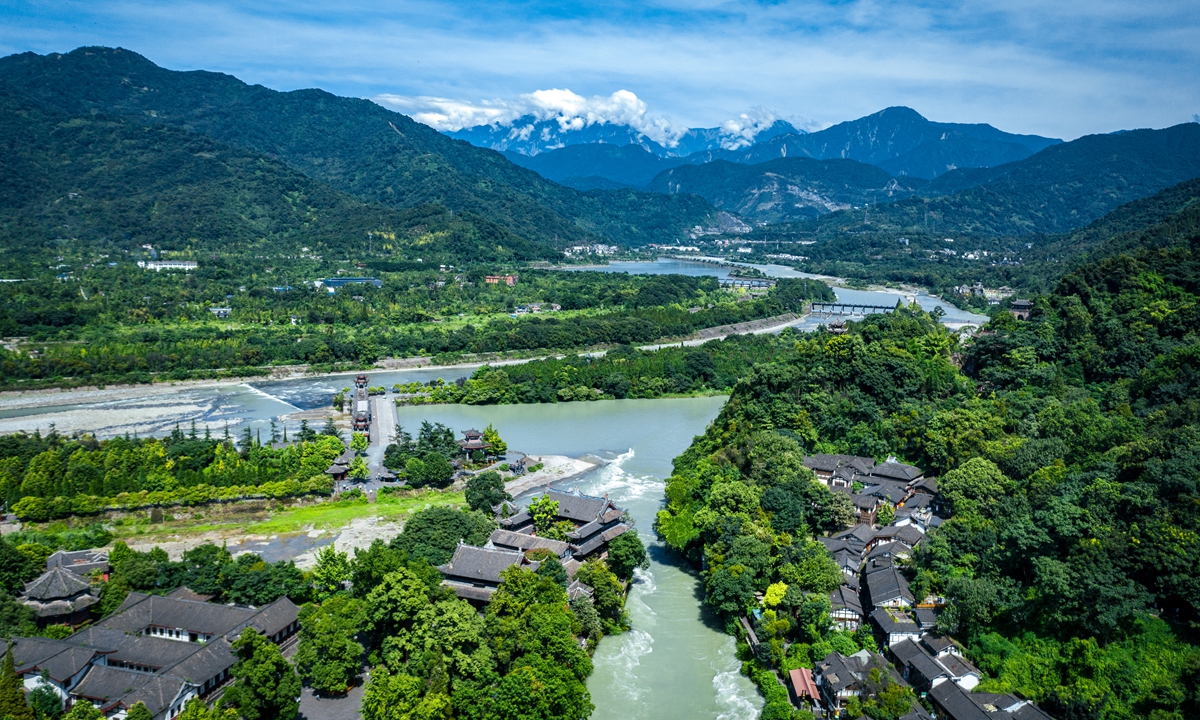
The Dujiangyan irrigation system in Southwest China's Sichuan Province Photo: VCG
The Dujiangyan irrigation system in Southwest China's Sichuan Province is the world's only ancient irrigation project still in operation today, and also one of the earliest successful practices of harmonious coexistence between humanity and nature. Over more than 2,000 years, the enduring vitality of Dujiangyan stems not only from its ingenious ancient engineering and sophisticated governance principles, but also from its ability to evolve with the times through the integration of modern technology — particularly its innovative digital twin applications — a testament to the perfect blend of ancient wisdom and today's innovation.
Recently, a Global Times reporter visited the Dujiangyan irrigation system to explore its day-to-day operations, sophisticated management practices, cutting-edge digital twin applications, and advanced water resources scheduling. The visit revealed how this ancient engineering marvel is seamlessly integrating modern digital technologies to optimize water allocation, bolster flood control, and ensure long-term water security for the region.
Digital twin of ancient irrigation
Stepping into the command center of the Dujiangyan irrigation system, the Global Times reporter was met by a wall-sized screen glowing with flowing data. Rivers pulsed, sluice gates flickered, and mountain contours rose in crisp detail — a digital twin of the ancient waterworks running in real time, mirroring the physical system outside almost instantaneously.
Covering 26.7 square kilometers around Dujiangyan's headworks, the 3D real-scene model integrates live data from 59 sluice gates, video feeds from more than 30 key locations, and readings from over 20 safety sensors, all converging into what the command center director described as the system's "smart brain," which continuously monitors and manages water flows.

Command center of Dujiangyan irrigation system Photo: Shen Sheng/ GT
During the 14th Five-Year Plan period (2021-2025), China has wrapped up 94 pilot digital twin river basin projects, advanced digital twin water network construction in 14 provincial pilot zones, and put 11 key projects — including the digital twin South-to-North Water Diversion Project — into operation. With accelerated development of an integrated "space-air-ground-water-engineering" monitoring system this year, a "smart brain" for water conservancy decision-making is now in place. The Dujiangyan irrigation system serves as a vivid illustration of such innovative practices.
When asked how the digital twin platform of Dujiangyan collects data, the command center director said that Sichuan has deployed 2,675 water monitoring stations and 1,611 video surveillance devices across the province. Combined with AI video recognition and GNSS technology, the system achieves 100 percent automated metering at key sites and over 80 percent monitoring coverage for critical dams and vulnerable sections, creating a comprehensive "water perception map."
Recently, at a press conference held by the Ministry of Water Resources on progress in building digital twin water systems during the 14th Five-Year Plan period (2021-2025), an official from the ministry's information center highlighted the achievements in irrigated areas. In the irrigation zone of Dujiangyan, digital twin technology has enabled precise water resource scheduling, allowing the completion of rice transplanting to be achieved seven days ahead of schedule for three consecutive years and ensuring that over 6 million mu (400,000 hectares) of rice paddies receive irrigation water in a timely and efficient manner.
"During the 2025 spring irrigation season, despite the drought, I called to request an emergency water supply, and water reached our village in less than half an hour," said Zhang Qin, Party secretary of Baimiao village in Pengzhou, a county-level city administered by Chengdu.
Baimiao village is one of many under the oversight of the Pengzhou water management station. The station's deputy head, Zhou Mingxuan - a veteran with 30 years in water management - proudly guided the Global Times reporter through the station's new "smart control room," a compact hub built on advanced digital infrastructure.
"Though small, this room handles remote control of sluice gates for nearly 750,000 mu of farmland, drone patrols, unmanned hydrological stations, soil moisture monitoring and more," Zhou said.
Operators use a single screen to oversee the area, a unified network to manage it and one system to control it - dramatically cutting response times for water scheduling, facility management and disaster prevention. What once took four hours to adjust gates across the station now takes just five minutes, saving time and effort, according to Zhou.
Digital twin technology has also played a critical role during extreme events. In the 2024 flood season, as Dujiangyan faced its largest peak flow in three years, the system used high-precision models to forecast peak volume and arrival time 72 hours in advance with less than 20 percent error, introduced Li Jin, director of the Dujiangyan irrigation zone command center.
Real-time monitoring and simulations guided coordinated gate operations between the inner and outer rivers, protecting irrigation infrastructure and reducing flood risks in urban areas, according to Li.
Enduring wisdom and its legacy
More than two millennia ago, during the Warring States period (475-221 BC), Li Bing, governor of Shu Commandery under the Qin State, oversaw the construction of Dujiangyan - a pioneering irrigation system that achieved automatic water regulation and flood control without the use of dams or gates, the Xinhua News Agency reported.
A "fish-mouth" shaped weir splits the Minjiang River into an inner channel for irrigation and an outer channel for discharge of flood water. A weir is a low barrier in a stream or river to control water flow.
Over generations, water managers distilled their experience into a comprehensive set of rules and maintenance practices, including principles like "divert for irrigation in drought, drain in flood." The famous guideline — "Deepen the channel [of the Inner River] so that water keeps moving, through annual dredging to sufficient depth; lower the [Feisha] Weir so that floods can overflow and droughts won't dry it out."
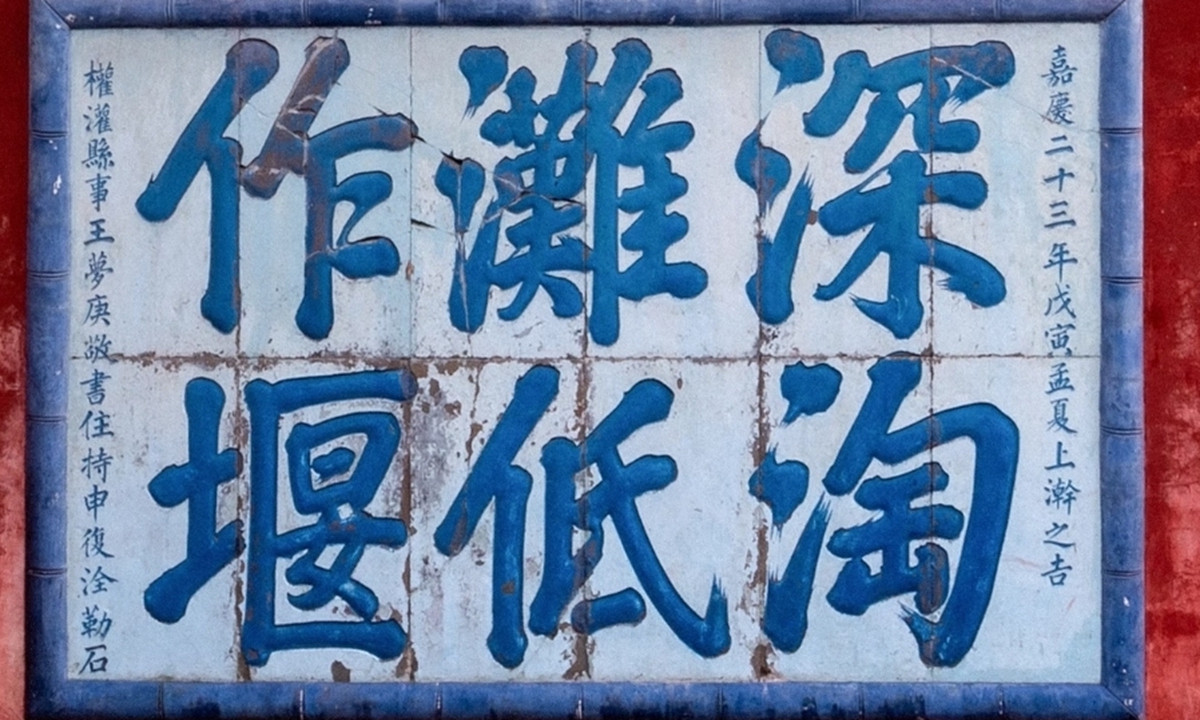
The famous six-character guideline for water governance in Dujiangyan Photo: Shen Sheng/GT
During the on-site visit, local command center staff explained to the Global Times that its techniques, such as deepening the riverbed and lowering the weir, illustrate the value of leveraging natural forces and making decisions in harmony with the environment. These methods reflect profound strands of traditional Chinese philosophical thinking, adapting to local conditions and guiding water in accordance with its natural momentum.
The staff added that, although the system was occasionally neglected during times of war in its long history, it has endured for thousands of years thanks to generations who consistently upheld and put its water-management philosophy into practice.
A video shared by Chinese Foreign Ministry spokesperson Mao Ning on X on December 9, 2025, highlighted a little-known episode: Japanese forces during World War II attempted to bomb Dujiangyan. Their planes flew around and around looking for a traditional dam, but they never imaged that Dujangyang could blend completely with nature.
When the Global Times reporter asked several local staff members about this episode, they admitted that they had never heard the story before. Yet, on the very day the reporter left Dujiangyan, they managed to dig through stacks of old books in the library and find the exact page that recounted it.
Back then, 108 Japanese planes not only bombed Chengdu but set out to destroy Dujiangyan. The enemies have believed that by obliterating this priceless treasure guarding Sichuan, they could sever the lifeline of men, materials and money flowing to the anti-Japanese front. But to their astonishment, Dujiangyan is a water project born of unity between man and nature - there simply was no dam. The enemy aircraft wheeled in circles above, searching in vain for the massive barrier they imagined damming the river, and in the end, they could only drop a few bombs with no specific target, according to the book.
The legend endures: from the ceaseless hum of this millennia-old engineering wonder to today's real-time digital orchestration, the Dujiangyan irrigation zone upholds its timeless duties in irrigation, flood control, and water supply with sharper science and efficiency — fortifying regional food security and water safety for generations to come.
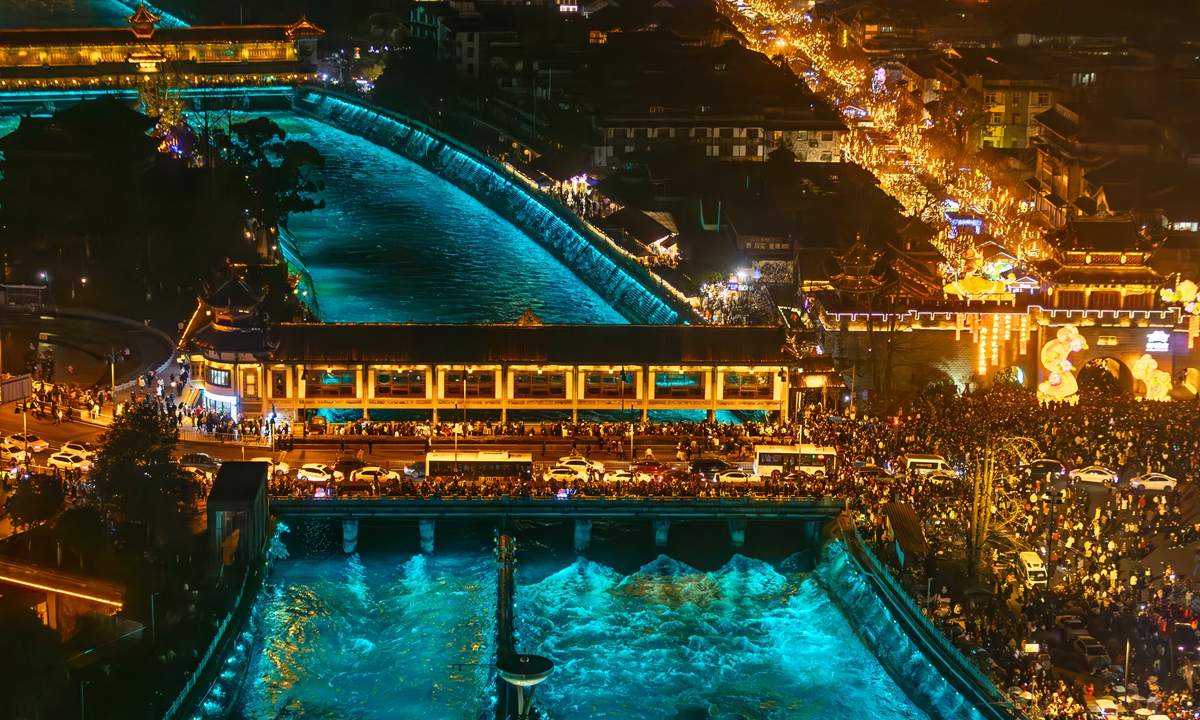
The Dujiangyan irrigation system in Southwest China's Sichuan Province Photo: VCG
RELATED ARTICLES