US capture of Maduro sparks fear of 'law of the jungle,' but most countries reject 'might makes right': Chinese scholar
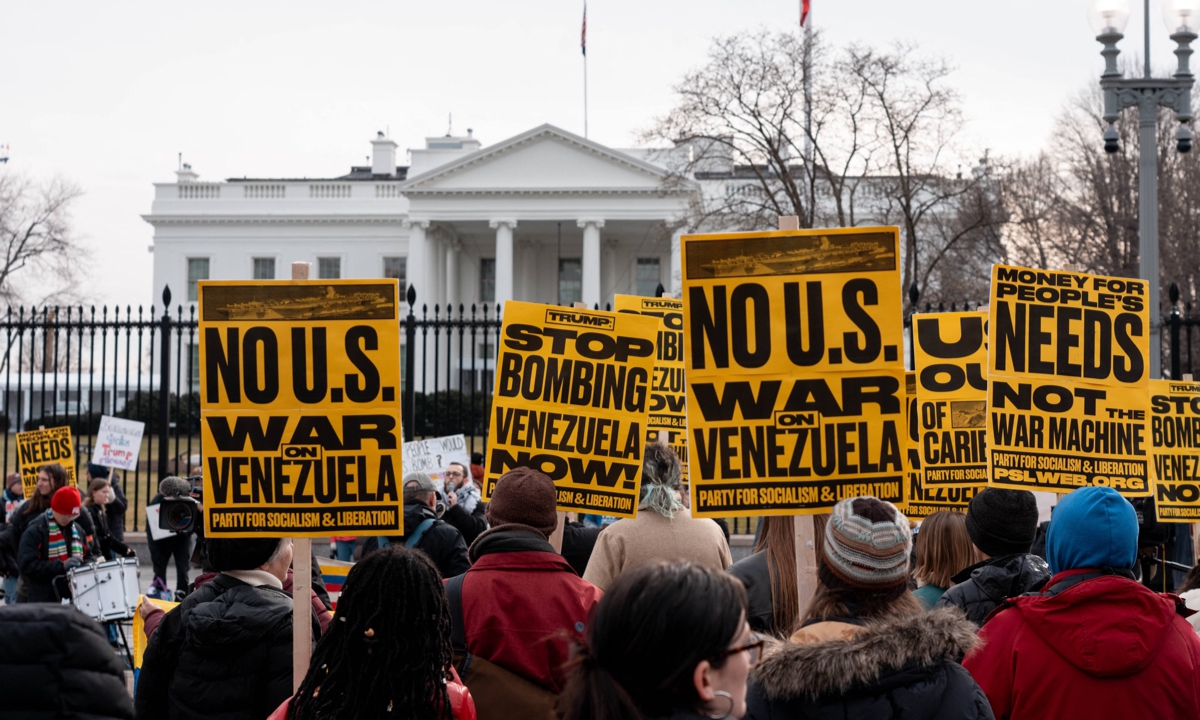
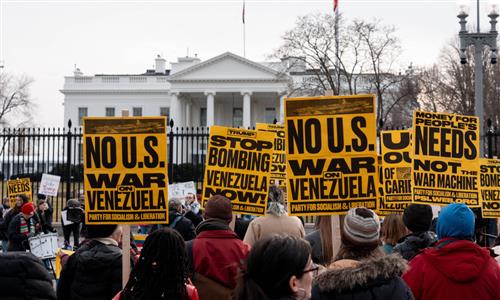
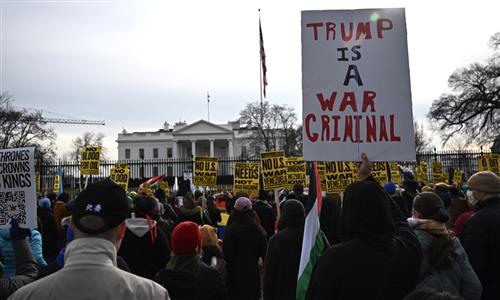
Protesters hold signs showing disapproval of American actions in Venezuela in front of the White House Washington on January 3, 2026. Photo: VCG
"Expressions of unbridled power don't come blunter than abducting a sitting president from his capital in the dead of night." This is how CNN commented on the striking news at the beginning of the year - the US launched strikes on Venezuela and captured its President Nicolás Maduro.On Saturday local time, a plane carrying the captured Venezuelan Maduro and his wife arrived in New York. The Venezuelan leader is expected to face drugs and weapons charges in Manhattan federal court in the coming week, according to reports. These US actions not only violate Venezuela's national sovereignty but also severely undermine international law and the global order.
Targeting Maduro, the US fabricated a false narrative for quite some time, calling his government illegitimate and accusing it of widespread election fraud. However, Venezuela's elections are a sovereign matter for its own citizens and state - an internal affair in which outsiders have no right to interfere. Just because the US declares a government illegitimate doesn't make it so. Moreover, the opposition figures supported by the US still lack broad popular support within Venezuela itself. Thus, this US unilateral operation jeopardizes the very foundations of international law and grossly tramples Venezuela's sovereignty.
This is hardly the first time the current US administration has used similar tactics to achieve strategic goals. On the evening of June 21, 2025, the US carried out air- and sea-launched strikes on three nuclear facilities in Iran in an operation US officials described as "very narrowly tailored" to "destroy or severely degrade Iran's nuclear program."
Backed by overwhelming military might, US special operations and precision strikes inflict severe psychological shock, strong political deterrence, and profound strategic intimidation on target countries. This approach has become a defining feature of the administration's decision-making. From this perspective, it would be no surprise if the US continues to employ such methods while reshaping the global geopolitical landscape.
In this Venezuela operation, the US has not declared the mission over. Instead, it claims that American forces will maintain a presence in the country. In other words, if Maduro's successor government refuses to cooperate, a second similar action is entirely possible. Once Venezuela is "resolved" by the US, other countries in the Caribbean and South America facing US hegemonic bullying may well wonder whether they will be next.
The US wants oil, it wants America First. And above all it wants absolute control over the Western Hemisphere. This is the core of the Donroe Doctrine.
This brazen US operation - the midnight arrest of Maduro - may stimulate countries to once again view international relations through the lens of jungle-law realism, where might makes right.
Military power remains a core pillar upholding American hegemony - and it is deployed precisely to bully Third World nations. Its defining trait is the bully's playbook: Leveraging overwhelming strength to intimidate the weak. South America, unfortunately, lies too close to the US and too far from heaven, leaving it vulnerable to US bullying.
Yet in essence, over the long term and strategically, imperialism is less frightening than it appears.
The US harbors deep-rooted structural flaws that no single administration can fix. Domestic bipartisanship is bitterly polarized. After this strike, leading Democrats swiftly scolded the mission. Meanwhile, the golden era for the American middle class has vanished, leaving the economy sluggish and faltering. Finally, Washington is also facing a disintegration of the US alliance system.
This partly explains the US preference for pinpoint, rapid operations. From the initial invasion of Afghanistan to the chaotic 2021 withdrawal - and in the case of Ukraine - the US, rather than seeking a solo confrontation, has preferred to build coalitions against Russia. These episodes indicate that, given current capabilities, the US lacks an appetite for protracted, high‑intensity warfare, which helps explain its choice of a low‑cost, high‑yield approach.
It's worth noting that the Donroe Doctrine may rampage unchecked in US' own backyard for a while, but it cannot hold back the unstoppable rise of a multipolar world. Today, most nations reject the idea that might makes right. They reject a chaotic international order and the prospect of war returning to the global stage. The latest US action has already drawn condemnation worldwide - even from its own allies. The growing opposition serves as irrefutable proof of how unwelcome America's actions have become.
The article is compiled by Global Times reporter based on an interview with Wang Qiang, a Chinese scholar of national security strategy studies. opinion@globaltimes.com.cn
RELATED ARTICLES