Illustration: Liu Rui/GT
From denying history to the dangerous strategic shift currently taking place in reality, behind it all lies the attempts by Japanese right-wing forces to honor the militarists. How can the international forces of justice, which made tremendous sacrifices for victory in WWII, stand idly by and allow this to happen?Recently, Toshio Tamogami, a former chief of staff of Japan's Air Self-Defense Force and an ultra-right figure, openly published a post claiming that Japan's attack on Pearl Harbor was "nothing but American propaganda," which quickly attracted a large number of likes and supportive comments. His remarks are by no means an isolated case; they reflect the long-standing, deliberate attempts by the Japanese right to distort the history of aggression. The various narratives used by these individuals to overturn the verdict on the Pearl Harbor attack serve as a mirror, revealing their refusal to acknowledge war crimes and their unwillingness to accept the outcome of defeat.
Japan's surprise attack on Pearl Harbor, which triggered the Pacific War, is a well-settled historical fact. Prior to the surprise assault on Pearl Harbor in 1941, Japan dispatched a diplomatic mission to Washington to create a smokescreen. Without issuing any formal declaration of war, Japan suddenly launched a military attack on Pearl Harbor, destroying numerous major US warships and causing heavy casualties among American military personnel. Cordell Hull, the then US secretary of state, criticized Japan for being full of deceit and brazenly distorting the truth. In one of his fireside chats, US president Franklin D. Roosevelt at the time stated bluntly: "No honest person, today or a thousand years hence, will be able to suppress a sense of indignation and horror at the treachery committed by the military dictators of Japan, under the very shadow of the flag of peace borne by their special envoys in our midst."
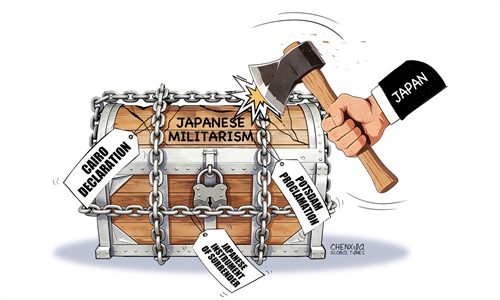
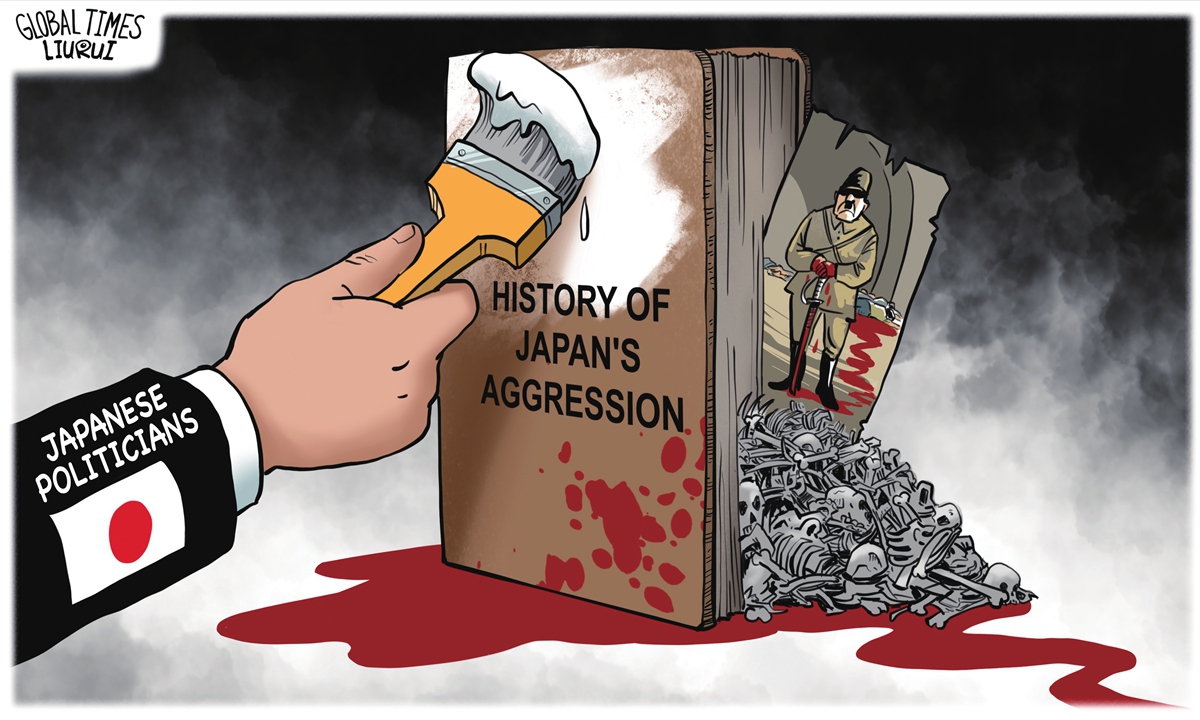
After the war, far from reflecting on its past, Japanese right-wing forces have attempted to whitewash the country's war crimes, shape a collective memory that favors the right-wing narrative and undermines the postwar international order.
One of their tactics is to invert cause and effect. Following the attack on Pearl Harbor, Japan issued an imperial rescript declaring war on the US and Britain, constructing a false narrative that Japan had been forced to "rise up" for "its existence and self-defense" due to increasing economic and military threats from the US and Britain. Even after its defeat, Japanese war criminals clung to this "self-defense" argument. As reported by The New York Times on December 26, 1947, Hideki Tojo "defiantly" told the 11-nation court that Western countries had maneuvered to force Japan to fire the first shot in "self-defense" and to preserve "national existence."
Over the decades since the war, rather than being dispelled, these militarist lies have steadily taken root. The Yushukan Military Museum at the Yasukuni Shrine has long promoted the narrative that the US, Britain, China and the Netherlands formed an "ABCD encirclement" against Japan, and that despite Japan's efforts to avoid war, it was ultimately forced to take a desperate gamble. Conspiracy theories such as "the attack on Pearl Harbor was a trap set by the US to drag Japan into war" continue to enjoy popularity in Japanese right-wing circles to this day.
The second tactic is the glorification of atrocities. Even during the war, Japanese militarists crafted rhetoric to "justify" the attack on the US: This war was not only for Japan's "self-preservation and self-defense," but also a "mission of liberation" representing the Asian races against Western white colonizers. For over 80 years since defeat, Japanese right-wing forces have never ceased whitewashing the war. To this day, they remain deeply convinced by the "glorious dream" woven by militarism. Inside the Yasukuni Shrine, the telescope used by Isoroku Yamamoto, commander-in-chief of the Combined Fleet during the attack on Pearl Harbor, along with letters he wrote, are prominently displayed, receiving daily veneration from believers.
The third tactic is distorting concepts. Thoroughly addressing the war crimes of Japanese militarism is an essential requirement for upholding justice. However, the Japanese right-wing forces have made unfounded countercharges by waving the banner of "reconciliation" in an attempt to sever ties with the history of aggression, implying that the victims of militarism should not dwell on historical issues. While preaching "peace," they simultaneously smear neighboring countries and hype up a "survival-threatening situation" to pave the way for abandoning the postwar path of peace. They have even transformed themselves, donning the mask of a "loyal ally" and using cooperation with the US military as a pretext to push for the lifting of restrictions on collective self-defense, moving further down the path of rearmament. Beneath this facade lies an extremely dangerous strategic calculation. How could the Japanese right, which has never accepted defeat and continues to honor the architect of the Pearl Harbor attack as a hero, truly submit in the long term to so-called allies across the ocean?
Japanese militarism is insidious and cunning, and the Japanese right wing's distortion of history is consistent and indiscriminate, with the whitewashing of the Pearl Harbor attack being just one example. From denying history to the dangerous strategic shift currently taking place in reality, behind it all lies the attempts by Japanese right-wing forces to honor the militarists. How can the international forces of justice, which made tremendous sacrifices for victory in WWII, stand idly by and allow this to happen?
Zhong Sheng is the People's Daily international news commentary column. opinion@globaltimes.com.cn
RELATED ARTICLES