Illustration: Liu Rui/GT
From Sunday to Thursday, Taoiseach of Ireland Micheál Martin is conducting an official visit to China, marking the first visit by a Taoiseach of Ireland in 14 years. According to the itinerary released by the Irish side, Martin will meet with Chinese leaders in Beijing before proceeding to Shanghai for business forums.
Brussels Morning reported that "Martin seeks to place Ireland as a formative EU ground to Beijing." This characterization accurately captures the significance of the visit and offers an essential perspective for external observers to understand China's approach to Europe. This visit comes at a complex moment in China-EU relations and carries significant demonstrative value and strategic importance.
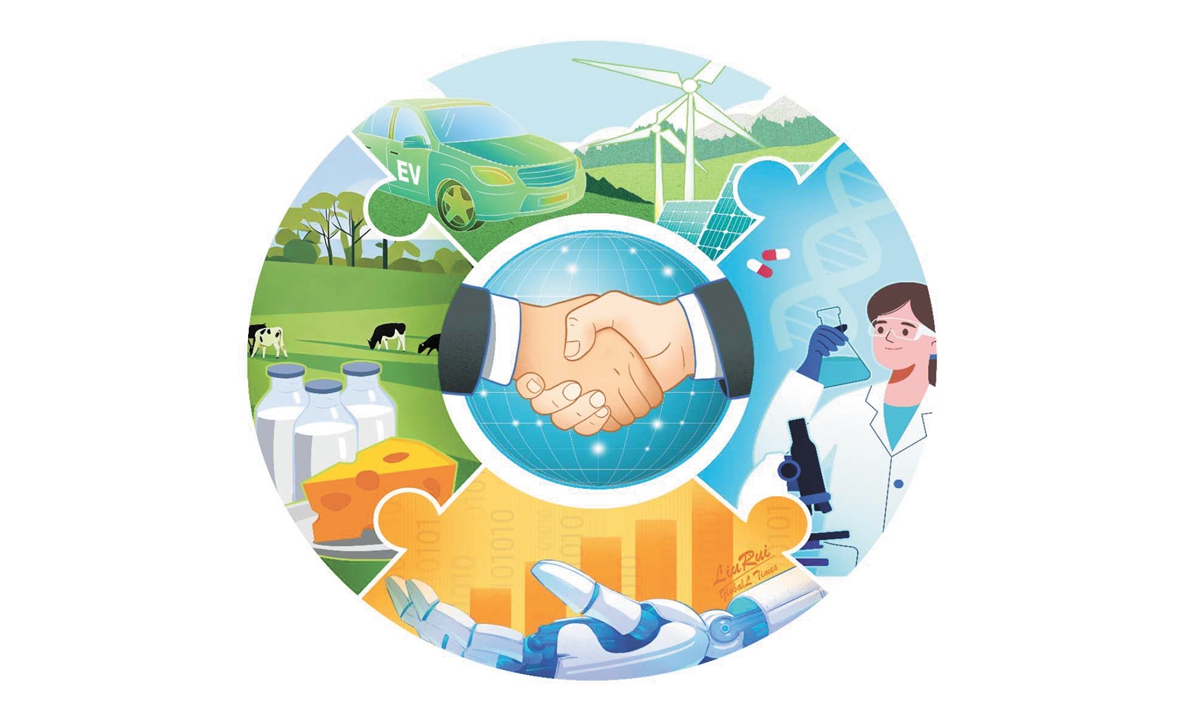
During the visit, both sides will focus on practical economic cooperation. Based on available information, pharmaceuticals, technology, agri-food and green energy constitute the priority areas for collaboration.
Ireland exports approximately 5 billion euros (approximately $5.8 billion) worth of pharmaceutical products to China annually and holds a prominent position in global biopharmaceuticals. Both sides are expected to deepen cooperation in drug research and development, as well as in aligning production standards.
In the agri-food sector, Ireland's premium beef, dairy products and seafood hold considerable market potential. Further tapping into the Chinese market would deliver substantial benefits to Irish agriculture. Additionally, cooperation in emerging fields such as artificial intelligence, advanced technology and fintech is on the agenda, aligning with both countries' shared needs for economic transformation and upgrading.
Bilateral trade between China and Ireland has reached $23.42 billion in 2024, with Ireland maintaining a trade surplus. This mutually beneficial arrangement provides a solid foundation for further cooperation.
China's policy toward Europe has consistently adhered to principles of mutual respect, equality, mutual benefit and open cooperation. China has never viewed EU member states as pawns in geopolitical competition, but rather respects each sovereign nation's right to make independent diplomatic decisions based on its own interests.
Martin's visit to China represents both a rational choice grounded in Ireland's national interests and a demonstration of resilience in China-EU relations. China welcomes the development of relations with Ireland and other EU member states — not to "divide Europe," but to enhance mutual understanding through bilateral exchanges and accumulate positive momentum for overall China-EU relations.
China-EU relations currently face particular difficulties and challenges. Against a backdrop of complex and evolving international dynamics, divergent perceptions of China have emerged within the EU. Some voices define China as a "systemic rival" and have adopted restrictive measures in trade, investment and technology.
The EU's imposition of substantial tariffs on Chinese electric vehicles and its push for "de-risking" in supply chains harm the interests of businesses and consumers on both sides while contradicting the principles of free trade and market economics. Meanwhile, some European political forces attempt to ideologize China-EU economic issues and politicize normal commercial cooperation, artificially creating confrontation and estrangement.
However, the fundamental logic of China-EU cooperation remains unchanged. China and the EU are each other's second-largest trading partner. The two economies are deeply integrated, with tightly interconnected industrial and supply chains. China-EU trade volume remained at high levels in 2024. Chinese investment in Europe has created numerous employment opportunities, and European companies have reaped substantial returns from the Chinese market.
On global issues such as addressing climate change, promoting energy transition and upholding the multilateral trading system, China and the EU share extensive common interests. These objective realities determine that China-EU relations should not and will not deviate from the main track of win-win cooperation due to temporary setbacks.
Though a small EU nation, Ireland possesses unique strengths in biopharmaceuticals, the digital economy and other fields, and shares common ground with China on issues such as multilateralism and free trade.
Deepening China-Ireland cooperation not only serves the interests of both peoples but also provides a valuable demonstration for China-EU relations: Countries with different social systems and at various development stages can fully achieve mutual benefits through mutual respect and equal dialogue.
As long as both sides adhere to the spirit of mutual respect, seeking common ground while shelving differences and pursue win-win cooperation, China-EU relations can overcome current difficulties and embrace a brighter future.
The Irish Taoiseach's visit to China represents a positive step in this process. We look forward to fruitful outcomes from the visit, which will inject fresh momentum into China-EU relations.