Western snide remarks fail to obscure autonomous devt of warming China-India ties
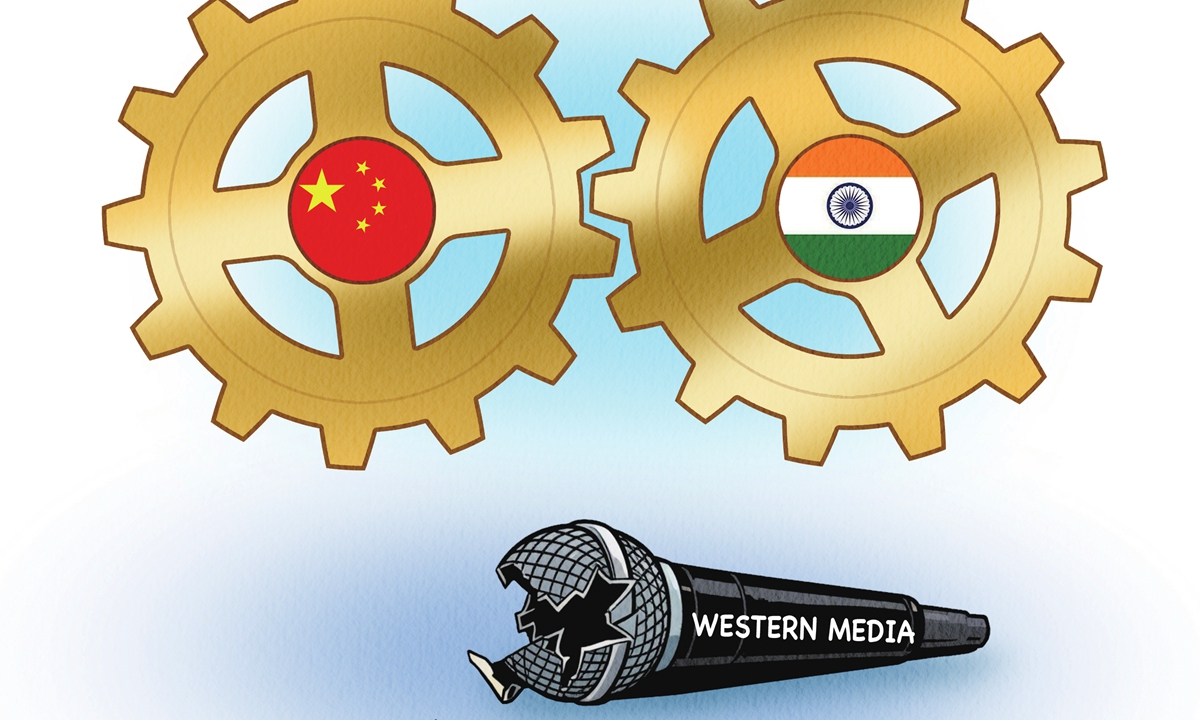
Illustration: Liu Rui/GT
Indian Prime Minister Narendra Modi concluded his visit to China on Monday, after which he posted on social media platform X that he is "thankful" to the Chinese government and people for the successful organization of the 2025 Shanghai Cooperation Organisation (SCO) Summit. The latest meeting between the leaders of China and India in North China's Tianjin has in-jected new momentum into bilateral relations. However, while both leaders actively signaled cooperation, Western establishment media rushed to issue a series of snide remarks, disre-garding the fact that Beijing and New Delhi are making strategic choices based on their own interests.
On Monday, the New York Times described Modi's first visit to China in seven years in a tone suggesting it's merely a side effect of the US tariff war, while Fox News went so far as to headline: "Trump tariffs push India closer to America's strategic rivals China and Russia." Such rhetoric reflects Western anxiety and discomfort over the warming bilateral relations as well as the growing independence of developing countries. They failed to recognize that the thaw in China-India relations is an inevitable trajectory driven by multiple shared interests.
Signs of a thaw in the bilateral relationship had appeared long before. On October 23, 2024, President Xi met with Modi on the margins of the BRICS Summit held in Kazan, Russia, reaching a consensus to make good use of the Special Representatives mechanism on the China-India boundary question and strengthen communication and cooperation in multi-lateral fora.
The Tianjin meeting at the 2025 SCO Summit was therefore a continuation and deepening of the consensus reached in Kazan. On August 31, during a meeting in Tianjin with Modi, Chinese President Xi Jinping stated clearly: China and India should become good-neighborly friends and partners that help each other succeed. A "cooperative pas de deux of the dragon and the elephant" should be the right choice for the two countries, he added. Modi also stressed it is vital for India and China to strengthen cooperation as important economies of the world. These friendly interactions show that the improvement in China-India relations is a sustained process, driven by their shared commitment to win-win cooperation, rather than the external pressures portrayed by Western media. Moreover, the 2020 Galwan Valley conflict, frequently invoked by foreign media, is neither the entirety of China-India relations nor a supposed "veto point."
"These reports from Western media typically reflect a black-and-white, 'friend-or-foe' mind-set," Long Xingchun, a professor from the School of International Relations at Sichuan International Studies University, told the Global Times. "Such narratives also show a lack of respect for India. As a major sovereign power, India has independent diplomacy and strategic autonomy, and regarding its foreign relations, it makes its own decisions based on its own principles and interests," Long added.
The warming of China-India ties stems from strategic choices driven by mutual interests. Economically, bilateral trade continued to grow in 2024. Geopolitically, as key members of the Global South, China and India have far more room for cooperation than confrontation within platforms such as BRICS and the SCO to safeguard the common interests of developing countries.
Rigid thinking prevents Western media from grasping the internal logic of China-India rela-tions. Their snide remarks are little more than expressions of discomfort with the growing autonomy of developing powers, mirroring their unease over the global power shift toward the East. They have observed that major developing countries are moving closer to each other, which makes them upset. The SCO Summit 2025 in Tianjin, attended by leaders from more than 20 countries and heads of 10 international organizations, was hailed as the largest ever, showing that many countries, including India, prefer cooperation within a multipolar framework.
The warming of China-India relations is not a "side effect" of the US tariff war but a proactive choice for the future made by both nations. Broad opportunities for multilateral cooperation form the real logic of the relationship. The future of China-India relations will be written by the two countries themselves.
RELATED ARTICLES