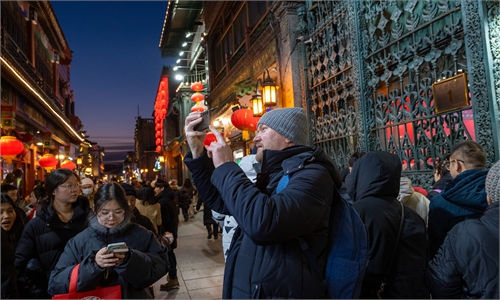
Tourists take photos at Prince Kung's Palace Museum in Beijing on January 3, 2026. Photo: Liu Yang/GT
China's transportation and tourism sectors have experienced significant growth during the 2026 New Year holiday, with a surge in cultural tourism visits and a noticeable uptick in inbound visits.
The vitality of the extended holiday was further highlighted by the unprecedented movement of people. According to the Ministry of Transport (MOT) on Sunday, China recorded average daily inter-regional passenger trips of 198 million during the three-day New Year holiday ending Saturday, marking a 19.62 percent year-on-year increase. The total passenger trips throughout the holiday reached 595 million, highlighting robust travel demand, said the MOT.
The tourism sector was the primary beneficiary of the massive mobility. The Ministry of Culture and Tourism announced on Sunday that the holiday market remained stable and orderly, with 142 million domestic trips made nationwide. Total domestic travel spending reached 84.789 billion yuan ($12.13 billion).
Analysts said the data point to a broad-based, consumption-driven recovery in domestic tourism at the start of 2026, supported by richer product offerings and a renewed appetite for travel. They attributed the robust figures to extended holiday duration, improved transportation infrastructure, visa-free transit policies and diversified tourism offerings tailored to different consumer preferences.
Surge in inbound tourism
The three-day holiday period, two days longer than that of 2025, created a perfect storm of tourism demand as domestic travelers embraced both short-distance getaways and long-haul vacations, while international visitors seized the opportunity to experience Chinese New Year celebrations, said industry observers.
Border inspection authorities nationwide handled 6.615 million cross-border trips by Chinese and foreign travelers during the New Year holidays, averaging 2.205 million trips per day. This represents a year-on-year increase of 28.6 percent, with a single-day peak of 2.265 million trips recorded on January 1, according to data released by China's National Immigration Administration (NIA) on Sunday.
Of these trips, 292,000 were visa-free entries, an increase of 35.8 percent from the same period last year, the NIA said.
Data from travel platform Qunar showed that during the New Year holiday, travelers using non-Chinese passports booked domestic flights to destinations covering 97 cities nationwide, indicating widespread international interest in experiencing Chinese New Year celebrations, and underscoring China's growing international appeal as a year-end destination.
According to data from Ctrip platform, inbound ticket bookings increased by 110 percent year-on-year, and bookings for experiential entertainment products increased by over 30 times. International tourists' interest in traveling to China is changing from visiting and checking in to in-depth experience.
Chengdu's immigration authorities reported a remarkable 74.8 percent year-on-year increase in foreign nationals crossing their checkpoints, with over 22,000 international visitors processed between January 1-3. The top three source countries for inbound foreign travelers were Thailand, Malaysia and Australia, according to Chengdu Fabu on Saturday.
Deng Yongsheng, general manager of Chengdu Le Tour International Travel Agency, reported hosting approximately 1,000 foreign visitors during the holiday, primarily from Thailand, Vietnam and Malaysia. "Our Southeast Asian tour groups have increased significantly," Deng noted. "The improved transportation links have made flying from Southeast Asia to Chengdu convenient and affordable."
In November 2025, China strived to enhance its attractiveness as a global tourism hub by expanding its 240-hour visa-free transit program, raising the total number of ports eligible for the 240-hour visa-free transit from 60 to 65, Xinhua News Agency reported.
The country also extended its unilateral visa exemption arrangements for more than 40 countries until December 31,2026. These changes have played a crucial role in boosting foreign arrivals, with tourists now enjoying easier access to China for longer stays and more flexibility in travel.
Experts attributed the growth to China's efforts to facilitate visas in recent years, saying that its measures have effectively attracted international visitors to the country for travel or business. They suggested that the extended visa exemptions, combined with improved mobile payment environment, the growing availability of regional tours and cultural experiences, have helped to drive the growth.
As the country has made it easier for international travelers to use their foreign credit cards by allowing them to link these cards directly to popular Chinese mobile payment platforms like Alipay and WeChat Pay, this year's New Year holiday also saw a notable increase in foreigners' spending, particularly in cities like Beijing, where tourists from various countries flocked to shopping areas such as Qianmen Street to purchase souvenirs, local teas and trendy clothing, Wang Peng, an associate researcher at the Beijing Academy of Social Sciences, told the Global Times on Sunday.
Booming holiday spending
According to CCTV News on Sunday, the holiday period saw a surge in diversified cultural and tourism consumption, with visitors enjoying a wide range of experiences. Online travel platforms reported that bookings for domestic scenic spots rose more than fourfold year-on-year, while bookings for inbound experience-oriented leisure products skyrocketed over 30 times, triggering the first consumption wave of the year.
Distinctive traditional cultural resources, snow views and winter sports, milder climates and New Year's Eve countdown trips have all been tapped to enrich visitor experiences. Meanwhile, short-distance tours to locations near people's residences or workplaces proved popular during the holiday period, according to the culture and tourism bureau.
Officials said travel preferences centered on short-and mid-distance, local and nearby trips, with forest wellness, coastal hot springs, rural homestays and family study tours among the most popular themes as cultural-tourism integration deepened, according to CCTV News.
This year's three-day New Year holidays are two days longer than that of 2025, with nearby trips, extended long-distance travel, and inbound tourism overlapping to push overall travel demand to a record high, according to data sent to the Global Times by travel platform Qunar. Hotel bookings at popular destinations during the New Year holidays rose 50 percent year-on-year, while hotel and homestay reservations made by Qunar users covered more than 1,000 county-level regions nationwide, excluding county-level cities and urban districts, according to Qunar data.
South China's Hainan Free Trade Port saw a major surge in holiday shopping during its first New Year holiday as a special customs supervision zone. According to Haikou customs, during the holiday period, Hainan's offshore duty-free sales skyrocketed to 712 million yuan, involving 83,500 shoppers and 442,000 purchased items. These figures represented staggering year-on-year increases of 128.9 percent, 60.6 percent and 52.4 percent, respectively, CCTV News reported on Sunday.
The longer holidays would offer people more flexibility for travel and further ignite the public's enthusiasm for exploring tourist destinations. Meanwhile, strong consumption around the New Year is expected to lay a solid foundation for consumption growth throughout 2026, driving a continued recovery in the consumer market, Pan Helin, a member of the expert committee of the Ministry of Industry and Information Technology, told the Global Times on Sunday.
The holiday's momentum could help sustain demand into the upcoming Chinese Lunar New Year travel peak, which begins in mid-February, provided supply capacity and service quality keep pace with rising visitor expectations, Wang said.
The tourism sector's solid start to 2026 is expected to contribute significantly to regional economic growth and employment throughout the year, with many destinations already planning additional attractions and services to sustain momentum into the peak spring travel season, Wang said.
RELATED ARTICLES