ROK president arrives in Beijing with 200 business delegates, hails full restoration of bilateral ties 'the greatest achievement'
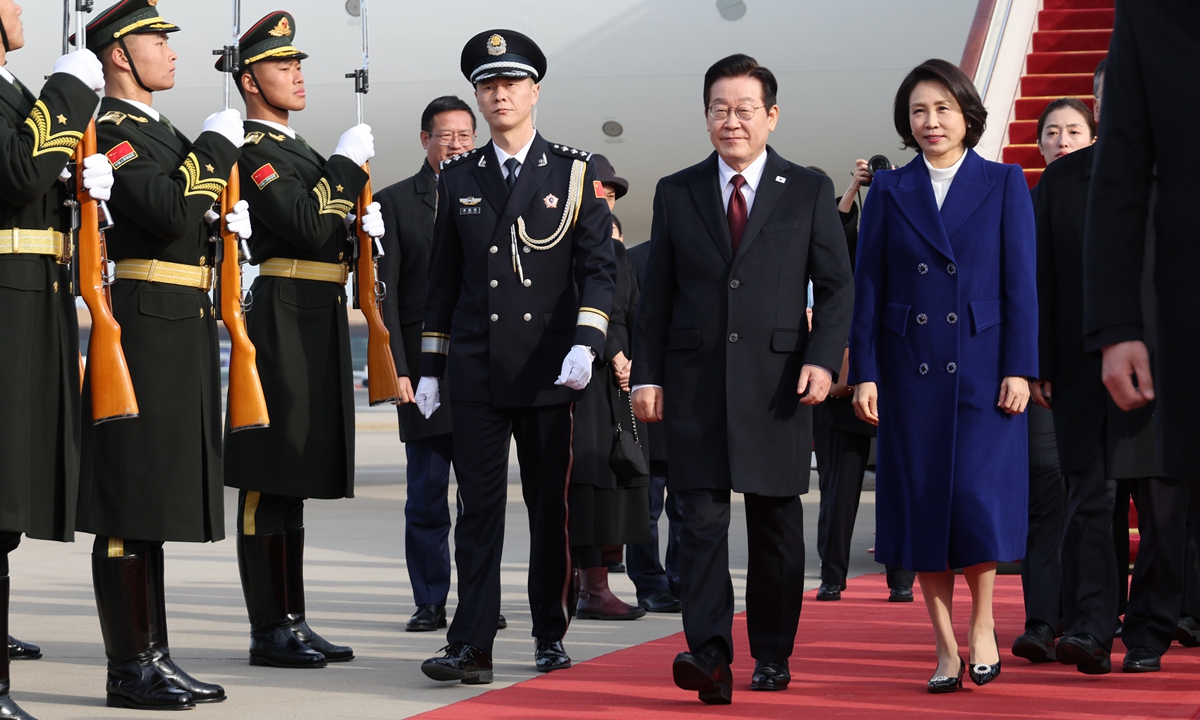
South Korean President Lee Jae-myung arrives at Beijing Capital International Airport by plane on January 4, 2026, kicking off his four-day state visit to China. Photo: IC
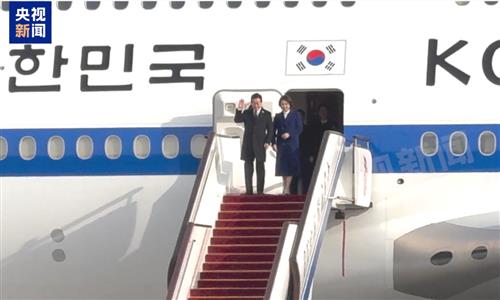
South Korean President Lee Jae-myung arrived in Beijing on Sunday for a state visit to China from Sunday to Wednesday, bringing with him about 200 South Korean business leaders, the Xinhua News Agency and South Korean media reported on Sunday. The four-day trip marks Lee's first to China since taking office in June last year and the first trip by a South Korean president since 2019.
"While there have been various diplomatic achievements, the full restoration of South Korea-China relations, which had been in retreat for a long time, is the greatest achievement and a significant accomplishment," President Lee said during a gathering with Korean compatriots held in Beijing on Sunday evening, The Chosun Daily reported on Sunday.
Lee stated, "It has been over 30 years since South Korea and China established diplomatic relations." He added, "As neighboring countries, we have sometimes faced difficult periods, but through exchange and cooperation, we have achieved remarkable development," the report said.
During President Lee's state visit to China, leaders of the two countries will hold talks in Beijing, marking their second meeting in around two months in South Korea. The meeting is expected to further consolidate the momentum of the full restoration of the China-South Korea strategic cooperative partnership, CCTV reported on Sunday.
About 200 South Korean business leaders have formed an economic delegation accompanying Lee on his visit to China, Yonhap reported.
According to South Korean media reports, the heads of major conglomerates in attendance include the chairmen of Korea's four largest groups - Executive Chairman of Samsung Electronics Lee Jae-yong, Chairperson of SK Group Chey Tae-won, Executive Chairman of Hyundai Motor Group Chung Eui-sun, and Koo Kwang-mo, Chairperson of LG Group.
The dispatch of an economic delegation to China marks the first in over six years since December 2019, and its scale is more than double that of the previous visit, ZDNet Korea reported.
The two sides are expected to discuss practical cooperation in areas that include supply-chain investments, the digital economy, the environment and climate change, people-to-people exchanges, tourism and responses to transnational crimes, according to Yonhap.
The two sides are also expected to sign more than 10 memorandums of understanding for cooperation in various areas, according to Yonhap.
A China-South Korea business forum will be held on Monday, a supporting activity for the South Korean president's China trip, co-organized by the China Council for the Promotion of International Trade (CCPIT) and the Korea Chamber of Commerce & Industry. About 400 participants will attend, the Global Times learned from CCPIT on Sunday.
According to an agenda seen by the Global Times, the forum will conduct in-depth dialogues centered on three core themes: manufacturing innovation and supply chain resilience, consumer market upgrading and innovation, and coordinated development of modern service industries.
The accompanying business delegation underscores the ROK government's strong emphasis on this visit and its prioritization of economic and trade cooperation, Lü Chao, a professor at the Liaoning Academy of Social Sciences, told the Global Times on Sunday.
Notably, beyond large conglomerates, South Korea places great importance on supporting small- and medium-sized enterprises in the Chinese market, where they have strong growth potential in regions like the three provinces in Northeast China and East China's Shandong Province that are geographically close to South Korea, Lü noted.
Lü also pointed out that South Korea may seek deeper penetration of its cultural products into China, such as K-pop.
According to South Korean media reports, Lee will visit Shanghai after wrapping up his Beijing tour. In Shanghai, he will attend a South Korea-China venture and startup summit to interact with young entrepreneurs in fields such as content, healthcare, infrastructure and energy. Afterward, he will visit the site of the Provisional Government of the Republic of Korea to honor the sacrifices and dedication of activists and reflect on the shared historical experiences of South Korea and China.
Hwang Jae-ho, director of the Institute for Global Strategy and Cooperation and a professor at Hankuk University of Foreign Studies, told the Global Times that the trip, which comes only two months after the two leaders' first meeting, highlights the shared determination of both sides to normalize relations and align their cooperation with respective national interests at the start of the new year.
The scholar added that Lee's arrangement to visit China, before one to Japan, also demonstrates South Korea's sincerity.
South Korean National Security Adviser Wi Sung-lac said on Friday at a press briefing that "It is unprecedented for the leaders of South Korea and China to begin their first diplomatic schedule of the new year together, and this will serve as an opportunity to open a new chapter in the development of bilateral relations," Korea Policy Briefing reported.
Prior to his visit, Lee had a nearly 20-minute interview on the program Leaders Talk of CCTV News at Cheong Wa Dae, which aired on Friday, during which he shared his expectations for his first visit to China, his views on trade development and bilateral relations, the current South Korean government's stance on the Taiwan question, and its approach to pragmatic diplomacy.
Lee said he hoped the interview would convey the importance the South Korean government attaches to South Korea-China relations, according to the TV program's translation.
When asked about the current South Korean government's position on the Taiwan question and how it plans to uphold the one-China principle, Lee said that the consensus reached between the governments of South Korea and China at the time of establishing diplomatic relations remains the core guiding principle governing bilateral ties, and its validity has never changed.
RELATED ARTICLES