S.Korea’s President Lee stresses importance of bilateral ties, reaffirms one-China stance on Taiwan ahead of China visit
Back-to-back head-of-state diplomacy in last two months underscores shared commitment to normalize ties: experts
By Published: Jan 03, 2026 10:55 PM

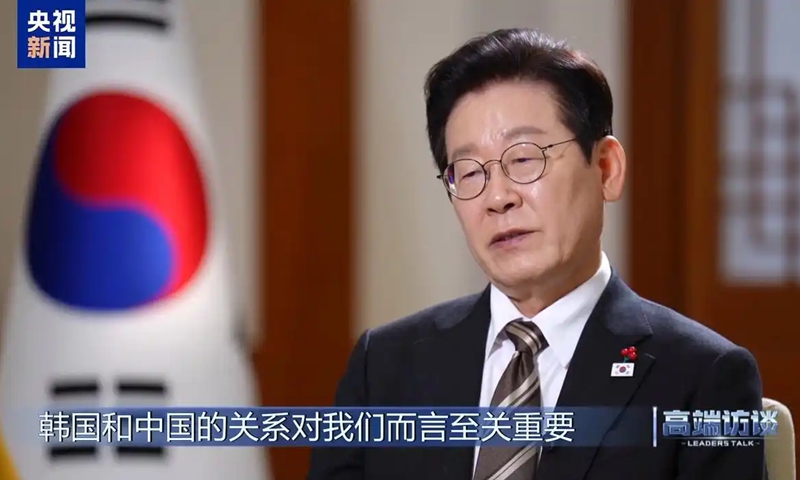
South Korean President Lee Jae-myung gives an interview with CCTV News that aired on January 2, 2026. Photo: screenshot from CCTV
South Korean President Lee Jae-myung is scheduled to begin a four-day state visit to China from Sunday. Ahead of the trip, his remarks on bilateral relations and his reaffirmation of respect for the one-China principle on the Taiwan question have drawn widespread attention in both China and South Korea. Experts from both sides reached by Global Times have expressed expectations for an improvement in bilateral ties, noting that back-to-back head-of-state interactions and other high-level exchanges underscore a shared desire to restore and develop relations.
At the invitation of President Xi Jinping, President Lee will pay a state visit to China from January 4 to 7, 2026, according to the Chinese Foreign Ministry.
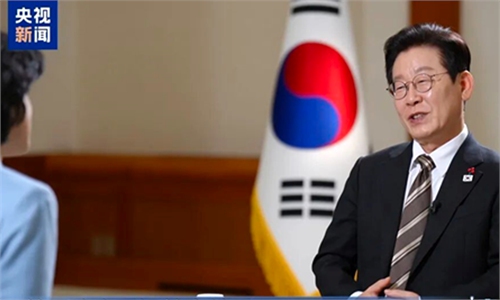
Prior to his visit, Lee had a nearly 20-minute interview on the program Leaders Talk at Cheong Wa Dae, which aired on Friday, during which he shared his expectations for his first visit to China, his views on trade development and bilateral relations, the current South Korean government's stance on the Taiwan question, and its approach to pragmatic diplomacy.
While noting that the interview with Chinese media was the first formal one he had given to any media outlet since the presidential office returned to Cheong Wa Dae, Lee said he hoped the interview would convey the importance the South Korean government attaches to South Korea-China relations, according to the TV program's translation.
When asked about the current South Korean government's position on the Taiwan question and how it plans to uphold the one-China principle, Lee said that the consensus reached between the governments of South Korea and China at the time of establishing diplomatic relations remains the core guiding principle governing bilateral ties, and its validity has never changed.
Lee said that he can state clearly that South Korea has always respected the one-China stance. In Northeast Asia, and on surrounding issues including cross-Straits relations, maintaining peace and stability is of vital importance. The fundamental positions underpinning China-South Korea relations were established at the outset of diplomatic ties and are principled and foundational.
The Lee Jae-myung administration's reaffirmation of the one-China stance underscores its emphasis on stable and healthy China-South Korea relations. At its core, the statement signals a return to the foundational political consensus forged at the time of diplomatic ties establishment, Lee Sang-man, a professor from the Institute for Far Eastern Studies of the Kyungnam University in South Korea, told the Global Times on Saturday.
Lee Sang-man noted that amid heightened complexity in the Taiwan Straits and growing competition among major powers, the statement is better understood as a move aimed at managing risks and stabilizing expectations, reflecting a return to the original intent of establishment of bilateral ties and a restoration of established consensus.
President Lee's exclusive interview with Chinese media has also prompted attention in academic circles, especially for his remarks on the Taiwan question, according to Lü Chao, a Korean Peninsula affairs expert at the Liaoning Academy of Social Sciences, who noted that the interview sent a clear signal that the new South Korean administration places high importance on China-South Korea relations.
President Lee's Taiwan-related statements could be interpreted as moving in the same direction as China in restoring bilateral ties, particularly regarding China's core interests. This stands in sharp contrast to the previous Yoon Suk-yeol administration's provocative rhetoric and helps build positive momentum for the upcoming China-South Korea leaders' summit, said Lü.
Wide attention
Lee's interview and his remarks on the Taiwan question have been widely reported by Chinese and South Korean media outlets on Saturday.
On Chinese social media, a related topic under the hashtag "Lee Jae-myung's statements on the Taiwan question" ranked among the top three trending topics on Sina Weibo as of Saturday afternoon. As of press time, the hashtag page had garnered 37 million views.
South Korean media also widely reported Lee's interview with the Chinese media. South Korean television network SBS ran a report titled "President Lee Jae-myung: 'Respecting the One-China stance… will eliminate misunderstandings and differences,'" while public broadcaster KBS published a report titled "President Lee Jae-myung to visit China tomorrow… Cheong Wa Dae says it 'respects the one-China position.'"
In a report on Saturday, South Korean media outlet Ilyo Shinmun mentioned Lee's interview with the Chinese media and quoted him as saying that the upcoming visit to China and the Chinese leader's previous visit to South Korea will "serve as a new catalyst for a fresh leap forward in China-South Korea relations."
A report by South Korean media outlet YTN noted that Lee's visit marks the first state visit to China by a South Korean leader since 2017. The leaders' summit is expected to serve as an opportunity for the two sides to sign memorandums of understanding in more than 10 areas, including industry, climate and environmental cooperation, and transportation.
After concluding his trip to China, President Lee Jae-myung is also expected to pursue a summit with Japan. Against the backdrop of heightened China-Japan tensions, attention is focused on whether South Korea can play a constructive bridging role, according to YTN.
President Lee's visit to China comes just two months after the Chinese leader's most recent visit to South Korea and at a time of year when diplomatic calendars are typically crowded, making the realization of high-level engagement all the more significant, Hwang Jae-ho, director of the Institute for Global Strategy and Cooperation and a professor at Hankuk University of Foreign Studies, told the Global Times on Saturday.
It also highlights the shared determination of both sides to normalize relations and align their cooperation with respective national interests at the start of the new year, the South Korean scholar said, noting a Chinese saying about "listening to one's words and observing one's actions." Lee's arrangement to visit China ahead of Japan, he added, also demonstrated South Korea's sincerity.
During the interview aired on Friday, Lee Jae-myung also expressed his views on South Korea's pragmatic diplomacy, noting that in the security domain, cooperation with the US is an undeniable reality, given the two countries' alliance. This, however, does not mean that relations with China should slide into confrontation or conflict - such an outcome would not serve South Korea's interests.
South Korea should, to the greatest extent possible, pursue coexistence and cooperation with China and actively seek areas of mutually beneficial, win-win collaboration, according to Lee.
Lü noted that Lee's visit—the first state visit to China by a South Korean president in nine years—marks a key effort to navigate domestic and external pressures and put China-South Korea relations back on a stable footing. While reaffirming the South Korea-US alliance as the cornerstone of his foreign policy, Lee's decision to bring a large economic delegation to China is also seen as preserving space for a pragmatic "security with the US, economy with China" approach.
Lü noted that the US will remain an important external factor in China-South Korea relations, particularly on sensitive issues such as nuclear-powered submarines and regional security. Given the lingering differences, he said greater efforts are needed from both sides to manage differences, strengthen communication, and prevent security frictions from affecting overall bilateral ties.
RELATED ARTICLES