Experts analyze whether the US really ‘intimidate’ Latin America by striking Venezuela and threatening three regional nations
By Bai Yunyi and Published: Jan 05, 2026 09:00 PM

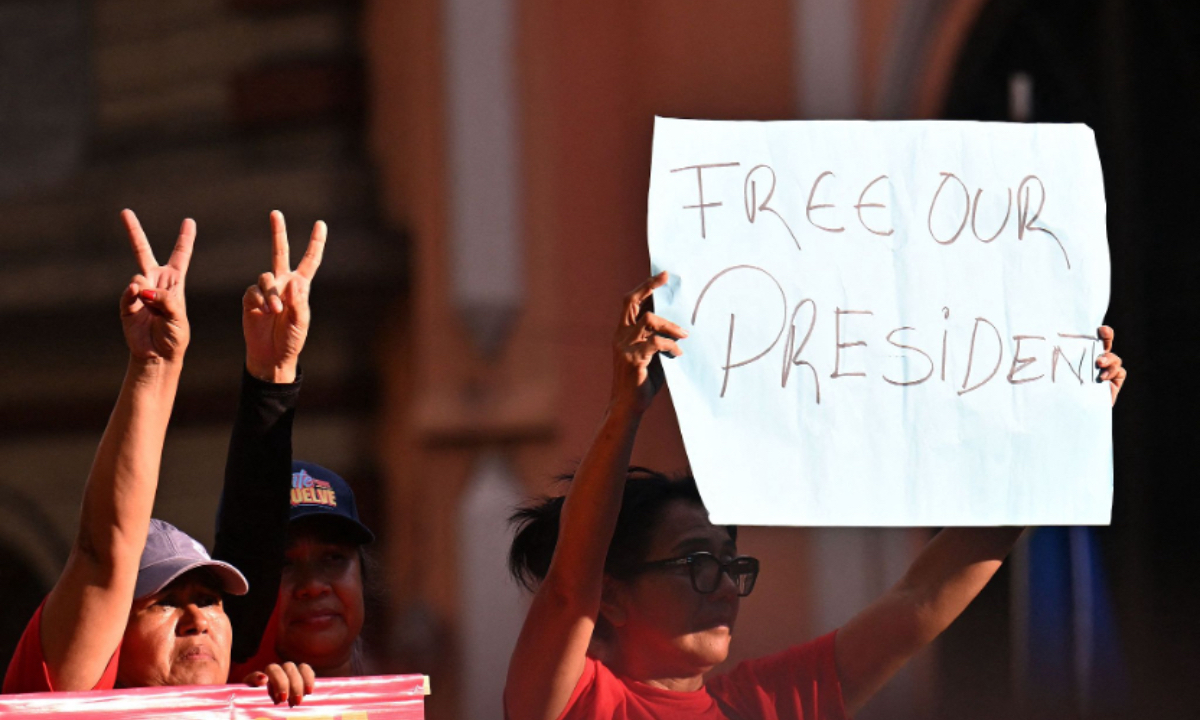
A supporter of Venezuela's President Nicolas Maduro displays a banner that reads "Free our President" during a demonstration in Caracas on January 4, 2026, a day after he was captured in a US strike. Nicolas Maduro's congressman son called on January 4, 2026, for Venezuelans to take to the streets following his father's seizure by US forces and transfer to a New York jail. Photo: VCG
After launching a surprise attack on Venezuela on Saturday and forcibly seizing Venezuelan President Nicolas Maduro and his wife, US President Donald Trump on Sunday (local time) turned his sights on three other Latin American countries — Cuba, Colombia, and Mexico — issuing threats against them.
Analysts widely believe that a major objective of US actions against Venezuela is to create a “chilling effect” in order to deter regional countries and strengthen US dominance in the Western Hemisphere.
However, can this series of US moves really “frighten” Latin America, pushing more countries in the region to “shift to the right” or even “pivot toward the US”? The answer may not be so simple, nor is it necessarily unfolding as smoothly as Washington expects.
According to publicly available media reports, after using force against Venezuela, Trump on Sunday once again threatened Colombian President Gustavo Petro while traveling aboard Air Force One from Florida back to Washington, saying that Petro “is not going to be doing it very long.”
Asked directly whether the US would pursue a military operation against the country, Trump answered, "It sounds good to me."
Later, the president said that Cuba is “ready to fall.” He also indicated that Cuba could become a topic of discussion as part of broader US policy in the region, according to media reports.
Earlier Saturday, Trump told Fox News' "Fox & Friends" that "something's going to have to be done with Mexico" in response to a question about America's southern neighbor, Axios reported.
Trump went on to allege that Mexican President Claudia Sheinbaum isn't running her country, but rather that drug cartels control the nation, according to the US media report.
"Today it's Venezuela, tomorrow it could be anyone else," Chilean President Gabriel Boric said on Saturday, following the US use of force against Venezuela, which captured the genuine concerns of many Latin American nations. Multiple Latin American countries publicly condemned the US military action against Venezuela, called for adherence to the UN Charter, and witnessed the emergence of protests opposing the US.
Ben Norton, an independent American investigative journalist who has traveled extensively across Latin America, visited Venezuela multiple times, and focuses on US-Latin American relations, told Global Times on Monday that US threats against other Latin American countries are not merely rhetorical, but represent a real risk that could translate into concrete action.
He explained that the US 2025 National Security Strategy shows Washington’s desire to control Latin America’s natural resources and key strategic infrastructure. Against this backdrop, the US attack on Venezuela may not be limited to Venezuela itself; rather, its true intention could be to reshape the political balance of the entire region, creating conditions for the US to establish hegemonic dominance in Latin America and gain control over its resources and infrastructure, Norton noted.
A series of current signs suggest that the US may be reviving a policy logic from 200 years ago — the Monroe Doctrine — under which it believes it has the right to determine the political direction of all of Latin America, Norton said. In addition to military means, he noted, the US may also intervene in Latin American politics through methods such as election interference, adding that given that major elections will be held this year in Brazil and Colombia, there is a possibility that US involvement in regional affairs could further intensify.
The US surprise attack on Venezuela has shown all Latin American governments that failure to respond “swiftly, fully, and unequivocally” to US political demands could result in high-pressure punitive measures, including “regime change” and “targeted elimination,” Pan Deng, director of the Latin America and Caribbean Region Law Center of China University of Political Science and Law, told the Global Times. He noted that this form of deterrence has generated widespread and intense security fears and sovereignty anxieties among Latin American leaders. “Today it is Venezuela; tomorrow it could be ourselves” has likely become a common psychological assessment across the region, Pan noted.
However, under the same set of threats, Latin American countries have shown divergent responses. Pan explained that, at present, left-wing governments have generally chosen to openly oppose the US move and express mutual support, emphasizing sovereignty and opposing interference. Centrist forces, while worrying about the spillover of intervention, are also wary of US pressure, adopting a relatively cautious posture and facing a “dilemma.” Pro-US forces, meanwhile, tend to keep a low profile and observe quietly, prioritizing the stabilization of their relations with the US, Pan said.
“The US attack on Venezuela has, in effect, reshaped the psychological bottom line of Latin American countries in their dealings with the US. From now on, safeguarding sovereignty and security will rise to the top of the decision-making agenda for the vast majority of countries in the region,” Pan believed.
However, he stressed that this by no means implies that all Latin American countries will “pivot toward the US.” On the contrary, countries seeking strategic autonomy are likely to strengthen their national defense readiness, border controls, and risk-prevention measures, while also attempting to coordinate positions through regional and multilateral mechanisms in order to reduce the risks of facing pressure alone.
From a longer-term perspective, the US practice of frequently resorting to threats of “regime change” and “targeted elimination” is unlikely to truly consolidate its long-term influence; instead, it may trigger systemic backlash. According to Pan’s analysis, at the level of political elites, this incident has prompted decision-makers in Latin America to more clearly recognize that once a country becomes strategically subservient to external powers, it not only loses sovereignty and policy autonomy, but may even find its political security itself impossible to guarantee. This sobering reality could push more countries to reassess their relations with the US and shift toward more independent and diversified foreign policy approaches.
“From a societal perspective, ordinary people will also gain a more direct understanding of how US hegemony operates through this incident. Over the long term, once such perceptions spread among young people, intellectual circles, and the broader public sphere, they may provide a wider social foundation for left-wing and progressive political forces,” he said.
In less than a year, Latin America has transformed from a perpetual backwater of US grand strategy to one of its main theaters, Politico said on Sunday.
Even small powers don’t like to be dictated to, and if the pressure gets too intense or if the demands become intolerable, they may choose to enact strategies of hedging or outright balancing to defend their own security interests, Politico said.
It would be the height of irony, then, if Trump’s military operation in Venezuela winds up complicating his own grand strategy over the long term, Politico added.
A US diplomat wo has been working in Latin American countries including Venezuela said in the report that regime change and nation rebuilding are extremely difficult, prolonged and require much more than military supremacy.
If the US does not achieve a democratic transition in Venezuela, if it gets bogged down like in Iraq and Afghanistan and is distracted from other hemispheric issues, it will have lost its big bet on regime change in Venezuela, Politico reported.
Longer term, Latin countries will reassess their very limited ability to deter US military attacks; a generation from now, the region may be less beholden to the US and have more, not fewer, links to extra-regional players, the US diplomat said in the Politico report.
This is a watershed moment for US relations with Latin America, a new “Monroe Doctrine” era, he said.
In Pan’s view, the US action against Venezuela this time is likely to resemble the 1999 Panama incident, becoming an “ignominious footnote” in the US history in the Western Hemisphere for decades to come, or even longer. “It will be written into textbooks, repeatedly studied by scholars, and frequently cited by social movements, becoming a landmark event that reminds Latin American peoples to remain vigilant against external interference and to uphold regional autonomy,” he noted.
“In this sense,” he concluded, “while US hardline measures may create shockwaves in the short term, in the long run they are more likely to push Latin America toward a clearer consensus on sovereignty and a stronger anti-hegemony awareness, and to provide new momentum for regional integration and multipolar development.”
RELATED ARTICLES