Translators' Voices: China-proposed four global initiatives reveal a clear vision of governance
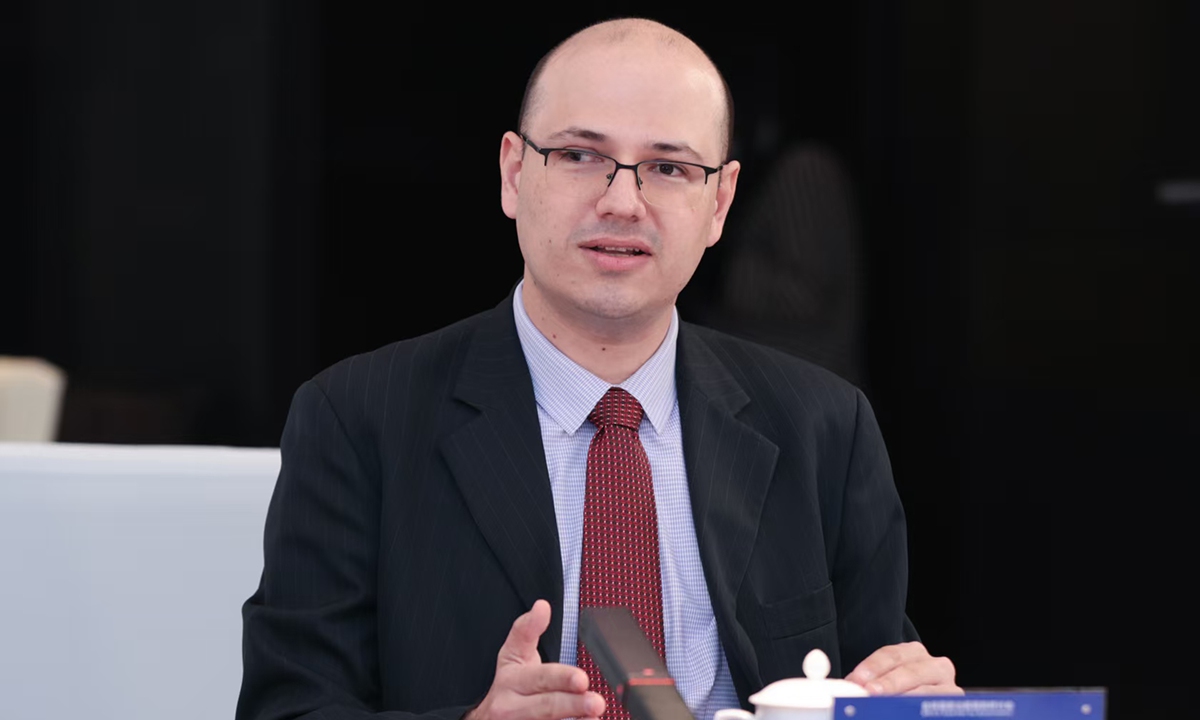
Rafael Zerbetto Photo: Courtesy of Zerbetto
At the "Shanghai Cooperation Organization Plus" Meeting in North China's port city of Tianjin in September 2025, Chinese President Xi Jinping formally proposed the Global Governance Initiative. With that proposal, the Global Development Initiative (GDI), the Global Security Initiative (GSI), the Global Civilization Initiative (GCI) and the Global Governance Initiative (GGI) together form a package of global public goods that China offers as a response to address global challenges.
The GDI provides the material foundation; the GSI safeguards a peaceful environment; the GCI builds a consensus of values; and the GGI supplies institutional and procedural guarantees.
Through these reflections on the questions of "what kind of world to build and how to build it," President Xi has established a comprehensive framework for action. This framework drives the practice of building a community with a shared future for humanity, contributing Chinese wisdom and solutions to the preservation of world peace and development, and the advancement of human civilization.
Because of the timing of its publication, the book series Xi Jinping: The Governance of China fully documents the conceptual depth and practical progress of the GDI, GSI and GCI. In Volume V of the series, Chapter 15 is titled "A community with a shared future for humanity." Volume V also contains multiple references to the idea of "global governance." The four initiatives should therefore be read as an integrated whole. Viewed as a unified framework, the four initiatives form a "four-in-one" interactive structure: development as the foundation, security as the guarantee, civilization as the bond, and governance as the coordinating mechanism - all serving the overarching objective of building a community with a shared future for humanity.
In the 19th installment of the special series "Decoding the Book of Xi Jinping: The Governance of China," the Global Times (GT), along with the People's Daily Overseas Edition, continues to invite Chinese and foreign scholars, translators of Xi's works, practitioners with firsthand experience, and international readers to delve into the logical connections between the four global initiatives and the vision of a community with a shared future for humanity, and to discuss their practical significance and contemporary value.
In the 19th article of the "Translators' Voices" column, GT reporters Li Aixin and Ma Ruiqian interviewed Rafael Zerbetto (Zerbetto), a Brazilian expert at China International Publishing Group and a recipient of the Chinese Government Friendship Award. Zerbetto was a member of the translation team of the Portuguese editions of Xi Jinping: The Governance of China.
GT: In volume V of Xi Jinping: The Governance of China, President Xi pointed out that "we in all countries must have a correct understanding of our world, our history, and our overall interests, and we must act to translate the vision of a community with a shared future for humanity into reality." From the GDI, to the GSI, the GCI and most recently the GGI, the four global initiatives form an interconnected and mutually reinforcing framework, and can be regarded as the Chinese solution for building a community with a shared future for humanity. How do you view the clear logic or supporting relationship among the four global initiatives? How do they constitute a complete conceptual system?
Zerbetto: We must understand the four global initiatives in the context of China's development as a world power. Now, for the first time we will see an ancient civilization with values and a mind-set distinct from those of the West starting to lead the world. For this reason, everyone is trying to understand what to expect from China and the four global initiatives it proposed. Together, all four initiatives signal essential values and guidelines that China wants to share with the world.
The four global initiatives share the same idea of promoting win-win cooperation, mutual understanding, mutually beneficial exchanges and common development. They support and complement each other, and together can be regarded as a framework that allows other countries to better understand China's philosophy on global governance and what we can expect.
The four global initiatives unfold like a scroll - revealing a clear vision of governance built on development, safeguarded by security, enriched through civilizational dialogue and perfected in shared destiny, beckoning the world to co-author a future of mutual prosperity.
GT: In volume V of Xi Jinping: The Governance of China, regarding GCI, President Xi emphasized that "no one country should impose its own values or models on others or stroke ideological confrontation." What does this mean in practical terms for other developing countries? Compared with initiatives proposed by some Western countries, why do you think the four global initiatives are better positioned to earn the trust of developing countries? What new ideas and impetus have been provided for other developing countries to explore their own paths of modernization?
Zerbetto: Most developing countries share a common history of exploitation, most of them were colonies in the past, forced to adopt the language, culture and values of the colonizer. In 2025, as we celebrated the 70th anniversary of the Conference of Bandung, we noticed that the spirit of Bandung has not yet been fulfilled. Although many developing countries are no longer colonies, their economic structures remain essentially unchanged, and production activities are not entirely driven by the genuine needs of their own development.
Every time a country finds an independent development path focused on its reality and needs, some Western countries tend to "export" their "freedom and democracy." We saw this in Brazil in 1964, when a US supported dictatorship was established to prevent Brazil from trading with socialist countries. We saw it again on January 3 this year, when the US sent troops to forcibly take control of Venezuelan President Nicolás Maduro and his wife and transport them out of the country - an act that clearly violated international law, basic norms of international relations, and the purposes and principles of the UN Charter. What we are witnessing is regime-change pressure exerted by the US at an unprecedented level.
Global South countries do not want externally imposed governance models. They want to explore and develop their own paths, a basic right of every independent country.
In short, while some Western initiatives treat the Global South countries as "children" who should do as they are told, China truly recognizes the self-determination of Global South countries, and that they have to solve their problems independently rather than being tutored by foreign powers.
Taken as a whole, the four global initiatives remind us that the world should not be a one-man show dominated by the strongest, but a rules-based and democratic system, with effective mechanisms to promote the peaceful settlement of disputes, safeguard the rights of all countries and advance mutually beneficial cooperation rather than zero-sum games, while allowing every country to explore its own development path.
China's four global initiatives are like sunshine, trusting each place to grow the crop that is best suited to its own soil.
GT: In the series of Xi Jinping: The Governance of China, President Xi, when discussing the GDI, the GSI and the GCI, repeatedly stressed the need to "implement the UN 2030 Agenda for Sustainable Development" and to uphold "the international system with the UN at its core." On September 1, 2025, President Xi proposed the GGI. The Concept Paper on the GGI notes that "to reform and improve global governance does not mean to overturn the existing international order or to create another framework outside the current international system." How do you view the four global initiatives as a means of complementing and improving the existing international order, rather than seeking to subvert or replace it?
Zerbetto: Let's take the BRICS New Development Bank as an example: It was created by BRICS not to be an alternative to the World Bank, IMF and other institutions, but simply to be a complementary platform focused on financing the development of the Global South, providing credit under conditions adapted to the reality of those countries, but never confronting other institutions.
BRICS itself is not an alternative to the UN or G20, just another mechanism that coexists with the other ones and can complement them.
The four global initiatives do not confront the existing international order either. They propose improvements such as respecting the right of each country to explore its own development path and promoting exchanges and cooperation focused on mutual benefits.
GT: The chapter "Build a Just World of Common Development" in volume V of Xi Jinping: The Governance of China pointed out that "China will always be a member of the Global South, a reliable long-term partner of fellow developing countries, and a doer and go-getter working for the cause of global development." Through concrete cooperation projects across different fields, how have the four global initiatives responded to developing countries' real needs for lasting peace, security, shared prosperity, and openness and inclusiveness?
Zerbetto: The four global initiatives vividly echo the collective aspirations of the Global South and safeguard its shared interests. Western support to Africa usually comes through NGOs focused on educational campaigns on personal hygiene, environmental education, reducing food waste. These are all important, but they do not promote economic development. China, on the other hand, built infrastructure such as hospitals, airports, railways, industrial parks and ports, upgrading the local business environment and contributing to adding value to local products.
In the face of profound injustices wrought by developmental imbalances, the GDI delivers a series of pragmatic collaborations - offering the Global South a truly fresh alternative: an efficient blueprint for equitable progress. For instance, in Latin America, while some Chinese companies are investing in the industrial transformation of Bolivian lithium, other Chinese companies are already producing electric vehicles in Brazil, and this is just an example of how Chinese companies contribute not only to adding value to local production, but also to integrating industrial chains of different countries, promoting regional integration.
Likewise, amid frequent turmoil and security crises, the GSI champions the principle that "security is indivisible." China is collaborating with nations worldwide to build a world where security benefits all.
In the face of escalating civilizational clashes and deepening divisions, the GCI boldly calls for equality, mutual learning, dialogue and inclusiveness. On platforms like BRICS, the SCO and ASEAN, the flowers of cultural exchange are blooming vibrantly, illuminating one another.
Confronting the glaring fairness deficit in global governance, the GGI firmly advocates that all countries should have the right to participate equally, make decisions equally and benefit equally in the global governance process - echoing precisely the shared aspirations of the Global South.
The most striking hallmark of the four global initiatives is their unwavering commitment to genuine multilateralism. In all, they inject strong confidence and momentum into the Global South's pursuit of multilateral cooperation, together ushering in a new era of peace, development, fairness and justice.
RELATED ARTICLES