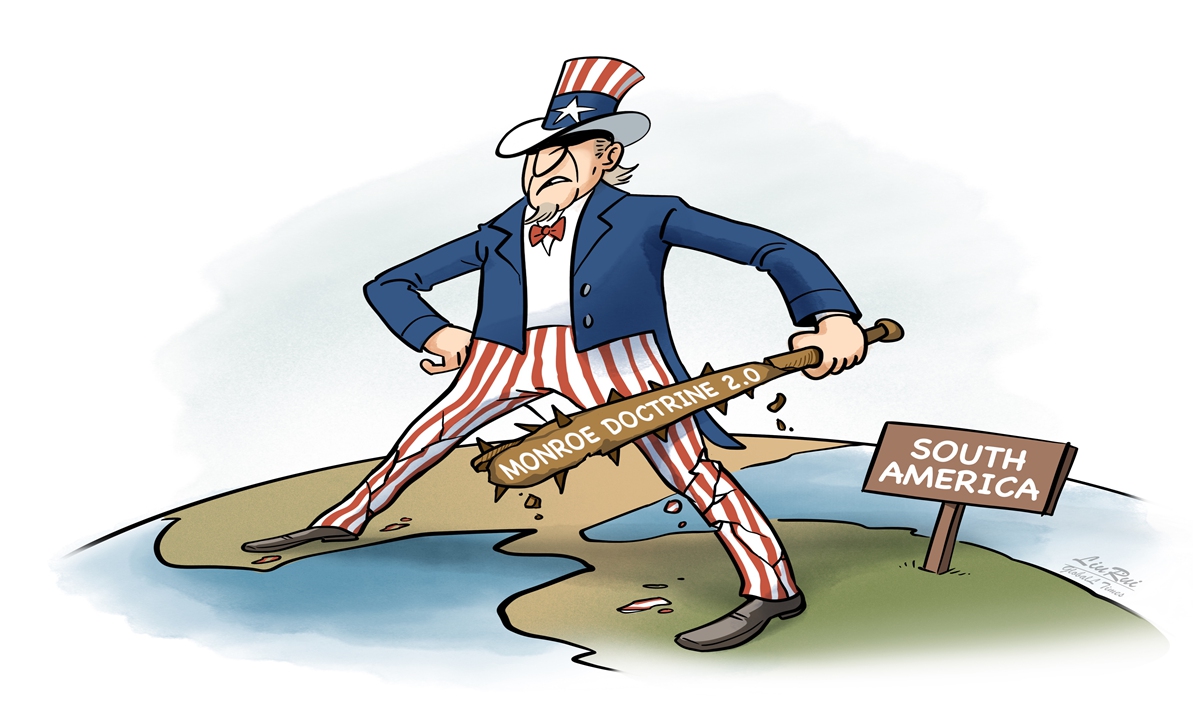
Illustration: Liu Rui/GT
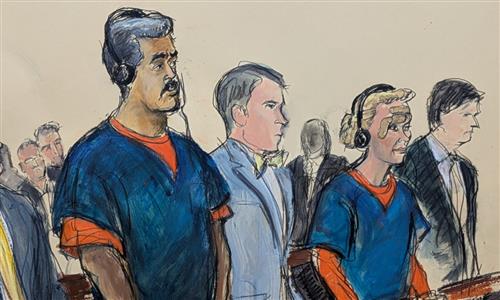
The dawn of January 3, 2026 marked a dramatic escalation in US foreign policy when American special forces, backed by airstrikes involving over 150 aircraft, raided Caracas and seized Venezuelan President Nicolás Maduro and his wife Cilia Flores. The US pledges to "run" Venezuela until a "safe, proper and judicious transition" has been achieved. This operation, dubbed "Operation Absolute Resolve," echoes centuries of US imperial interventions in Latin America, reviving the Monroe Doctrine in a modern guise dubbed the "Donroe Doctrine." Yet, as history demonstrates, such actions often become a "rod for America's own back" - a self-inflicted burden of instability, resentment and strategic overreach that undermines US interests far more than it secures them.
The Monroe Doctrine, proclaimed in 1823 by the then president James Monroe, warned European powers against meddling in the Western Hemisphere, ostensibly to protect nascent republics but effectively asserting US primacy. Theodore Roosevelt's 1904 Corollary expanded this into "gunboat diplomacy," justifying interventions to enforce stability and debt repayments, as seen in the 1902-03 naval blockade of Venezuela by the UK, Germany and Italy - with tacit US approval - to collect debts. This episode, which bombarded Venezuelan ports, foreshadowed a pattern: foreign powers using economic pretexts to exert control, often over resources like oil, which would later define US-Venezuela relations.
Cold War-era echoes are even more pronounced. The US backed dictators like Venezuela's Marcos Pérez Jiménez in the 1950s, providing CIA assistance amid torture and repression, to safeguard oil interests against perceived communist threats. Interventions in Guatemala (1954), the Dominican Republic (1965), Chile (1973) and Grenada (1983) followed similar scripts: Ousting leftist leaders under anti-communist banners, only to install regimes that bred long-term chaos and anti-US sentiment. The 1989 invasion of Panama, which captured Manuel Noriega on drug charges, offers the closest parallel to Maduro's fate - yet it left Panama economically dependent with migration issues unresolved, much like the Venezuelan refugee crisis today. These actions, justified as defending democracy or combating narcotics, often masked hegemonic control, entrenching cycles of intervention and backlash.
The 2025 US National Security Strategy (NSS) formalizes this revival through the "Donroe Doctrine." Venezuela, with the world's largest oil reserves, serves as the doctrine's first test case. The NSS prioritizes the region for direct US military intervention over Asia, deploying naval forces to curb migration and trafficking. Furthermore, it views instability like Venezuela's as a direct threat to US security.
The January 3 intervention embodies these echoes. Months of planning, including CIA tracking and troop rehearsals on a mock Maduro compound, culminated in strikes disabling air defenses, jamming the grid and extracting the couple via the USS Iwo Jima.
Casualties reached at least 80, mostly Venezuelan security forces, no US forces were killed and there were "few" injuries. Venezuelan acting president Delcy Rodríguez's changing attitude toward the US from defiance to seeking collaboration suggest internal fractures, as well as the risk of guerrilla resistance from Chavista militias.
Herein lies the "rod for America's own back." Historical interventions have consistently boomeranged: Panama's capture of Noriega didn't end drug flows; Iraq's 2003 invasion, justified by dubious WMD claims, cost trillions, thousands of lives and US credibility, fostering ISIS and regional instability. Venezuela risks similar quagmires - prolonged occupation amid armed opposition, exacerbated migration (already straining neighbors), and humanitarian crises from strikes causing blackouts and deaths. Global backlash is swift. Domestically, there are Americans fearing endless wars and taxpayer burdens. Threats of further strikes to pressure post-Maduro leaders only heighten escalation risks.
Some critiques frame it as resource imperialism, punishing Venezuela's socialist experiment while ignoring internal causes like corruption. Conservatives defend it as pragmatic against threats, yet acknowledge parallels to failed nation-building. With reasonable assurance, destabilizing consequences loom: entrenched resistance, allied pushback and multipolar shifts accelerating US decline. US' moves, while tactically bold, repeat historic follies, turning hemispheric dominance into a costly entanglement that weakens America more than its adversaries. In reviving the Monroe Doctrine, the US risks forging its own chains in a world no longer tolerant of a unilateral empire.
The author is an adjunct professor at the Queensland University of Technology, and a former advisor to Kevin Rudd, former Australian prime minister. opinion@globaltimes.com.cn
RELATED ARTICLES