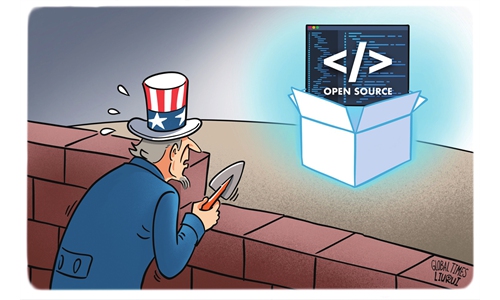
Illustration: Chen Xia/GT
The Consumer Electronics Show (CES), widely regarded as the annual barometer of the global tech industry, is being held from Tuesday to Friday in Las Vegas, the US. From sci-fi-like wearable robots and consistently popular AI glasses to new energy vehicles and smart healthcare solutions that are reshaping everyday life, the presence of Chinese enterprises has drawn widespread interest.Xiang Ligang, director-general of the Zhongguancun Modern Information Consumer Application Industry Technology Alliance, a telecom industry association, told the Global Times on Tuesday that, based on his observations, Chinese companies stood out most at this year's CES in the field of artificial intelligence, particularly in smart robotics and intelligent vehicles.
A wave of Chinese AI hardware and humanoid robot exhibitors lined up at the show to showcase products aimed at moving AI from lab concepts to commercial reality, the Global Times has learned. South Korean media outlet the Korea JoongAng Daily noted that 149 Chinese companies participated in the "robotics" category this year, accounting for about 25 percent of the total 598 exhibitors in that field.
CES reflects the world's close attention to China's technological innovation. However, the development of Chinese tech companies has not been smooth sailing. According to Reuters, Italy's antitrust authority has ended an investigation into the Chinese AI system DeepSeek for allegedly failing to warn users that it may produce false information, agreeing to binding commitments as a condition for closing the case on Monday. This case highlights the challenges Chinese tech companies face overseas.
As China rises rapidly in the technology sector, some countries claim that China's advances in new energy, artificial intelligence, and other high-tech fields would deliver a "more severe impact" on the global economy than that of the traditional manufacturing era. Such narratives are essentially a continuation of Cold War thinking, ignoring the substantial dividends and win-win opportunities that China's development brings to the world.
At the beginning of 2025, amid a surging wave of artificial intelligence, DeepSeek made a strong mark in the history of global AI development through breakthroughs in its open-source large language model, DeepSeek-R1, while inviting developers worldwide to jointly build its ecosystem. In terms of tech going global, Chinese brands have also delivered strong performances. Chinese robotic vacuum cleaners have become the cleaning tool of choice for many middle-class households worldwide. Lawn-mowing robots have emerged as a new growth segment in the smart cleaning market, with Europe and the US as their core markets. Products such as DJI drones and Insta360 cameras have also earned widespread acclaim internationally.
China's tech products are not confined to cloud-based laboratories; they are rapidly moving into large-scale commercial application, demonstrating strong vitality in global markets. DJI's agricultural drones now serve agricultural spraying operations in more than 100 countries and regions, covering over 300 crop varieties and helping farmers worldwide tackle practical challenges. Meanwhile, an agricultural network project jointly developed by ZTE and Liberian enterprises has enabled more than 580,000 users in remote areas to access 2G and 4G services, building digital "bridges" that help local communities cross the digital divide. This is the kind of opportunity that Chinese technology brings.
More broadly, in its engagement with the world, China's tech sector has consistently sought to act as a constructive force in global technological innovation and industrial development - offering cooperation opportunities rather than exclusionary threats. By actively participating in global open-source ecosystems, delivering high-quality and cost-effective innovative products, and promoting localized R&D and production overseas, Chinese companies have deepened integration with the world at the technological and supply-chain levels, while also fostering knowledge sharing, market vitality, and job creation in practice. This has generated multi-level win-win outcomes spanning technology, industry, business, and local communities.
Adhering to openness and cooperation, embedding development locally, and complying with international rules remain key to the steady and sustainable global expansion of Chinese companies. In the ongoing wave of technological change, China has consistently demonstrated its determination to turn development challenges into innovation opportunities and to make technological breakthroughs benefit global progress as a whole.
RELATED ARTICLES