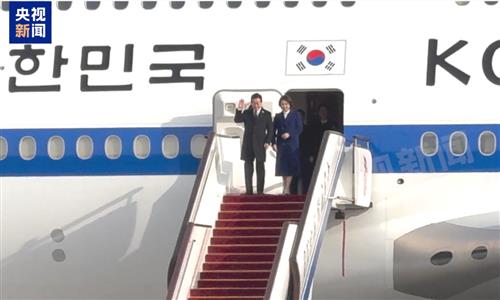
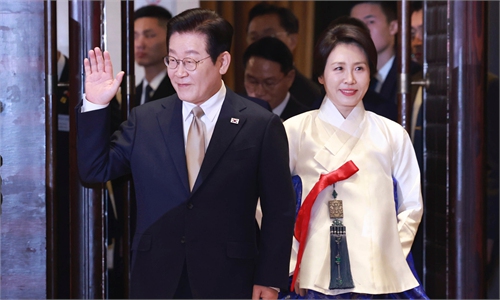
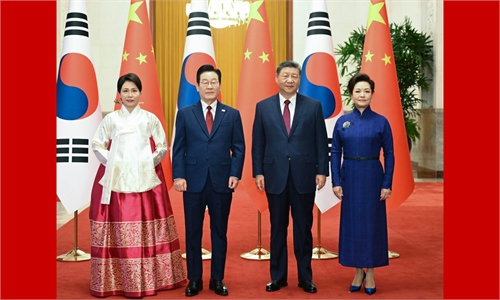
ROK President begins Shanghai visit, scheduled historical site visit in spotlight amid attention of Japanese media
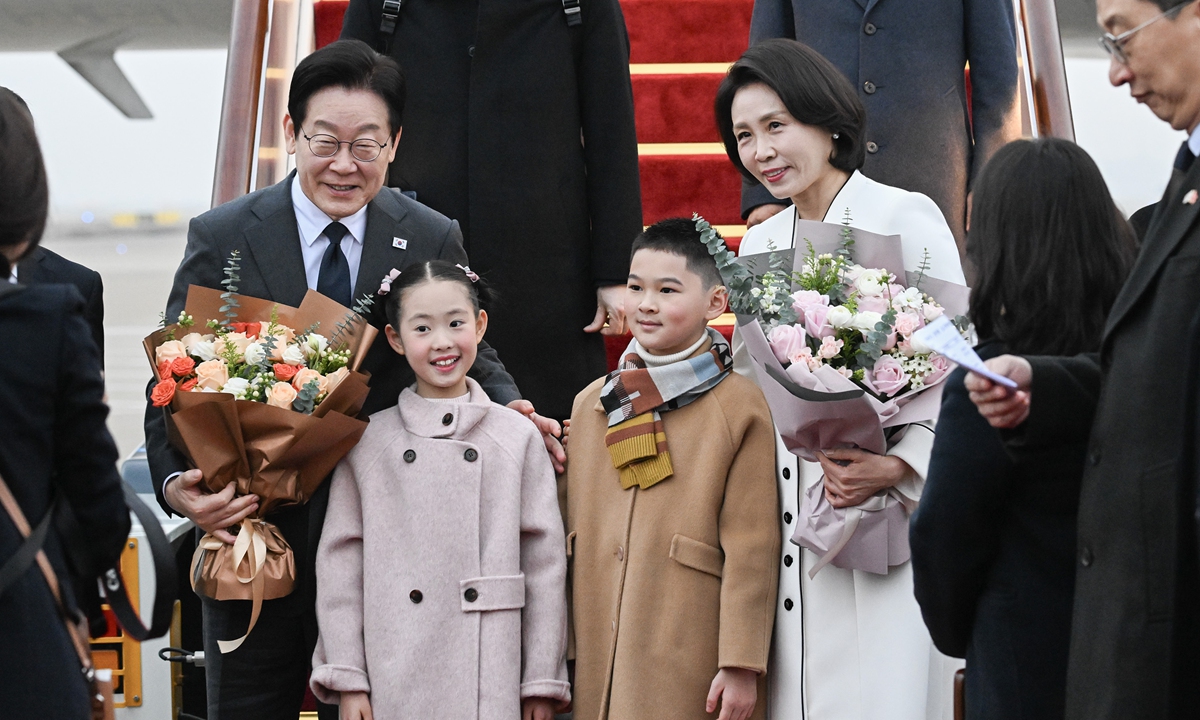
South Korean President Lee Jae-myung and First Lady Kim Hea-kyung pose for photos with children on January 6, 2026 after they arrived at Shanghai Pudong International Airport. Photo: VCG
During his meeting with Lee, Li pointed out that China and the ROK are important economic and trade partners to each other, with close economic ties and industrial and supply chains deeply interwoven. The two sides should abandon the zero-sum mindset and provide more certainty for each other's development through strengthened cooperation, Li said, the Xinhua News Agency reported.
China and the ROK should work together to uphold multilateralism and free trade, and safeguard international fairness and justice, to contribute to the promotion of peace, stability and development in the region and the wider world, Li said, according to Xinhua.
For his part, Lee said that the ROK attaches great importance to its relations with China, and is willing to respect each other's core interests, enhance bilateral dialogue and exchanges, and deepen mutually beneficial cooperation in various fields such as economy and trade, Xinhua reported.
Following the meeting, Lee posted a photo and a message on his X account in both Chinese and Korean. He wrote that as this was his third meeting with Premier Li, he approached the talks "with the feeling of meeting a close friend," which made their exchanges on the future direction of bilateral relations "more candid and profound."
During meeting with Lee, Zhao, chairman of the Standing Committee of China's National People's Congress (NPC), said China is willing to work with the ROK to implement the important consensus reached by the two heads of state, consolidate good-neighborly friendship, deepen mutually beneficial cooperation, shore up the foundation of public opinion, and promote the stable and long-term development of China-ROK strategic cooperative partnership, according to Xinhua.
Zhao added that China's NPC is willing to maintain the sound momentum of high-level exchanges with the ROK National Assembly, strengthen communication and cooperation on multiple levels and in various fields, and provide legal guarantees for mutually beneficial cooperation between the two countries, Xinhua reported.
Lee said the ROK is willing to deepen cooperation with China in economy, culture and other fields, step up exchanges between legislative bodies and political parties, and enhance non-governmental exchanges to promote the development of bilateral relations, according to Xinhua.
In another post on X, Lee wrote in Chinese and Korean that he had met with Zhao and confirmed their shared willingness to further promote the mature development of ROK-China relations. He said Zhao has long contributed to advancing parliamentary exchanges, economic cooperation and bilateral friendship, making the meeting particularly meaningful.
Lee continued his state visit to China by traveling to Shanghai on Tuesday afternoon. Analysts noted that this leg of the trip to China's economic powerhouse will likely place greater emphasis on strengthening economic cooperation and people-to-people and cultural exchanges.
Chen Jining, secretary of the CPC Shanghai Municipal Committee also met Lee on Tuesday. During their meeting, Chen extended a warm welcome to President Lee and his delegation on their visit to Shanghai, saying that China and the ROK are close neighbors that cannot be moved away and partners whose cooperation cannot be separated, according to The Paper.
Lee thanked Shanghai for its warm reception and said the city serves as a key hub for exchanges between the ROK and China. He also expressed appreciation for Shanghai's preservation of the site of Provisional Government of the Republic of Korea.
On Wednesday, Lee will attend the Korea-China Venture Startup Summit before visiting the former site of the Provisional Government of the Republic of Korea, KBS reported.
As China's economic center, Shanghai offers tremendous opportunities for Korean enterprises. It is also one of the most important outbound travel destinations for South Koreans, Dong Xiangrong, a senior research fellow at the National Institute of International Strategy under the Chinese Academy of Social Sciences, told the Global Times on Tuesday.
Shanghai, where the Provisional Government of the Republic of Korea seated during the period of Japanese colonial rule, is also a city that bears witness to and preserves the history of the two nations' joint resistance against Japanese aggression.
In Shanghai, Lee will mark key historical milestones - the 150th anniversary of the birth of independence fighter Kim Koo and the 100th anniversary of the establishment of the building of the Provisional Government of the Republic of Korea, according to The Korea Times.
"Lee visits Shanghai independence movement sites, seen as signaling historical stance before Japan trip," South Korean media Chosun said in a report on Tuesday.
Against the backdrop of strained China-Japan relations due to Sanae Takaichi's erroneous remarks on Taiwan, as well as Lee's upcoming visit to Japan, it serves as a clear signal that South Korea will never forget the painful history of Japanese colonization and aggression, Dong noted.
Some Japanese media outlets have continued their attention over Lee's visit to China. Nikkei claimed in a Tuesday editorial that another round of summit talks only two months after the Asia-Pacific Economic Cooperation (APEC) meeting held in Gyeongju, the ROK, was "highly unusual," and claimed to prevent China from "driving a wedge between Japan, the United States and South Korea."
The editorial also claimed that "vigilance must not be relaxed" towards ROK, even after explaining the Lee administration's "pragmatic diplomacy" that prioritizes national interests over ideology and seeks to maintain sound relations with all countries.
On Tuesday morning, Lee sharply criticized a far-right group that staged protests demanding the removal of the "Statue of Peace," a symbol of victims of the Japanese military's wartime "sexual slavery," calling it "brainless defamation of the dead."
Lü Chao, an expert on Korean Peninsula affairs at the Liaoning Academy of Social Sciences, said that China and South Korea share a historical experience of jointly resisting Japanese aggression, while Japan and South Korea still have deep disagreements over recognition of historical issues, including unresolved issues such as compensation for Korean forced laborers during the war and the "comfort women" issue, which are both grave crimes committed by Japan during its period of invasion and occupation.
Lee's itinerary leverages the shared memory of China-Korea resistance against Japanese aggression to foster emotional closeness, while also preemptively establishing a narrative framework of "historical justice" in anticipation of potential diplomatic frictions with Japan, Lü noted.
RELATED ARTICLES