Chinese foreign ministry lambasts US seizure and 'trial' of Maduro: No country should place its rules above international law
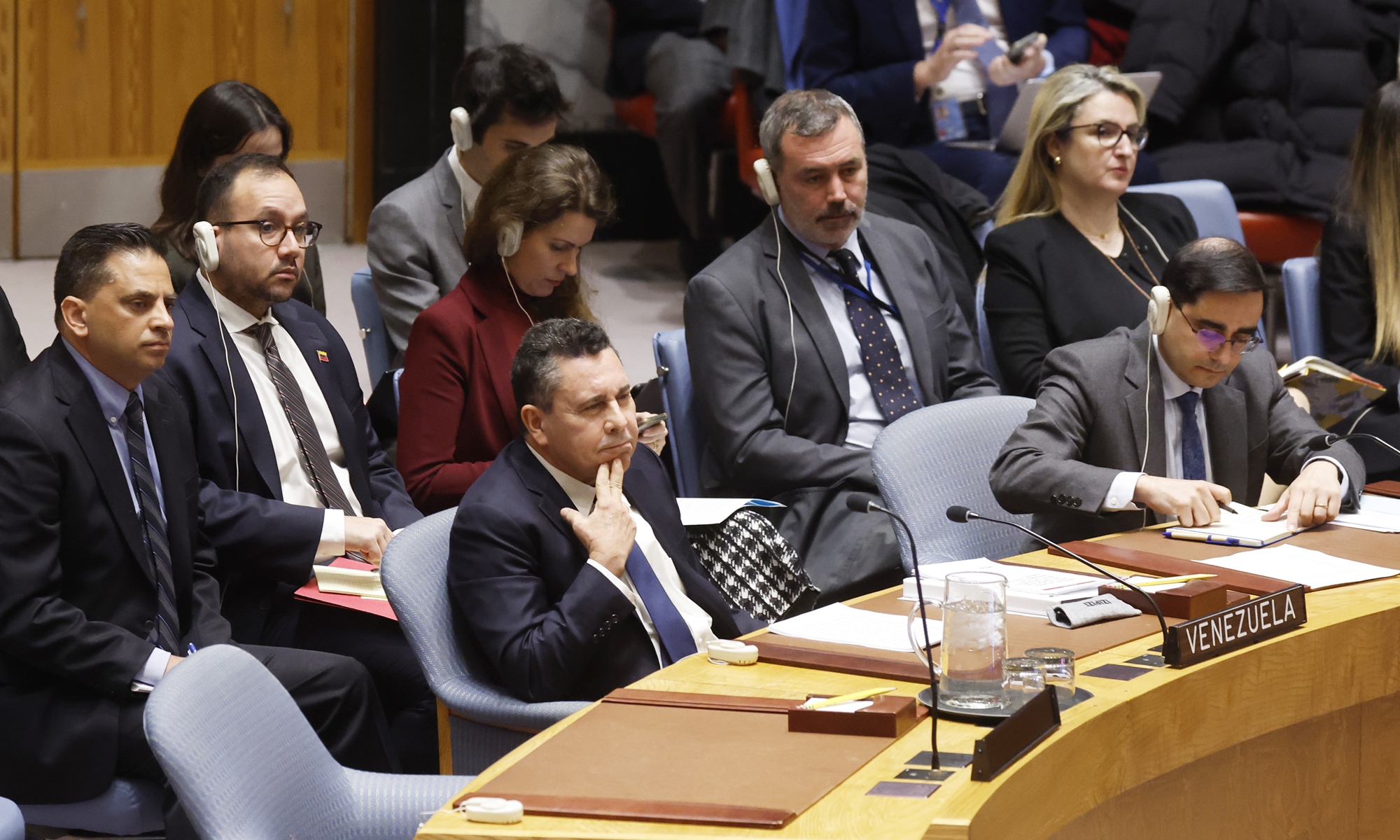
Venezuela Ambassador to the United Nations Samuel Reinaldo Moncada Acosta attends an emergency meeting on Venezuela at the UN headquarters in New York, January 5, 2026. Photo: VCG
The Chinese Foreign Ministry on Tuesday strongly condemned the US' forcible seizure of Venezuelan leader Nicolás Maduro and the subsequent "trial" against him in a US domestic court. This comes in the wake of an emergency UN Security Council meeting held on Monday, where both US friends and foes sharply criticized the American action.
"No country can act as the 'world policeman,' and no country can proclaim itself the 'international judge,'" a Chinese Foreign Ministry spokesperson slammed the US, a permanent member of the UN Security Council, for disregarding the serious concerns of the international community and wantonly trampling on Venezuela's sovereignty, security, and legitimate rights and interests.
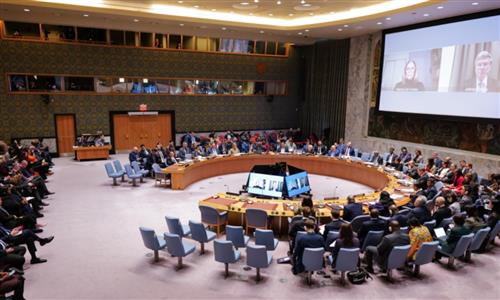
On Monday, at the UN Security Council emergency meeting, envoys from multiple countries including China, Russia and Columbia voiced their condemnation and concern of the US military action against Venezuela.
"China is deeply shocked by and strongly condemns the unilateral, illegal, and bullying acts by the United States," said Sun Lei, charge d'affaires of China's Permanent Mission to the UN. "The lessons of history offer a stark warning. Military means are not the solution to problems, and the indiscriminate use of force will only lead to greater crises," Sun said, according to the Xinhua News Agency.
Among US allies, France was by far the most outspoken at the meeting, the BBC reported. Jay Dharmadhikari, Deputy Permanent Representative of the Republic of France to the United Nations, said Maduro's taking by the US runs "counter to the principle of peaceful dispute resolution and runs counter to the principle of the non-use of force."
French President Emmanuel Macron on Monday said he "neither supported nor approved" the US military operation to grab Venezuelan leader Nicolas Maduro, a government spokesman said.
His comment clarified an initial public reaction Macron made that Venezuelans "can only rejoice" at US seizing of Maduro.
Monday's New York saw Maduro and his wife Cilia Flores making their first court appearance, during which they pleaded not guilty to drug and weapons charges.
The Guardian reported that the pair were earlier brought to the court under tight security from the notorious Metropolitan detention center in Brooklyn, whose previous residents include Jeffrey Epstein associate Ghislaine Maxwell, Mexican drug kingpin Joaquín "El Chapo" Guzmán, and the singer Diddy.
As Maduro entered the courtroom, shackled at the ankles though not at the wrists, he looked toward the jury box. Before sitting down, Maduro told the public gallery "Happy new year!" in English, the report said.
Maduro's wife had large Band-Aids on her temple and forehead. Her lawyer, Mark Donnelly, said she sustained "significant injuries during her abduction" and required medical examination for "severe bruising" on her ribs, per The Guardian.
In addition to heated media attention, netizens have also been discussing the incident. On TikTok, a netizen @Patrick Elis cast doubt on the trial, asking "Why should he plead guilty?" Another netizen @n.z.d8 commented "This is all about OIL."
The US is "creating reality TV show," a netizen @Freddie posted on X.
Chinese netizens are also closely following developments surrounding the trial.
On Tuesday, a user on Sina Weibo, an X-like platform, invoked an old Chinese proverb: "He who seeks to condemn will never lack pretexts." As of press time, that post had garnered around 700 likes.
Maduro has pleaded not guilty to all the charges he is faced with, US media reported. Four counts were listed on the indictment, including narco-terrorism conspiracy and possession of machine guns and destructive devices, BBC reported.
"I am not guilty," Maduro said in the court, "I am a decent man, I am president of my country," Maduro added, per NBC.
In response to Maduro's pleading not guilty to all charges, Chinese Foreign Ministry spokesperson Mao Ning said on Tuesday that the US has disregarded Maduro's status as a head of state, and openly indicted him at a domestic court and conducted a so-called "trial," which seriously violated Venezuela's sovereignty and seriously undermined the stability of international relations.
"No country should place its rules above international law," Mao stressed, urging the immediate release of Maduro and his wife.
Shots were fired late Monday near Venezuela's presidential palace, witnesses said, AFP reported. A source close to the government said the situation was under control, and there were unidentified drones flying over the Miraflores palace in central Caracas, and security forces opened fire in response, the source said, hours after Maduro's deputy Delcy Rodriguez was sworn in as interim president, the report said.
Wang Youming, Director of the Department for Developing Countries Studies at the China Institute of International Studies, told the Global Times on Tuesday that the condemnation from both America's "friends and foes" at the UNSC meeting clearly shows that the US has openly violated the norms governing modern international relations. At a time when Latin American countries have seen an unprecedented rise in their awareness of strategic autonomy, the US intervention can only achieve temporary success but which lacks sustainability, Wang said, "it will face strong resistance from regional countries and simultaneously fuel the surge of anti-US sentiment."
"For allies of the US, they did not expect the US to trample on international law in such a blatant manner, which has caused them to feel deep disappointment and frustration. The US' action this time has led to an all-round loss of its diplomatic assets," Sun Yanfeng, director of Latin American research at the China Institutes of Contemporary International Relations, told the Global Times on Tuesday.
Spreading concerns
The nighttime raid of Maduro and his wife set off shock waves across the globe, and prompted fears that the US could act on threats it has made to other countries.
Maduro's son Nicolas Maduro Guerra on Monday appeared before the National Assembly. He warned, "If we normalize the kidnapping of a head of state, no country is safe. Today it is Venezuela, tomorrow it could be any country that does not yield," reported Anadolu Agency.
Following the US' sudden raid on Venezuela, which triggered concerns from many countries, some defense-focused media reported that there has been a sudden surge of US aircraft to Europe, prompting speculation of future special operations in the region. The deployment comes amid the US' Venezuela takeover fueling fresh worry about a US taking over Greenland.
About a dozen oil tankers loaded with Venezuelan crude and fuel have left the country's waters since the start of the year in apparent defiance of the US government's blockade on exports, according to documents seen by Reuters and industry sources including monitoring service TankerTrackers.com, Reuters reported on Monday.
US President Donald Trump said on Monday the US may subsidize oil companies' efforts to rebuild Venezuela's energy infrastructure in a project he estimated could take less than 18 months, Reuters reported in a separate article.
The Trump administration is also planning to meet with executives from US oil companies later this week to discuss boosting Venezuelan oil production, which are crucial to the administration's hopes of getting top US oil companies back into the South American nation, per media reports.
However, American oil giants are "not sharing Trump's dream of making Venezuelan oil great again," a CNN report on Monday said. "The appetite for jumping into Venezuela right now is pretty low," one well-placed industry source told CNN on Monday. "The president's desire is different than the industry's. And the White House would have known that if they had communicated with the industry prior to the operation on Saturday."
Wang said the unwillingness to take over Venezuela's oil industry stems from several key factors: high requirements for supporting infrastructure development, the inadequacy of Venezuela's fragile power system and shortage of technical workers and manual laborers; as well as an unstable investment environment, as Venezuela's current political situation is highly uncertain and volatile.
RELATED ARTICLES