China-S.Korea business complementarity far outweighs competitiveness, business leader tells GT
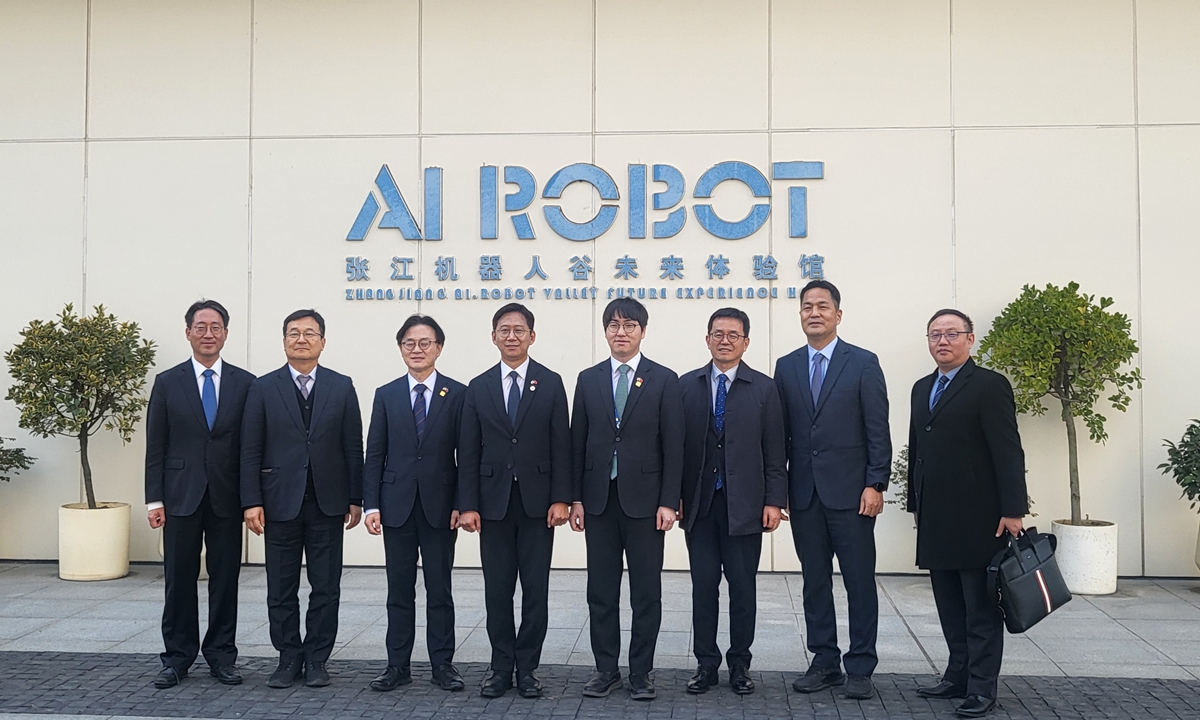
A delegation of South Korean government visits Zhangjiang AI Robot Valley in Shanghai on January 6, 2026. Photo: Courtesy of KIC China
China is continuously improving its investment and business environment by strengthening infrastructure, fostering innovation enterprises and attracting high-end talent, and this will create vast space for mutually beneficial cooperation between China and South Korea at a higher level, Kim Jong-moon, chief representative of the Korea Innovation Center (KIC China), told the Global Times in an interview on Wednesday.
On Tuesday, Bae Kyung-hoon, deputy prime minister and minister of science and ICT of South Korea, led a delegation comprised of South Korean research institutes to visit tech centers and companies in Shanghai, including the Zhangjiang Science City, the Huawei Lianqiu Lake R&D Center, the Zhangjiang Robot Valley, Shanghai Fourier Intelligence Co, and Shanghai Agibot New Creation Technology Co.
"Through the visit, we gained a more intuitive and profound understanding of China's development, particularly its technological strength and business environment," Kim said, who was a member of the delegation.
"What astonished me most during the visit is China's strong construction capacity and investment showcased in the infrastructure field," Kim said. From intricate highway network, efficient and intelligent traffic management to stable and robust power engineering, all this left a deep impression on him. These hard infrastructures not only symbolize a country's modernization, but also serve as the most fundamental and critical supporting conditions for sustainable development of scientific technologies and upgrading of industries, he said.
In addition, China's booming high-tech ecosystem demonstrates its global competitiveness. China's leading tech enterprises have not only seized leading places in their domestic market, but also shown great innovation vitality and competitive competence on the international stage, constituting the main force of China's new quality productive forces, according to Kim.
"Through our exchanges with people from all walks of life, we deeply felt the rich pool of talent that underpins China's high-tech industry. From top research staff to energetic young entrepreneurs, China boasts a massive, well-structured and highly innovative talent pool, which will provide a steady stream of intellectual support for sustained breakthroughs in technology innovation and long-term development of high-tech industries," Kim said.
Citing observations during this visit, Kim said that he believes that China and South Korea have vast room to expand cooperation.
The two countries boast the natural advantage of geographical proximity. This not only significantly reduces the cost of logistics and personnel exchange but also provides a natural physical foundation for building efficient and stable regional industrial and supply chains, he said.
Over the past 30-strong years of diplomatic relations, China and South Korea's high-tech sectors have developed an intertwined collaborative relationship. While competition exists in certain areas, their complementarity far outweighs competitiveness. The two countries have established a highly specialized and efficient division of labor across every link of key industrial chains, such as semiconductors, new-energy vehicles, and display panels, according to Kim.
Given the advantages, the two countries can deepen sci-tech cooperation by enhancing in-depth exchanges and communications between high-tech talent and researchers between our two countries.
By means of joint research and development (R&D), co-established laboratories, and mutual technological recognition, the two countries can extend their cooperation from manufacturing to high-value-added stages such as R&D design and standard-setting, which will not only help collectively mitigate the risks of technological blockades and supply chain decoupling, but also empower to make technological breakthroughs and accelerate the commercialization of scientific research, ultimately making a bigger cake, he said.
More importantly, the two countries can serve as bridgehead for each other to jointly explore global and third-party markets. On one hand, South Korea can become a "high-value gateway" for Chinese technologies, products, and services to enter developed markets. On the other hand, China's massive market, comprehensive supporting industries, and strong manufacturing capabilities can serve as a "strategic hinterland" for South Korean companies to expand their global business, particularly in deepening their presence in the Asian market, Kim said.
As a bridge and platform for China and South Korea, KIC China plays an active role in promoting substantive cooperation among innovation enterprises, research institutions and investment institutions, hoping to boost the connectivity between technological innovation and industrial ecosystem and jointly forge a future-oriented and sustainable innovation cooperation landscape in the two countries, he said.
RELATED ARTICLES