China’s measures in line with laws, fully justified: FM on Japan’s protest to nation’s export control
Japan’s protest reflects stubborn refusal to correct mistakes: expert
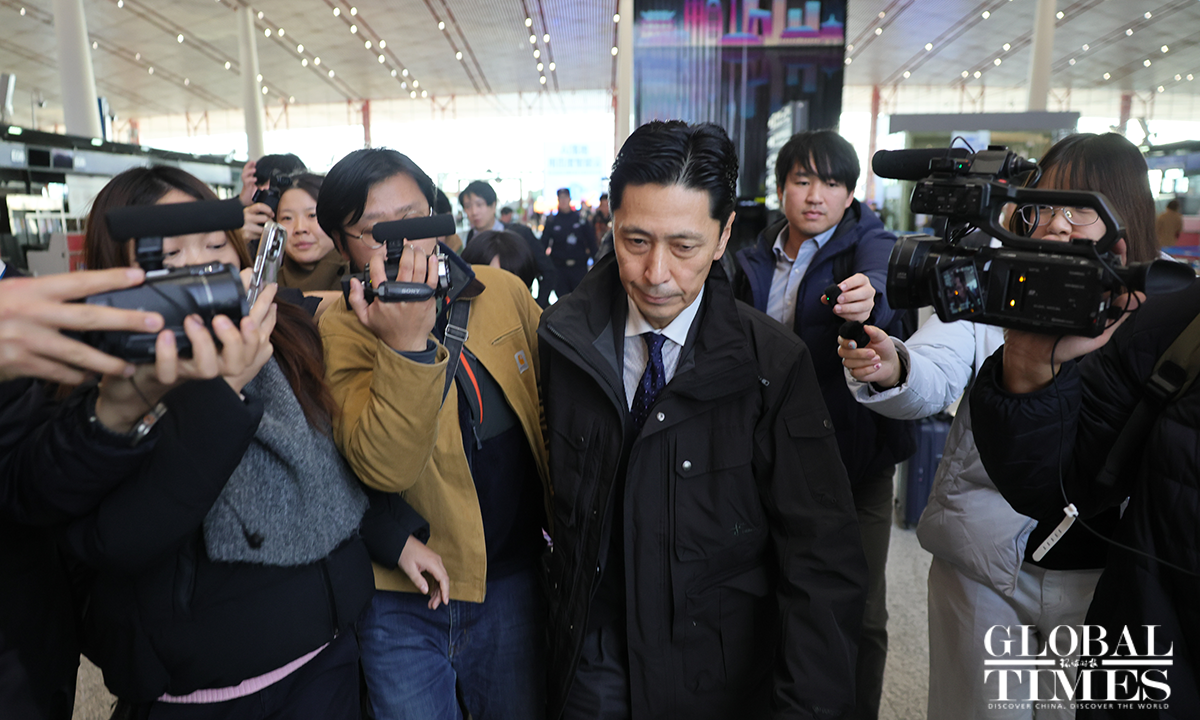
Japanese diplomat Masaaki Kanai leaves China after meeting with Chinese official. Photo: Li Hao/Global Times
With the aim of defending national security and interests and fulfilling non-proliferation and other international obligations, China took measures in accordance with laws and regulations, which are fully legitimate, justified and lawful, Chinese Foreign Ministry spokesperson Mao Ning said on Wednesday, when asked to confirm whether China's strengthened export controls on dual-use items destined for Japan include rare earths-related items, and to comment on Japan's following protest to China.
The spokesperson stressed that Prime Minister of Japan Sanae Takaichi's erroneous remarks on Taiwan violated China's sovereignty and territorial integrity, blatantly interfered in China's internal affairs, and threatened the use of force against China.
"We urge Japan to face up to the root cause of the issue, do soul-searching, rectify its wrongdoings and retract the erroneous remarks by Prime Minister of Japan Sanae Takaichi." Mao added.
China's Ministry of Commerce (MOFCOM) announced on Tuesday a decision in accordance with relevant Chinese laws and regulations to tighten export controls on dual-use items destined for Japan, citing national security and non-proliferation obligations.
However, Japan quickly reacted, demanding the withdrawal of these measures. Masaaki Kanai, director-general of the Asian and Oceanian Affairs Bureau at Japan's Foreign Ministry, who visited China last November, claimed in an official statement on Tuesday that the move was "absolutely unacceptable and deeply regrettable."
The statements by the Japanese official continue to refuse to acknowledge the serious mistakes that harm China's core interests and evade the root causes of tensions in China-Japan relations, Chen Zilei, director of the Research Center for Japanese Economics at Shanghai University of International Business and Economics, told the Global Times on Wednesday.
"Japan has neither reflected on its Taiwan-related remarks nor on its dangerous 'remilitarization' moves. Instead, it tries to mask its refusal to admit guilt with tough rhetoric," Chen added, stressing that this approach exposes the Japanese side's persistent inability to recognize its own mistakes."
The Japanese leader in November made erroneous remarks regarding China's Taiwan region, hinting at the possibility of military intervention in the Taiwan Straits.
A MOFCOM spokesperson on Tuesday criticized such comments, saying they interfered in China's internal affairs, seriously violated the one-China principle, and are extremely egregious in nature and impact, following the announcement of tightening export controls on dual-use items to Japan.
Chen said that China's countermeasure directly targets Japan's national strategy of transforming into a "war-capable state" in violation of its pacifist constitution. As a defeated World War II nation, Japan's military buildup has effectively violated the UN Charter and the postwar international order, seriously undermining security and stability in Asia, Chen added.
"From the perspective of safeguarding regional peace, China's export control on dual-use items that may be converted for military purposes is a necessary measure based on situational judgment. It is fully reasonable and legitimate, reflecting the responsibility of a major country," Chen noted.
Foreign Ministry spokesperson Mao Ning on Tuesday, responding to Japan's plan to advance revisions to three key security documents within the year, said this reflects the dangerous trend of Japan "remilitarizing" itself faster, which is bound to undermine regional peace and stability. The international community must stay on high alert.
She added that China and all peace-loving countries and people in the world should never allow Japanese right-wing forces to turn back the wheel of history or allow the revival of militarism.
Some Japanese media has expressed concern over the potential impact of the measures and the worsening bilateral relations. Japan Wire by Kyodo News, citing industry and foreign affairs experts, noted on Wednesday that the move could have wide-ranging repercussions for Japanese industries.
Kyodo News expressed concern earlier that the measure follows earlier calls to refrain from travel to Japan and represents an additional countermeasure, warning that if rare earths are included in the scope, the impact on Japanese companies could be significant.
Broad estimates show that dual-use items Japan imports from China total ¥10.7 trillion ($80.25 billion), roughly 42 percent of Japan's total goods imports from China in 2024, Bloomberg reported citing a Japanese economist. If the new controls were to apply to rare earths, Japan would take a significant hit.
The economist estimated that "If rare-earth export restrictions were to last three months, the resulting economic loss would amount to about ¥660 billion, cutting Japan's economic output by 0.11 percent."
Amid rising tensions, the heads of Japan's major business groups on Tuesday expressed hope for dialogue with China as bilateral ties remain strained, the Mainichi reported.
Speaking at a press conference, Ken Kobayashi, chairman of the Japan Chamber of Commerce and Industry, said Japan "will not close the door to dialogue to deepen a mutually beneficial relationship," while Keidanren Chairman Yoshinobu Tsutsui stressed the need to "find an opportunity for dialogue at the economic level."
With bilateral relations are now at their most serious point since normalization, Chen said that Japan's repeated challenges to China's core interests and repeated crossing of red lines are the direct cause of the ongoing deterioration and the underlying reason for harming its own economic development and destabilizing peace in the Asia-Pacific region.
"If Japan continues down the wrong path, China may take further actions to safeguard its rights. Japan will pay a heavy price for its politicians' mistakes," Chen said.
Chen emphasized that reversing the situation depends on whether the Japanese government corrects its errors, reflects on history in practice, abandons military expansion, and takes concrete actions to promote stable and healthy China-Japan relations and regional peace.
RELATED ARTICLES