US reportedly sets demands for Venezuela to pump more oil; experts say ‘anti-drug’ claims a pretext, exposing neo-colonialism
By and Published: Jan 07, 2026 03:04 PM


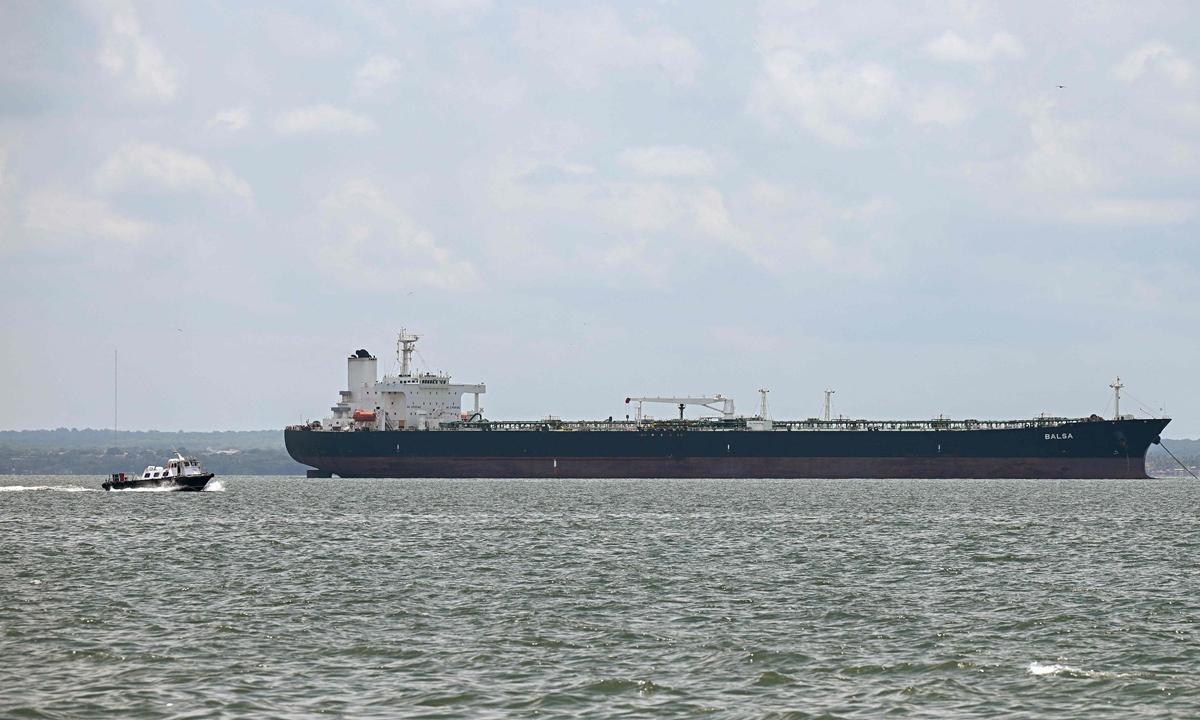
Panamanian crude oil tanker Balsa waits its turn to be loaded with crude oil at Lake Maracaibo in Maracaibo, Zulia State, Venezuela on May 9, 2025. Photo: VCG
The Trump administration has told Venezuela's interim president Delcy Rodríguez that Caracas must meet the White House's demands before being allowed to increase oil production, according to a media report citing three people familiar with the plan. The report underscores that Washington's earlier framing of its actions as "tackling drugs" largely serves as a pretext, with the seizure of Venezuela's oil resources remaining the core objective — an approach some Chinese experts describe as a form of neo-colonialism and hegemonism.An ABC News report on Wednesday cited sources as saying that Venezuela must kick out China, Russia, Iran, and Cuba and sever economic ties. Venezuela must also agree to partner exclusively with the US on oil production and favor America when selling heavy crude oil.
According to one person, Secretary of State Marco Rubio told lawmakers in a private briefing on Monday that he believes the US can force Venezuela's hand because its existing oil tankers are full. Rubio also told lawmakers that the US estimates that Caracas has only a couple of weeks before it will become financially insolvent without the sale of its oil reserves, per ABC.
In an exclusive interview with ABC News, Senate Armed Services Committee Chairman Roger Wicker confirmed that the US plan hinges upon controlling Venezuela's oil. He claimed that he did not believe it will require the deployment of US troops.
No country has the right to dictate whom another may cooperate with. Such demands reflect typical hegemonic thinking and violate Venezuela's sovereignty. For Trump administration, proposing stringent demands is a bargaining tactic designed to apply pressure and extract concessions, much like the US' approach in the tariff war, Sun Chenghao, a research fellow at Tsinghua University's Center for International Security and Strategy, told the Global Times.
Behind Washington's actions lie both economic motives and great-power rivalry. Oil is central, with the aim of securing Venezuela's resources. Also, the US seeks to curb the presence of other major powers in the Western Hemisphere, particularly China and Russia's economic ties with Venezuela, Sun said.
The latest reports underscore that the earlier rhetoric of "fighting drugs" is primarily aimed at domestic US audiences, serving the needs of domestic politics and midterm elections. Washington's actions against Venezuela — including the seizure of the country's oil — are designed to advance its own political interests and those of key financial backers, Li Haidong, a professor at the China Foreign Affairs University, told the Global Times.
Asked at a press conference on January 3 about US relations with China, Russia and Iran after the US military action in Venezuela, where all three countries have interests, Trump appeared to primarily address Beijing. "In terms of other countries that want oil, we're in the oil business. We're going to sell it to them," Trump claimed, according to a report from the Wall Street Journal.
Trump claimed that after "removing" Nicolás Maduro as Venezuela's leader, the US will rebuild the country's oil infrastructure and "we'll be selling oil probably in much larger doses."
On Tuesday, in a post on Truth Social, Trump claimed that "I am pleased to announce that the Interim Authorities in Venezuela will be turning over between 30 and 50 MILLION Barrels of High Quality, Sanctioned Oil, to the United States of America."
This Oil will be sold at its Market Price, and that money will be controlled by me, as President of the United States of America, to ensure it is used to benefit the people of Venezuela and the United States! I have asked Energy Secretary Chris Wright to execute this plan, immediately. It will be taken by storage ships, and brought directly to unloading docks in the United States," Trump claimed.
The announcement came three days after US' forcible seizure of Venezuelan leader Nicolas Maduro, and his wife in Caracas, and took them to New York, where they are charged in a federal drug-trafficking conspiracy indictment, according to a report from the CNBC News. Maduro has pleaded not guilty to all the charges he is faced with.
Trump claimed that US oil companies would end up investing billions of dollars to rehabilitate Venezuela's aging oil production capabilities, per CNBC.
A Wall Street Journal report on Tuesday said that that Trump plans to meet with representatives from the major US oil companies Chevron, ConocoPhillips, and Exxon Mobil, along with other domestic producers, at the White House on Friday "to discuss making significant investments in Venezuela's oil sector."
What the US is doing is power-based coercion — pressuring other countries to surrender their resources. It reflects a form of neo-colonialism, or hegemonism. At its core, it amounts to blackmailing other countries through superior strength, said Li.
At a regular press conference on Monday, when asked about US President Trump's remarks explicitly linking regime change in Venezuela and control of its oil reserves to US objectives,including plans for major American oil companies to enter the country, Chinese Foreign Ministry spokesperson Lin Jian said the US' blatant use of force against Venezuela seriously violates international law and basic norms governing international relations, infringes on Venezuela's sovereignty, and threatens peace and security in Latin America and the Caribbean region.
China has condemned this, Lin said, adding that parties need to respect Venezuela's right to independently choosing development path and work for stability and the return of order in Venezuela.
RELATED ARTICLES

