What Japan should most settle is the big accounts of regional peace: Global Times editorial
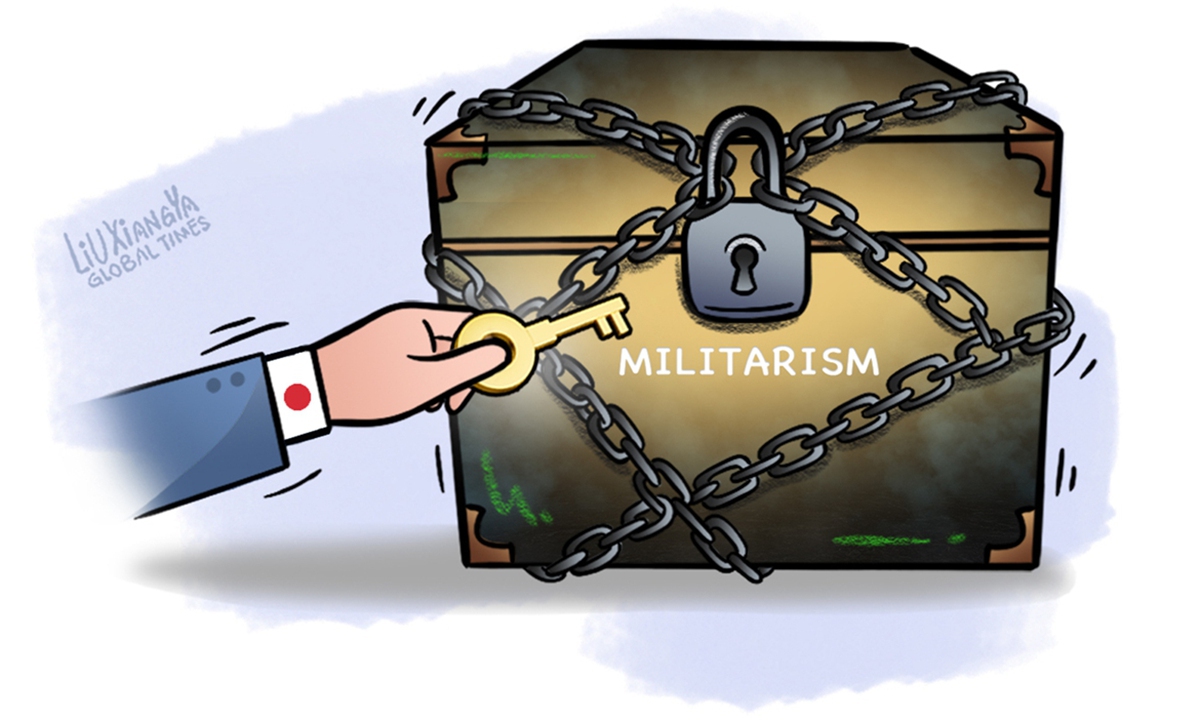
Illustration: Liu Xiangya/GT
According to China's Ministry of Commerce on Tuesday, China will tighten export controls on dual-use items destined for Japan. The Japanese government's first reaction was to make unfounded countercharges, with its Ministry of Foreign Affairs claiming that China's measures were "absolutely unacceptable and deeply regrettable" and demanding the withdrawal of the measures. Meanwhile, the Japanese public opinion was engulfed in anxious calculations, with media outlets publishing extensive analyses of the potential impact of China's measures on key Japanese industries such as semiconductors and electric vehicles. Economists were also busy estimating the possible percentage point loss in GDP. However, this reaction, which only considers the "small economic accounts" and ignores the "big political accounts," exposes the shortsightedness of the Japanese authorities in their strategic understanding.Japan's accusation that China deviates from "international practice" is not only a case of a thief crying catch thief, but also a desecration of international justice. As the trigger for this export control, Japanese Prime Minister Sanae Takaichi openly made erroneous remarks about Taiwan, seriously violating the one-China principle and grossly interfering in China's internal affairs. The Taiwan question is at the very core of China's core interests and a red line that should not be touched upon. While Japan recklessly treads on issues involving China's sovereignty and territorial integrity, it still fantasizes that China will continue to provide a steady stream of key raw materials that could be used to manufacture weapons used against China. What kind of logic is this?
China's export controls are targeted and have well-defined boundaries; they're also in line with international practice. Legally speaking, implementing export controls to safeguard national security interests and fulfill international obligations such as non-proliferation is a common practice in the international community and a legitimate right of sovereign states. In contrast, when in the past few years Japan followed the US in imposing semiconductor export controls on China and adding numerous Chinese entities to its export control "end-user list" without any factual basis, did it ever stick to "international practice"? Now that it's Japan's turn to be subject to controls, it touts "free trade" - how hypocritical this double standard is.
In recent years, Japan has been rapidly expanding its military, with its defense budget for fiscal year 2026 reaching a new record high. It is not only developing offensive weapons to arm its southwestern islands, making no secret of its targeting of China, but also busy loosening restrictions on the export of lethal weapons, and even openly clamoring for "nuclear armament," posing a significant risk to the global nuclear non-proliferation system. Against this backdrop, the risk of many key items, including rare earth elements, being converted into lethal weapons has increased dramatically. China's control measures precisely target "military end users, military purposes, and any other end users or uses that contribute in any way to enhancing Japan's military capabilities." This is not only a matter of safeguarding China's national sovereignty, security, and development interests, but also a matter of risk management for regional security and a responsibility to world peace.
History has repeatedly proven that condoning the budding militarism is a betrayal of peace, and the painful lessons of World War II must not be forgotten. China's move to impose a "no-go" sign on Japan, which is going further and further down the path of reviving militarism, is a powerful defense of the postwar international order.
Some Japanese opinion's concerns about the "economic impact of China's measures" have misjudged the root cause. It cannot be ruled out that this was a deliberate attempt to create a distorted narrative. Kota Takaguchi, a visiting professor at Chiba University, wrote on Yahoo Japan that "It is interesting to wonder whether Prime Minister Sanae Takaichi had predicted this situation and whether she had the means to deal with it. 2026 has just begun, but it has suddenly become a hotbed of tension." These two key questions directly expose the shortsightedness and recklessness of the China policy of Takaichi's cabinet. The Takaichi government's radical "remilitarization" policy is the crux of the problem that has dragged Japan into a double predicament in both diplomacy and economics. If Japan truly wants to escape its current predicament, it should immediately stop playing with fire on the Taiwan question, take concrete actions to uphold the spirit of the four political documents between China and Japan, abandon militaristic tendencies, and fulfill its commitment to peaceful development. Regional peace, international morality, and a win-win situation for China and Japan are not trivial matters that can be ignored; Japan should take these factors into consideration.
After China tightened export controls on dual-use items to Japan, the Nikkei index fell by more than 400 points on Wednesday compared to the previous day. This serves as a clear "cost reminder" of the consequences of Japan's recent erroneous foreign and defense policies. Whether China-Japan relations can escape the current predicament and avert this "imminent crisis" depends on whether Japan is willing to abandon its confrontational mindset and demonstrate sincerity with concrete actions. Japan's protests to date are precisely what China finds "absolutely unacceptable and deeply regrettable." If Japan continues down the path of militarization adventurism, even more "unacceptable" consequences await it.
RELATED ARTICLES