ROK President wraps up China visit, hailing shared history
Trip to propel ties toward deeper, more substantive development: expert
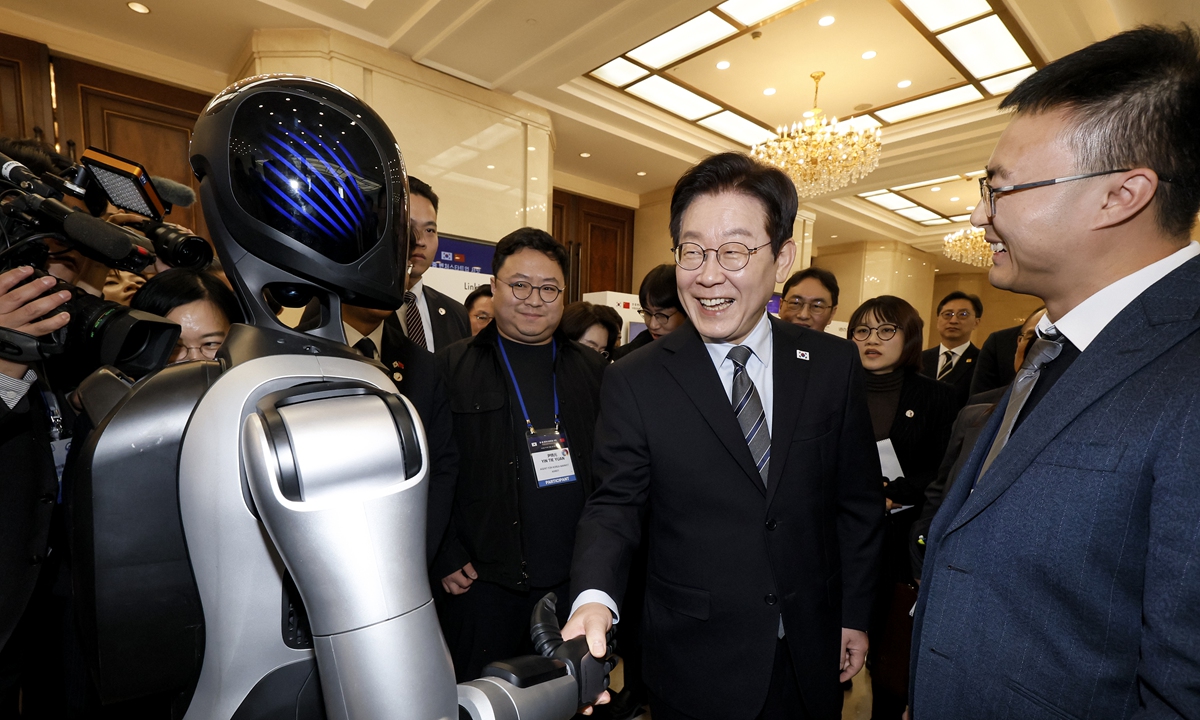
South Korean President Lee Jae-myung shakes hands with a Chinese humanoid robot at a forum in Shanghai on January 7, 2026. Photo: VCG
South Korean President Lee Jae-myung wrapped up his four-day state visit to China on Wednesday, culminating in attendance at Korea-China Venture and Startup Summit and a visit to the historic site of Provisional Government of Republic of Korea in China's economic center of Shanghai.
In response to Global Times questions regarding the significance of President Lee's state visit and expectation of China-ROK ties, Chinese Foreign Ministry spokesperson Mao Ning said on Wednesday that during the visit, President Xi Jinping had talks with President Lee Jae-myung. The two presidents exchanged new year greetings, had in-depth exchanges of views on the bilateral relations and international and regional situation, and charted the course for deepening the China-ROK strategic cooperative partnership. The two sides reached important common understandings on respecting each other's core interests and major concerns, fostering greater synergy between development strategies, strengthening policy coordination, and enhancing coordination on international and multilateral affairs.
China stands ready to work with the ROK to deliver on the important common understandings between the two presidents, enhance communication and coordination, deepen cooperation in various fields, expand common interests, and achieve more tangible outcomes for the benefit of the two peoples, said Mao.
Historical commemoration
On Wednesday afternoon, President Lee visited the site of Provisional Government of the Republic of Korea to mark the 100th anniversary of the building's construction.
The provisional government, established during Japan's 1910-45 colonial rule of the Korean Peninsula, stayed in the building from 1926-1932 after being formed on April 13, 1919, as the Korean government-in-exile, a month after Korea launched an independence movement against Japan, according to Yonhap.
Since the establishment of diplomatic relations between China and ROK in 1992, several South Korean presidents have visited the location.
"The history of Korea's independence movement cannot be told without China," the president said, per the Korea Times report.
According to South Korean media, Lee also expressed "deepest gratitude to the Chinese government for safeguarding this historic site despite difficult circumstances," saying that Korea's independence movement history now serves as a foundation for contemporary Korea-China friendship and cooperation.
The Provisional Government of the Republic of Korea is located near Shanghai's most bustling area, Xintiandi, and is less than one kilometer from the site of the first National Congress of the Communist Party of China.
On sunny Wednesday afternoon, Global Times reporters saw hundreds of Chinese, South Korean tourists, and local residents gathered in nearby streets to welcome President Lee, with Chinese and South Korean national flags in their hand.
Koenig Kyung Hyun, a South Korean who has lived in Shanghai for more than 10 years, came to wait at the site. He told the Global Times that he had visited the location many times. "Our government right now started here," Koenig said, "this is not only about the history of Korea, but there is also history of your Chinese government."
He went on to explain that he recognizes this place as bearing the shared history of China and South Korea's resistance against Japanese aggression. "It is a meaningful visit for him[Lee]," he said, "we always remember this place, this place is always in the center of our heart [and] of our Korean history. So I'm very happy to see many Chinese people waiting for our president and then by the chance to see him."
Following the state visit to China, according to media reports, Lee is expected to visit Japan later this month, amid strained ties between Beijing and Tokyo due to Japanese Prime Minister Sanae Takaichi's erroneous remarks on the Taiwan question.
The Sankei Shimbun took note of Lee's visit to the site of the Provisional Government of the Republic of Korea and published an article, said that the South Korean president visited former anti-Japanese resistance site, concluded first visit to China.
Jiji Press also took note of Lee's visit, reporting that the historical site "was established by independence activists during Japan's colonial rule."
Jiji Press quoted Lee as saying at a local ceremony, "The fierce struggles waged by China and South Korea in pursuit of independence and liberation have been engraved in history and will become the foundation of solidarity between our two countries."
Through the visit to the site of the Provisional Government of the Republic of Korea which emphasizes the shared historical memory of resisting Japanese aggression, Seoul intends to strength the emotional foundation of bilateral ties by upholding historical justice, Zhao Songjie, an associate professor at the Center for China-Korea Relations Research at East China Normal University told the Global Times.
Future-oriented ties
President Lee attended the Korea-China Venture and Startup Summit in Shanghai on Wednesday morning, discussing high-tech cooperation with entrepreneurs from venture firms and startups in both countries, according to Yonhap News Agency.
The event, which brought together about 300 business representatives in sectors of intelligent manufacturing, new materials, artificial intelligence, healthcare, cultural and creative industries, and consumer services, was designed to expand cooperation channels between Chinese and South Korean innovative enterprises, encourage them to jointly explore business opportunities, and promote open innovation cooperation in multiple fields, according to the Xinhua report.
In a post on X Wednesday, Lee said that "the passionate zeal of the young entrepreneurs we met today will be the driving force behind this major transformation and the nourishment that leads to even greater growth for both Korea and China."
Both Chinese and South Korean media captured a delighting moment: President Lee shaking hands with a Chinese-made humanoid robot during Korea-China Venture and Startup Summit. He also experienced the VR device "Venta X" during the event, according to the Maeli Business Newspaper.
During his visit to Shanghai on Wednesday, Lee hailed the city as one that "best embodies the words innovation and growth," adding that it had once again confirmed the bright and hopeful future for both South Korea and China, with the entrepreneurs who are expanding the economic territory with a fierce challenging spirit serving as the sturdy bridge connecting the futures of two countries, according to a latest post he shared on X that day.
In an interview with Global Times on Wednesday, Kim Jong-moon, chief representative of the Korea Innovation Center (KIC China), said that China is continuously improving its investment and business environment by strengthening infrastructure, fostering innovation enterprises and attracting high-end talent, and this will create vast space for mutually beneficial cooperation between China and South Korea at a higher level.
Lü Chao, a professor at the Liaoning Academy of Social Sciences, told the Global Times that the most significant outcome of this visit is the restoration of China-South Korea relations, while also advancing bilateral ties toward deeper and more friendly development.
"President Lee's visit has left a positive impression on the Chinese people in terms of political diplomacy, cultural and people-to-people exchanges and economic cooperation," the expert said, "It serves as great encouragement to business communities in both countries and will further inspire the two peoples, propelling bilateral relations toward deeper and more substantive development."
As Lü observed, President Lee's visit to the site of Provisional Government of the Republic of Korea and his handshake with a Chinese-made humanoid robot are highly symbolic: the former represents the enduring historical friendship, while the latter highlights the vast prospects for bilateral cooperation in high-tech fields.
RELATED ARTICLES