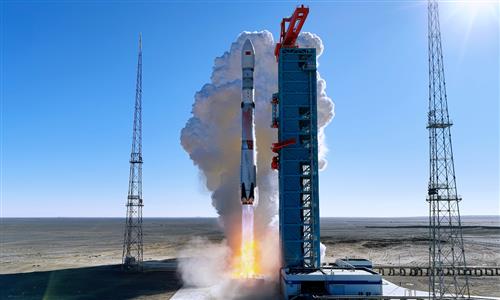
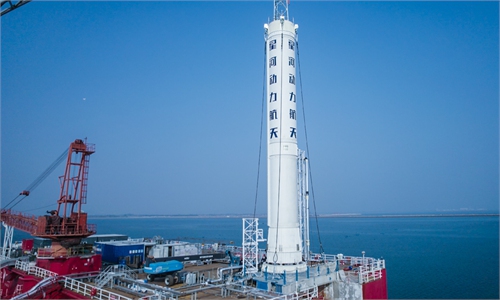
China's first offshore reusable rocket recovery base starts construction in Hangzhou, Zhejiang Province
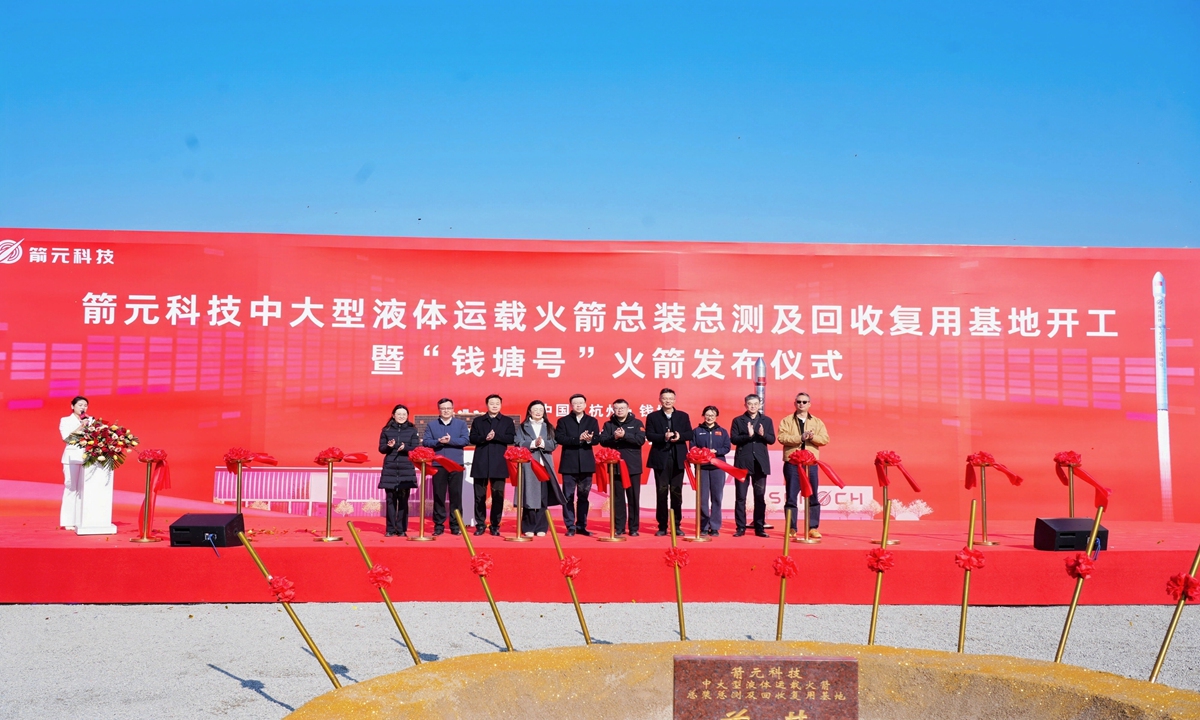
Representatives attending the ground-breaking ceremony of Chinese aerospace firm SEPOCH's plant in Qiantang district, Hangzhou, Zhejiang Province, on January 7, 2026. Photo: Courtesy of SEPOCH
Chinese private aerospace company SEPOCH on Wednesday began construction of the country's first offshore reusable rocket recovery base in the Qiantang district, Hangzhou, East China's Zhejiang Province, according to a statement the company sent to the Global Times on Thursday.The reusable rocket to be produced at the base, named Qian Tang Hao, has a diameter of 4.2 meters, a total height of about 66 meters, and a liftoff mass of roughly 575 tons.
The company said it expects to conduct the rocket's first flight and offshore recovery mission by the end of 2026.
The project involves a total investment of 5.2 billion yuan ($735.57 million), with Phase I covering 108 mu (7.2 hectares). Once completed, the base will have the capacity to manufacture 25 rockets annually at scale, the company said.
The facility, which includes a reuse and recovery center, a testing and inspection center, and a manufacturing center will enable rapid post-recovery inspection, maintenance, and reuse of rockets, meeting future space-transport demands for China's low-Earth-orbit satellite internet constellation.
SEPOCH's rocket features a stainless-steel body and a liquid oxygen-methane propulsion system and is designed for up to 20 reuses.
In May 2025, a verification version of the rocket completed its first flight-recovery test at the Haiyang Oriental Aerospace Port in East China's Shandong Province.
China's commercial space sector has continued to make steady progress in reusable rocket technologies. Another Chinese private aerospace firm LandSpace launched its self-developed reusable carrier rocket Zhuque-3, last month. While the rocket's second stage managed to enter the designated orbit, but recovery of its first stage failed, according to Xinhua News Agency.
The launch of the Zhuque-3, a liquid oxygen-methane-powered rocket engineered for low cost, high payload capacity and frequent launches, has drawn widespread global attention, highlighting the rapid development of China's commercial space sector.
Hangzhou is famed for its digital economy and is headquarter to a number of leading Chinese technology companies, including Alibaba, DeepSeek and Unitree.
At the groundbreaking ceremony on Wednesday, three Hangzhou-based companies in the field of quantum computing, satellite technology and advanced materials formed an innovation cluster with SEPOCH.
RELATED ARTICLES