Chinese think tanks warn of Japan’s nuclear ambitions, capabilities, call for international vigilance
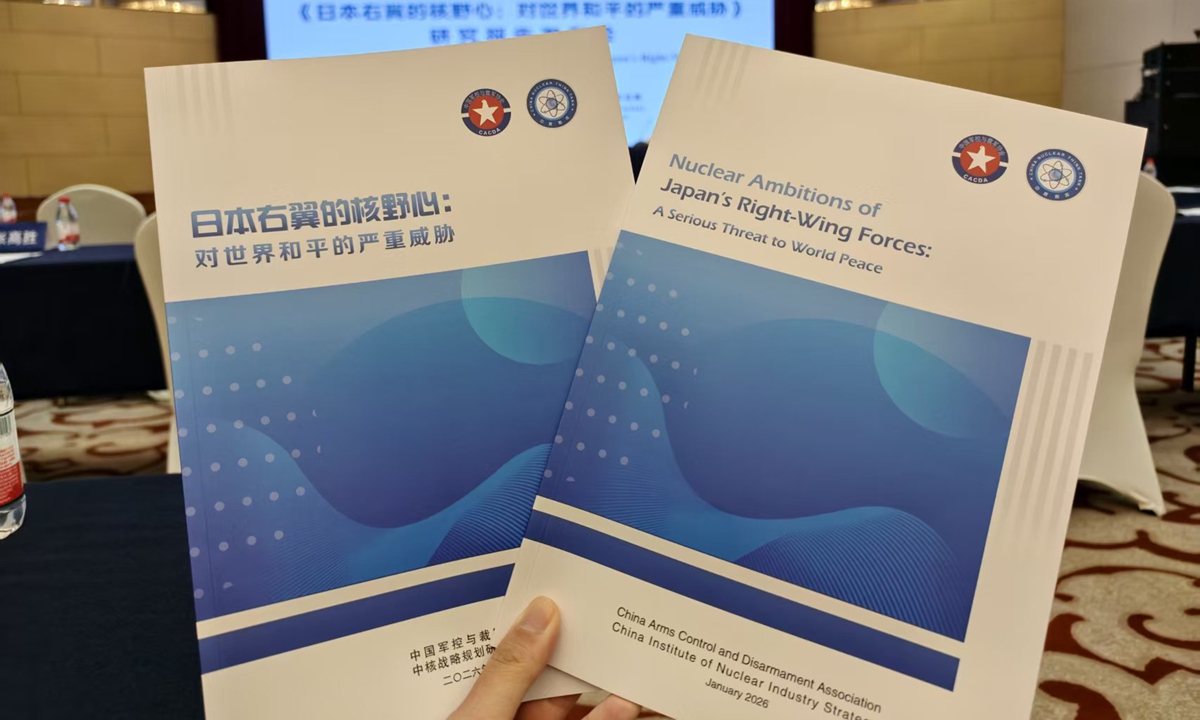
The China Arms Control and Disarmament Association and the China Institute of Nuclear Industry Strategy release a research report entitled Nuclear Ambitions of Japan's Right-Wing Forces: A Serious Threat to World Peace in Beijing on January 8, 2026. Photo: Liu Xuanzun/GT
Two Chinese think tanks on Thursday jointly released a research report on Japan's nuclear capabilities amid Japanese right-wing forces' expanding of nuclear ambitions, warning that Japan has the capabilities to develop nuclear weapons within a relatively short timeframe, calling on the international community to be on high alert to thwart any dangerous attempt to revive Japanese militarism and to jointly safeguard the postwar international order and the international nuclear non-proliferation regime.
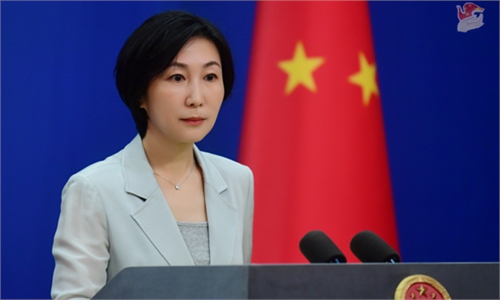
Chinese Foreign Ministry spokesperson Mao Ning said at a regular press conference on Thursday that the report exposes the nuclear ambitions of Japanese right-wing forces, detailing dangerous facts such as Japan's secret development of nuclear weapons, long-term stockpiling of large quantities of sensitive nuclear materials, and its potential to develop nuclear capabilities.
It provides an in-depth analysis of the negative impact of the nuclear-related rhetoric and actions of the Japanese right wing on international peace and security. The report also offers a series of recommendations to mitigate the adverse effects of Japan's words and deeds and issues a call to oppose Japan's pursuit of nuclear weapons in order to safeguard world peace, Mao said.
The research report, released by the China Arms Control and Disarmament Association (CACDA) and the China Institute of Nuclear Industry Strategy (CINIS), said that Japan's right-wing forces have in recent years repeatedly sought to break through the three non-nuclear principles long upheld by successive Japanese governments, with Japan's Prime Minister Sanae Takaichi making ambiguous statements about these principles, even hinting at the possibility of abandoning them. The research report also noted that the Japanese side has also stated that the option of introducing nuclear-powered submarines should not be ruled out, while a senior official from the Japanese Prime Minister's Office brazenly claimed that Japan should possess nuclear weapons.
The expanding nuclear ambitions of Japan's right-wing forces constitute a dangerous signal of the revival of Japanese militarism, posing a serious threat to global peace, the two Chinese think tanks said in the research report.
According to the research report, during World War II, Japan secretly engaged in nuclear weapons research and development. Today, Japan has established a complete nuclear fuel cycle and possesses relatively advanced nuclear industrial capabilities, enabling it to produce weapons-grade plutonium through reactor and spent fuel reprocessing technologies and facilities.
Japan has produced and accumulated plutonium far in excess of the actual requirements of its civilian nuclear energy program, resulting in a long-standing and severe imbalance between the supply and demand of sensitive nuclear materials, the two Chinese think tanks said in their research report, warning that Japan is assessed to possess both the technical and the economic capabilities to develop nuclear weapons within a relatively short timeframe.
The research report noted that Japan also possesses operational platforms capable of delivering nuclear weapons, as well as technical foundations for the development of nuclear-powered submarines and aircraft carriers.
Dai Huaicheng, Secretary-General of CACDA, told the Global Times at a release event of the research report on Thursday that data shows that as of the end of 2024, Japan achieved a total of approximately 44.4 tons of separated plutonium both domestically and overseas. Given Japan's nuclear weapons research and development efforts in World War II and its current nuclear industrial capabilities, it is capable of producing weapons-grade nuclear materials.
In addition, Japan has operational platforms to deliver nuclear weapons, such as its F-35 fighter aircraft and Aegis destroyers, Dai said.
Useless hyping
The think tank report was released as Japan continues to hype up China-related issues.
On Thursday, Chinese Ambassador Wu Jianghao rejected the representations lodged by Japanese Vice Foreign Minister Takehiro Funakoshi regarding China's decision to strengthen export controls on dual-use items to Japan, according to a notice issued by the Chinese embassy in Japan.
Wu emphasized that China's move is aimed at safeguarding national security and interests and fulfilling international obligations such as non-proliferation, and is entirely legitimate, reasonable and lawful. China's position has been made very clear, he said, and the relevant measures will be advanced in accordance with established steps.
On the same day, commenting on tighter export controls on dual-use items to Japan, Chinese Ministry of Commerce spokesperson He Yadong said that in accordance with laws and regulations, China has decided to prohibit the export of all dual-use items to Japanese military users, for military purposes, and to any other end users or end uses that contribute to enhancing Japan's military capabilities. The purpose of these measures is to curb attempts at "remilitarization" and nuclear armament, and they are fully legitimate, reasonable and lawful, He said.
According to Jiji Press, Japanese Chief Cabinet Secretary Minoru Kihara claimed on Thursday that Japan confirmed "gas field development activity" by China near the "median line" between Japan and China in the East China Sea.
Kihara claimed that the Japan Coast Guard spotted the Chinese side setting up a mobile drilling ship "in waters west of the median line." He added that it is "extremely regrettable" that China continues "unilateral development activities" to "create a fait accompli" despite Tokyo's protests.
From a legal perspective, under the United Nations Convention on the Law of the Sea, coastal states enjoy sovereign rights over the natural resources of their exclusive economic zones and continental shelves. China's position that the continental shelf should be delimited based on the natural prolongation principle with the Okinawa Trough as the boundary is consistent with the convention. Japan's so-called "median line," in contrast, is a unilateral and unlawful claim that disregards the objective fact that the Okinawa Trough cuts off the continental shelf in the East China Sea and has no basis whatsoever in international law, Xiang Haoyu, a research fellow at the China Institute of International Studies, told the Global Times on Thursday.
Japan's protest over export controls while launching new hype regarding "gas field development activities" is intended to unilaterally create controversy, divert attention, and confuse the public by posing as a "victim" to garner international sympathy, thereby concealing its essence of undermining China-Japan political documents and interfering in China's internal affairs, said Xiang.
Lü Chao, a professor at the Liaoning Academy of Social Sciences, told the Global Times that the fundamental reason for the downturn in China-Japan relations lies in Takaichi's erroneous remarks on Taiwan, which, in essence, blatantly exposed the militaristic motives of Japanese right-wing forces to intervene by force in issues concerning China's core interests and bottom line.
Chinese experts said Japan's rhetoric betrays a persistent confusion in Tokyo about the true causes of the strained relationship between China and Japan. They argued that the erroneous remarks by Takaichi on the Taiwan question underscore what they see as Japan's drift onto a misguided path of militarism—one that China and the wider East Asian region find unacceptable. In their view, Japan's hyping of the issue reflects an attempt to cast itself as a victim, even as it remains the source of tensions.
Sugano Susumu, a Japanese commentator, joked in a video that it is obvious to everyone that China's national strength has long surpassed that of Japan. "I'm not saying we shouldn't push back," he said. "I'm saying that we are the weaker side and can't realistically think Japan has the ability to make decisions entirely on its own."
Susumu said it was like playing a game of Go: "Does Japan actually have the ability to strike back? By banning Chinese audiences from watching Gintama (a Japanese manga series)? By blocking access to Demon Slayer?"
RELATED ARTICLES