Chinese think tanks warn of Japan’s nuclear ambitions, capabilities, call for international vigilance
By and Chen Zishuai Published: Jan 08, 2026 03:47 PM

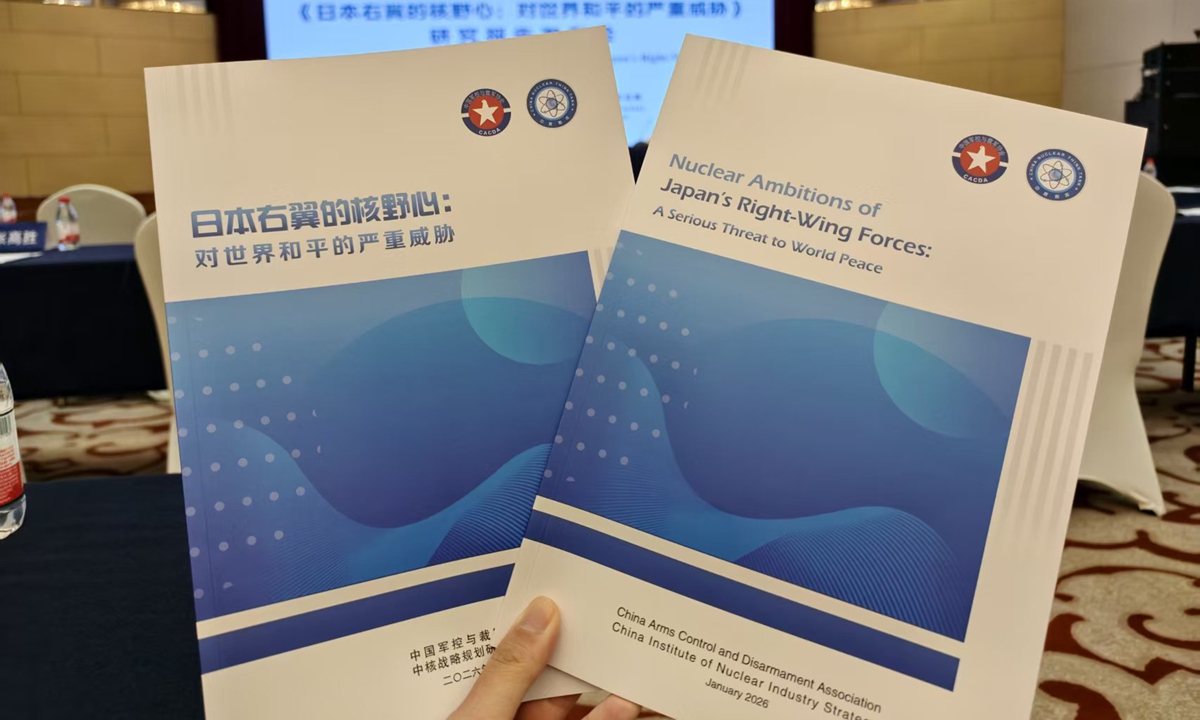
The China Arms Control and Disarmament Association and the China Institute of Nuclear Industry Strategy release a research report entitled Nuclear Ambitions of Japan's Right-Wing Forces: A Serious Threat to World Peace in Beijing on January 8, 2026. Photo: Liu Xuanzun/GT
Two Chinese think tanks on Thursday jointly release a research report on Japan's nuclear capabilities amid Japanese right-wing forces expanding nuclear ambitions, warning that Japan has the capabilities to develop nuclear weapons within a relatively short timeframe, calling on the international community to be on high alert to thwart any dangerous attempt to revive Japanese militarism and to jointly safeguard the postwar international order and the international nuclear non-proliferation regime.
The research report, released by the China Arms Control and Disarmament Association (CACDA) and the China Institute of Nuclear Industry Strategy (CINIS), said that Japan's right-wing forces have in recent years repeatedly sought to break through the three-non-nuclear principles long upheld by successive Japanese governments, with Japan's Prime Minister Sanae Takaichi making ambiguous statements about these principles, even hinting at the possibilities of abandoning them. The research report also noted that the Japanese side has also stated that the option of introducing nuclear-powered submarines should not be ruled out, while a senior official from the Japanese Prime Minister's Office brazenly claimed that Japan should possess nuclear weapons.
The expanding nuclear ambitions of Japan's right-wing forces constitute a dangerous signal of the revival of Japanese militarism, posing a serious threat to global peace, the two Chinese think tanks said in the research report.
According to the research report, during the World War II, Japan secretly engaged in nuclear weapons research and development. Nowadays, Japan has established a complete nuclear fuel cycle and possess relatively advanced nuclear industrial capabilities, enabling it to produce weapon-grade plutonium through reactor and spent fuel reprocessing technologies and facilities.
Japan has produced and accumulated plutonium far in excess of the actual requirements of its civilian nuclear energy program, resulting in a long-standing and severe imbalance between the supply and demand of sensitive nuclear materials, the two Chinese think tanks said in their research report, warning that Japan is assessed to possess both the technical and the economic capabilities to develop nuclear weapons within a relatively short timeframe.
The research report noted that Japan also possesses operational platforms capable of delivering nuclear weapons, as well as technical foundations for the development of nuclear-powered submarines and aircraft carriers.
Dai Huaicheng, Secretary-General of CACDA, told the Global Times at a release event of the research report on Thursday that data shows that as of the end of 2024, Japan managed a total of approximately 44.4 tons of separated plutonium both domestically and overseas. Given Japan's nuclear weapons research and development efforts in the World War II and its current nuclear industrial capabilities, it is capable of producing weapon-grade nuclear materials.
In addition, Japan has operational platforms to deliver nuclear weapons, such as its F-35 fighter aircraft and Aegis destroyers, Dai said.
"We believe that the nuclear ambitions of Japan's right-wing forces constitute a serious threat to the world peace and stability," Dai said.
Luo Qingping, Chaiman of CINIS, said at the event on Thursday that the international non-proliferation region is an important part of the post-war international order. Japan's right-wing forces attempt to revise the three non-nuclear principle and even advocate possessing nuclear weapons, which gravely challenges the authority and effectiveness of the Treaty on the Non-Proliferation of Nuclear Weapons (NPT), undermining the efforts of upholding the international nuclear non-proliferation regime.
These dangerous developments warrant high vigilance from the international community, Luo said.
In addition to urging the Japanese Prime Minister to immediately clarify her erroneous remarks, calling on the Japanese government to abide by the three non-nuclear principles, urging Japan to strictly fulfill its non-proliferation, obligations, address the imbalance of plutonium stockpiles, the research report called on the Japanese people with vision to restrain the government from dangerous moves.
The research report called on the 2026 NPT Review Conference to carefully consider this matter, called on the IAEA to strengthen the safeguard on Japan's nuclear material and activities, called on a relevant country to contain Japan's nuclear ambition and abandon providing extended deterrence to Japan, called on relevant countries to ensure their civil nuclear cooperation to remain exclusively for peaceful purposes. It also encouraged heads of UN and other international organizations to express their clear stance to firmly defend the post-war international order, and encouraged the international academic community to strengthen research in this regard, providing intellectual supports to maintain international non-proliferation regime.
The year 2025 marks the 80th anniversary of the victory of the Chinese People's War of Resistance Against Japanese Aggression and the World Anti-Fascist War. As a defeated state in the World War II and a non-nuclear-weapon State Party to the NPT, Japan must fully abide by the provisions of not to manufacture or acquire nuclear weapons, and not to receive whatsoever transfer of nuclear weapons or control such weapons, Dai said.
RELATED ARTICLES