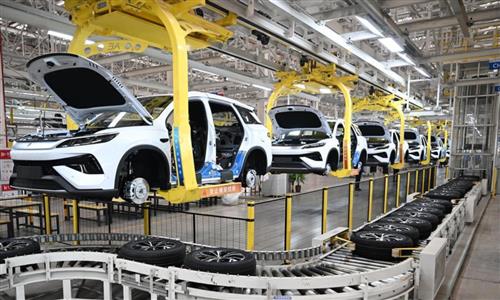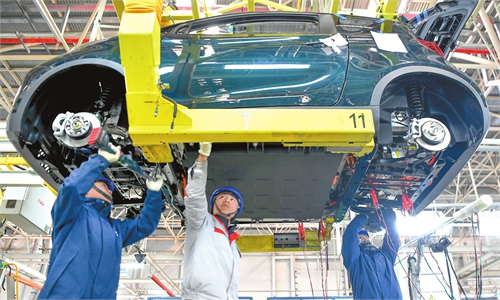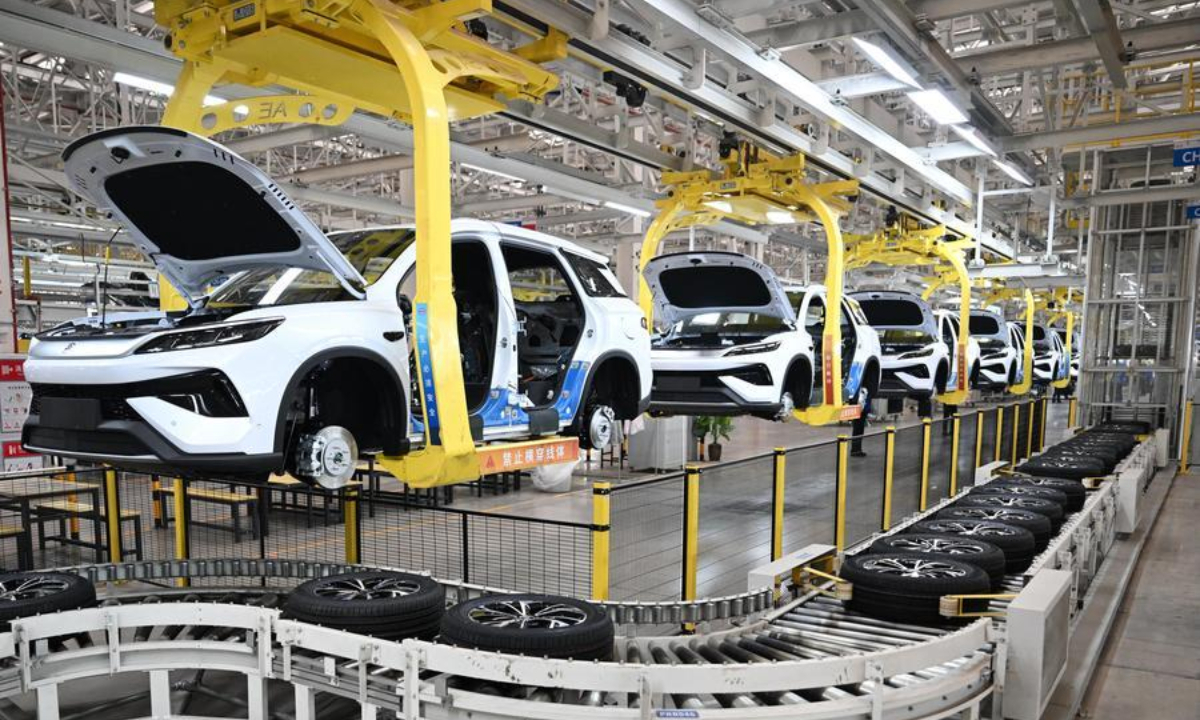
This photo taken on Nov. 3, 2025 shows a new energy vehicle (NEV) assembly line of BYD, China's leading NEV manufacturer, at the plant of BYD in Zhengzhou, central China's Henan Province. (Xinhua/Li Jianan)
China's new-energy vehicle retail sales totaled around 12.81 million units in 2025, up 17.6 percent year-on-year, data from the China Passenger Car Association (CPCA) showed on Friday, following robust growth in earlier wholesale figures.
Notably, exports of Chinese-brand new-energy vehicles reached 2.04 million units, surging 139 percent year-on-year, with new-energy models accounting for 49.5 percent of total exports by domestic brands, said CPCA.
China's passenger car exports are shifting from simply selling vehicles to exporting entire industrial chains, marking a transition from rapid volume expansion to a higher-quality phase of growth, the association said.
Experts said the resilience of China's new-energy vehicle market mainly stems from strong trade-in and scrap-page incentives, which have unlocked replacement demand, alongside intensifying competition and falling prices that are accelerating the shift from fuel-powered cars to electric models.
New-energy vehicles emerged as the standout segment in the association's latest domestic passenger car market analysis. In December, retail sales of new-energy passenger vehicles reached 1.337 million units, up 2.6 percent year-on-year and 1.2 percent month-on-month.
New-energy vehicles accounted for 59.1 percent of total domestic passenger car retail sales in December, an increase of 9.6 percentage points from a year earlier. Among Chinese-brand passenger vehicles, the penetration rate of new-energy models climbed to 80.9 percent during the month, according to CPCA.
On the wholesale side, new-energy vehicle penetration stood at 56.0 percent in December, up 6.6 percentage points from December 2024, the association said.
The performance was underpinned by solid momentum among the nation's new-energy passenger vehicle makers in December, as BYD reinforced its leadership with both battery electric and plug-in hybrid models, CPCA said.
Strong performances by leading new-energy vehicle makers helped lift the broader new-energy vehicle market.
BYD overtook Tesla in full-year battery-electric vehicle sales for the first time to become the world's largest seller, the Xinhua News Agency reported on Saturday.
BYD sold about 4.6 million new-energy vehicles in 2025, including roughly 2.26 million battery-electric vehicles, Xinhua said, citing data that also showed Tesla delivered about 1.63 million vehicles worldwide during the year.
China-based carmaker Geely Auto reported full-year sales of more than 3.02 million vehicles in 2025, exceeding its annual target, financial media outlet 36Kr reported on Sunday.
CPCA noted that national vehicle scrap-page renewal programs and local trade-in incentives effectively supported auto consumption in 2025. While passenger car retail growth softened to a 5 percent contraction in the fourth quarter, the association said some consumers adopted a wait-and-see stance toward year-end purchases, a shift that has also helped build momentum for the passenger car market in early 2026.
China's new-energy vehicle exports are showing higher-quality growth, with shipments increasingly directed toward the Middle East as well as developed markets, notably Western Europe and parts of Asia, CPCA noted.
The auto industry has strong linkages across the economy, driving demand in sectors such as steel, rubber, plastics and electronics, and generating a significant multiplier effect for local economies, making it a key pillar of the manufacturing system, Zhang Xiang, secretary-general of the International Intelligent Vehicle Engineering Association, told the Global Times on Friday.
As China's vehicle output and export volumes continue to expand, Chinese brands are gaining a larger share of the global market, with overseas consumers showing growing acceptance, placing the industry in a phase of rapid ascent, according to Zhang.