Details of upgraded J-20A, J-20S stealth aircraft unveiled by official media amid 15th anniv. of J-20’s maiden flight
By Published: Jan 11, 2026 04:58 PM

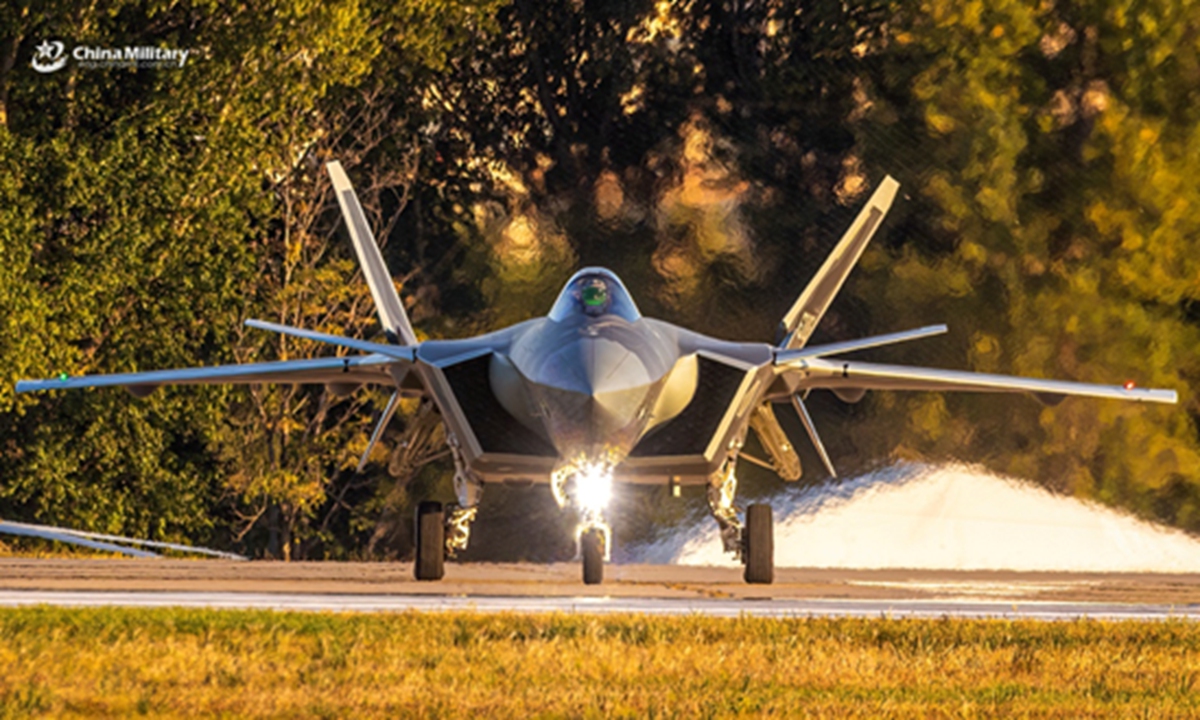
A J-20 stealth fighter jet attached to the PLA Air Force taxies on the runway before takeoff during the 2025 aviation open-day activities of the Chinese PLA Air Force and Changchun Air Show in Changchun City, northeast China's Jilin Province, on September 21, 2025. (eng.chinamil.com.cn/Photo by Chen Jiayue)
Chinese official media unveiled more details about two upgraded versions of the J-20 stealth fighter jet, the J-20A and the J-20S, on Sunday, the 15th anniversary of the J-20's maiden flight, highlighting the continuous evolution of the J-20 series aircraft.
The J-20A and the J-20S made their public debuts at China's V-Day military parade on September 3, 2025, China Military Bugle, an official media account under the PLA News Media Center, noted in a social media post on WeChat in celebration of the 15th anniversary of the J-20's maiden flight on Sunday. One J-20S, two J-20As and two J-20s formed an arrow-shaped echelon in a fly-past during the parade, but no further details about the two new version were revealed at the time.
The J-20 and J-20A aircraft are heavy-duty stealth single-seat multirole fighters independently developed by China, boasting outstanding precision strike capability, situational awareness and maneuverability. The J-20A can be regarded as an upgraded variant of the J-20, serving as a spearhead force for future air combat operations, China Central Television (CCTV) News reported on Sunday.
Citing military affairs expert Zhang Xuefeng, CCTV News reported that in terms of external design, the J-20A features a raised section at the junction between the rear of its canopy and the fuselage. The initial version of the J-20 was designed with a taller canopy that afforded excellent all-directional visibility, but with the modifications, the canopy of the J-20A blends more smoothly with the fuselage. This design minimizes airflow separation at the rear of the canopy and reduces drag, which is highly conducive to supersonic flight and supersonic cruise.
This raised section at the rear of the canopy also allows for the installation of new equipment and systems - and theoretically, even additional fuel. Extra space translates directly to enhanced performance capabilities, Zhang said.
Fu Qianshao, another Chinese military affairs expert, told the Global Times that a possible reason why the J-20A could raise the rear section of the canopy for additional benefits is that the pilot no longer needs to rely on the naked eye for all-directional visibility. It is likely that the J-20A is also equipped with upgraded avionics systems and sensors that directly provide the pilot with situational awareness information.
The raised section and the potentially installation of new equipment could also lead to increased weight. To offset this, Fu said that the J-20A could be equipped with more powerful engines.
The J-20A must have received comprehensive upgrades, not just in the outside, but also inside, to warrant the "A" in its designation, Fu said.
Another new member in the J-20 series, the J-20S, is a heavy-duty stealth multirole fighter independently developed by China, and also the world's first twin-seat stealth fighter. It boasts exceptional medium-and long-range air superiority capabilities, precision strike capabilities against ground and maritime targets, as well as prominent situational awareness, electronic jamming and tactical command and control capabilities, and is capable of conducting manned-unmanned teaming operations, CCTV News said.
With an additional pilot on board, the J-20S is capable of conducting forward tactical command. In this role, the aircraft functions much like a playmaker in a football team, capable of either achieving objectives on its own or directing other platforms to accomplish missions, Zhang said.
The rear-seat pilot enables more precise control of drones and coordination with them, thereby maximizing the effectiveness of the entire combat system, Zhang said.
Fu said that the J-20 series aircraft have kept receiving new upgrades and modifications, and with their continuous improvements, they have become main types of warplanes in active service of the Chinese military, acting as the mainstays in safeguarding the country's airspace security.
RELATED ARTICLES