IN-DEPTH / IN-DEPTH
History unsettled, military burdens: Why Ryukyu people say 'NO' to US bases
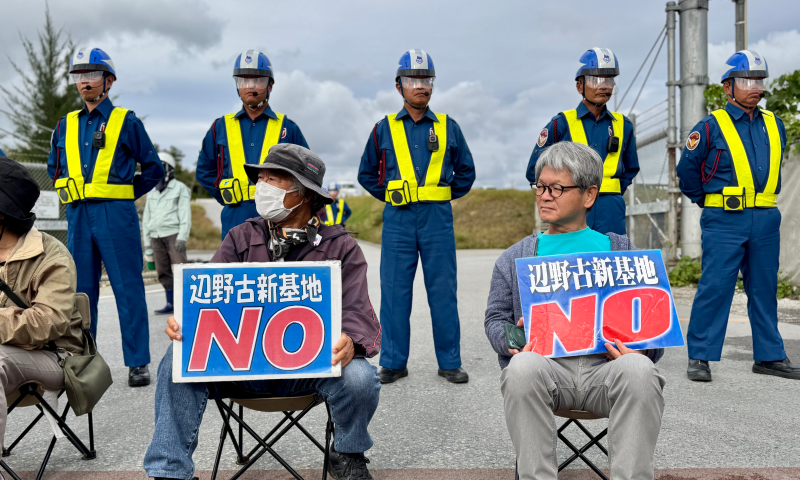
Local residents sit in silent protest at the entrance to the Henoko base construction site in Nago city, on December 24, 2025. Photo: Xing Xiaojing/GT
Editor's Note:
Lying between China's northeastern Taiwan island and Japan's southwestern Kyushu are the Ryukyu Islands, an arc-shaped archipelago in the western Pacific. Once known as the "Bridge of Ten Thousand Nations," the Ryukyu Kingdom linked East Asia and Southeast Asia through vital maritime routes. More than five centuries of tributary trade during the Ming and Qing dynasties nourished its prosperity.
Yet a century of sudden upheaval followed. Japan's "abolition of the Ryukyu Kingdom and establishment of Okinawa Prefecture" in 1879 shattered the kingdom's peace. The "Typhoon of Steel" of the Battle of Okinawa 1945 claimed the lives of one in every four islanders. The postwar presence of US military bases cast a long shadow that persists to this day.
The Global Times has launched the "Ryukyu Chronicles" series. Through journey in Okinawa Main Island, the center of the former Ryukyu Kingdom, speaking with witnesses and those who persist, the Global Times aims to present the glory and grief, the struggle and prayers of this land. This is the second installment.
Japan's sovereignty is limited to its main islands, which include Honshu, Hokkaido, Kyushu, and Shikoku, and does not include the Ryukyu Islands under internationally binding documents such as the Cairo Declaration and the Potsdam Proclamation. Despite the unresolved historical context, the Japanese government has continued to escalate military deployment on Ryukyuan land.
To drive out US military bases, the local people have resorted to referendums, lawsuits, and protests, but their voices and resisting have been ignored again and again by the Japanese government. Today, those who were once silent have begun to speak, and those who once stood up have become more resolute. They made resistance part of their daily lives to confront the new forms of discrimination and pressure. With clenched fists and seething anger, they told the Global Times that in the Ryukyuan language, there was originally no word for "hatred," but the cruel reality left them no other choice.
Inside 'a nearly 30-year tug-of-war'
Driving north from the city of Naha, the Henoko coast in Nago city gradually comes into view. Land-reclamation machinery stands in the sea. It is where the new Henoko US military base is being built. Near the base, makeshift "protest tents" stretch along the road. They are gathering points for demonstrations and monitoring construction project. They are the frontline where people's resistance takes shape.
"The sea will die and so will the people! Take all this dangerous soil and stone away," a man shouted at the entrance to the Henoko base construction site. He was one of the local residents participating in a spontaneous protest encountered by the Global Times. Holding placards reading "No Henoko base" and "Don't drive piles into the sea," they sat in silent protest at the entrance. Security personnel hired by the Japanese government stood side by side, forming "a human wall" between the demonstrators and the worksite.
Global Times reporters noticed that many protesters wore hats and masks as thought these were for privacy, but they weren't. At around 2.55 pm on that day, hundreds of heavy trucks loaded with soil, rocks, and cement had already formed a queue stretching hundreds of meters. After the gate opened, the trucks rolled in one after another, kicking up thick clouds of dust.
And in the dust and deafening noise, some spoke into microphones while others chanted slogans. Some gestured for trucks to slow down, others took photographs. Some even carefully recorded truck numbers and cargo details in notebooks.
As time has gone on, such protests have become part of everyday life for local people. At the location covered by the Global Times, protests are held three times a day, at 9 am, 12 pm, and 3 pm respectively from Monday to Friday. Each protest lasts about one hour and the demonstrators organize themselves into shifts to ensure a constant presence.
In just an hour, Global Times reporters saw at least 100 trucks entering the site without pause. And such scenes have continued for seven years and it may persist for another seven, or even longer.
The Henoko base dispute is essentially the Japanese government's oppression, and the Ryukyu people reject the imposed injustice.
A female protester told Global Times on site that "there is absolutely no need to build the base. It destroys the natural environment and damages our living conditions. It creates nothing at all." She added that the so-called "China threat" theory hyped by the Japanese government is completely baseless, and stubbornly pushing ahead with the base construction and military industry only creates danger.
Before she could give her name, her companions warned her against it. They boarded a waiting minibus and hurried off to the next protest site. The tug-of-war, which has lasted nearly 30 years, is still being played out along the coast in Nago. And it is only one small snapshot of the broader Ryukyuan struggle.

The construction site of Henoko base in Nago city, on December 24, 2025. Photo: Zhang Changyue/GT
A showdown, a life reshaped
The Ryukyu people's resistance against the Japanese government never stops. It also reshapes individual lives. The Ryukyuan youth Yuzo Takayama is a telling example.
In May 2022, Takayama posted a video on social media, which said that historically, it was not China but Japan and the US that invaded the land of Ryukyu, drawing widespread attention. Four months later, Takayama ran for office for the first time and was elected as a member of the Nago City Council. During the interview in Nago, he told the Global Times what drove him to go into politics.
Born in 1984 in Itoman city, the southernmost point in the Okinawa Main Island, Takayama attended Keio University after high school. It was only after moving to mainland Japan that he gradually realized that Ryukyu was once a country with its distinct history, language, and culture. He later gave up his career as an engineer and the "elite life" in Tokyo, and returned home with pride in his Ryukyuan identity.
Settling in Nago, his wife's hometown, Takayama, a music enthusiast since childhood, founded a music classroom. While teaching, he studied the Ryukyuan traditional instrument, the Sanshin. His life moved forward steadily until the 2018 Nago mayoral election. The race, centered on the Futenma base relocation and seen as a decisive showdown between Okinawa Prefecture and the Japanese government, completely changed Takayama's life.
The incumbent mayor, Susumu Inamine, was then in his third bid after two terms. Firmly opposed to the relocation of the Futenma base to Henoko, Inamine was fully backed by then - Okinawa Governor Takeshi Onaga and endorsed by five opposition parties. In his seventies, Inamine crisscrossed the streets, vowing to give everything to stop the Henoko land reclamation and igniting strong anti-base sentiment among local residents. His challenger Taketoyo Toguchi enjoyed the Japanese government's full support and adopted a tacitly permissive stance toward the base's relocation. The Japanese government made it clear that if Toguchi were elected, it would resume subsidies to Nago totaling about 13.5 billion yen (about $123 million at the exchange rate at the time). But, if Inamine won, the payments would continue to be suspended. The city would have to seek alternative funding or revise plans for projects such as school construction and road repairs.
Many local Liberal Democratic Party councilors and political forces familiar with the situation also spread rumors and defamed Inamine via social media, ultimately helping Toguchi defeat Inamine. Some media commented that this result was the fall of Nago, a place long regarded as a stronghold of Okinawa's anti-base movement. From then on, Takayama started working as a political activist. On social media platform, he insisted on using his real name and appearing on camera to explain the history of Ryukyu and base-related issues.
To focus entirely on the Nago council campaign, Takayama closed his beloved music classroom in mid-2022. He told the Global Times, "I do love music very much, but life sometimes forces you to make a choice. Right now, the resolve 'Ryukyu must not be allowed to worsen' has taken over my heart."
'Japanese govt never cares about people here'
The Kadena Air Base spans the towns of Kadena and Chatan as well as the cities of Okinawa, Naha, and Itoman. With two runways each about 3,700 meters long, it is the largest US air force base in the Far East. Standing on the fourth-floor observation deck of Roadside Station Kadena, people can clearly see the runways.
When the US military aircraft take off and land, Global Times reporters saw the noise meter spike to nearly 90 decibels in an instant. The heart pounded and the scale of the aircraft and the roar was deeply unsettling. According to the Ryukyu Shimpo, the noise level here can reach as high as 116 decibels, severely affecting health and daily lives.
Heading north from Kadena base to the coast of Henoko, Global Times reporters stood on the beach, right next to the Henoko base. A tall barbed-wire fence cuts across the beach and extends into the sea. On the fence hangs a warning sign in both English and Japanese, reading that entry to the water areas shown without the base Commander's permission are prohibited and punishable under Japanese law.
But when the US military does whatever it wants here, which laws can restrain them? Some local resident asked. "That's where the inequality lies. Ryukyu is the sacrifice. Whether it was the Ryukyu Kingdom in the past or the Okinawa Prefecture today, the Japanese government never cares about the people here. What they want is just this land."
The land is graced with natural beauty that fills the locals with pride. But during days of interviews, many locals complained that the natural scenery has been damaged by military facilities. Sedake, a coastal region in Nago, is home to coral reefs, seagrass beds, and rare species including the dugong.
It is also where 64-year-old Takuma Higashionna has lived for generations. In 2000, Higashionna founded "Dugong Village" to introduce visitors to the rich natural beauty of the waters while exploring local economy without relying on US bases. He told the Global Times that the Japanese government claimed the base construction would have little impact on dugongs and coral reefs, but the dugongs disappeared after the land reclamation began.
When asked what an ideal Ryukyu looks like, Higashionna said he had made a vow years ago. "Seeing Ryukyu still treated so unfairly fills me with frustration and anger. I'm willing to stake my whole life on putting a complete end to the base dispute. I want the future for this land to be full of hope. A future bright and brilliant, built by our own hands," he said.

History unsettled, military burdens
RELATED ARTICLES