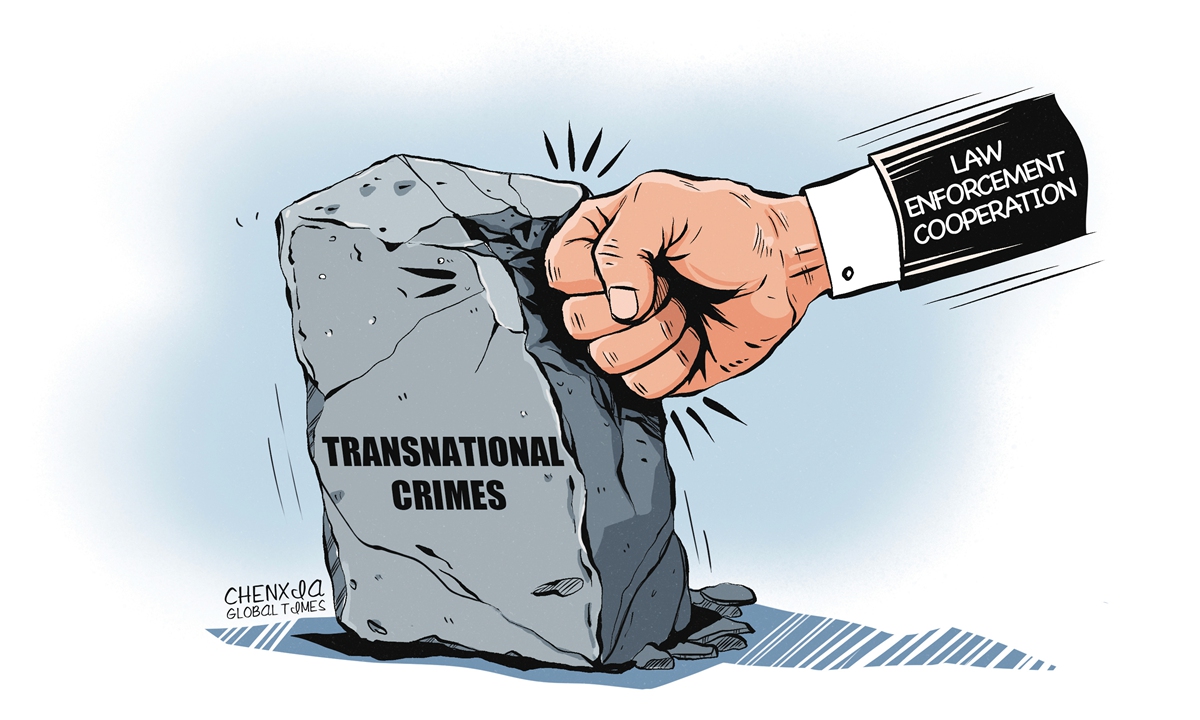
Illustration: Chen Xia/GT
On January 10, China's Ministry of Public Security criminal investigation bureau publicly released close-up footage of four major telecom fraud kingpins being escorted back to China for the first time.Since the launch of specialized operations against Myanmar-based telecom fraud in October 2023, criminal syndicates known as the "Four Major Families" in Kokang, northern Myanmar, have been dismantled. Ringleaders have been repatriated, and all related cases have entered judicial proceedings.
The release of this footage signals more than just domestic resolve against fraud. It raises a question worth contemplating: When transnational crime becomes a shared challenge among neighboring countries, how can pragmatic law enforcement cooperation transcend traditional security dilemmas and open new possibilities for regional governance?
This cross-border crackdown on telecom fraud carries significance far beyond ordinary criminal investigation. Over 7,600 Chinese nationals suspected of telecom fraud have been repatriated from Myawaddy and other locations.
A trilateral coordination mechanism among China, Myanmar and Thailand continues to function. Law enforcement agencies from six Mekong countries have jointly signed agreements to combat telecom fraud. Behind these concrete actions lies the emergence of a new paradigm for regional security cooperation. The core value of this paradigm lies in its "problem-driven" rather than "camp-based" approach.
Transnational crimes - such as telecom fraud, human trafficking, and drug smuggling - recognize no borders or political systems. They directly threaten the lives and property of citizens across all countries.
Southeast Asia has long grappled with structural challenges: geopolitical complexity, weak trust foundations among nations and high sensitivities around sovereignty. Traditional security cooperation, often built on ideological differences, great-power competition and historical grievances, struggled to achieve substantive breakthroughs.
Facing such common threats, nations share a straightforward yet solid motivation for cooperation: protecting their own citizens and maintaining social stability. This pragmatic orientation, rooted in real needs, enables parties to set aside differences, focus on action and achieve breakthroughs in the relatively sensitive domain of law enforcement.
This cooperation demonstrates a viable path from "trust deficit" to "strategic trust." Cross-border law enforcement involves highly sensitive issues: jurisdictional sovereignty, judicial independence and intelligence sharing. Unilateral action by any party could trigger diplomatic friction. Through institutionalized platforms such as the Lancang-Mekong ministerial meeting on law enforcement and security cooperation, parties have gradually established comprehensive chains - from information exchange and joint operations to personnel transfer and judicial assistance - while respecting each other's sovereignty and legal systems.
This trust accumulation is incremental, concrete, and verifiable. It relies not on grand narratives but on successive instances of successful cooperation.
Transnational crime not only directly endangers public safety but also erodes business credibility, disrupts investment climates and undermines trade order. Successful law enforcement cooperation does more than combat crime - it clears obstacles to regional economic integration, provides investors with predictable security assurances and creates environments where people can live in peace of mind and engage in cross-border exchanges.
This security-development interaction proves far more sustainable than economic concessions or political gestures alone.
Deepening this cooperation demands long-term strategic resolve and political wisdom. It requires all participants to genuinely uphold the principles of mutual respect for sovereignty and non-interference in internal affairs, while avoiding the instrumentalization or politicization of law enforcement cooperation.
China will adopt an increasingly open and inclusive posture, providing more public goods for the region while respecting each country's strategic autonomy and development path choices. It also appeals to neighboring countries to adopt a more pragmatic stance, placing their citizens' security and well-being above geopolitical calculations, and to jointly resist attempts to turn regional cooperation into bloc confrontation.
From a broader perspective, the positive interaction between law enforcement and economic cooperation is reshaping the internal logic of regional integration. The deepening of frameworks such as the Lancang-Mekong Economic Development Belt, the Regional Comprehensive Economic Partnership, and the upgraded China-ASEAN Free Trade Area all require stable security environments as foundations.
In an increasingly interdependent world, no country can remain unaffected in isolation, nor can any threat be eliminated through unilateral action. Only by resolving geopolitical competition through pragmatic cooperation and promoting common development through shared security, can we forge a viable path toward lasting peace and universal prosperity for our neighborhood and the wider world.
RELATED ARTICLES