Expert criticizes Europe's double standards for fueling US coercion, practice of sending troops to Asia without ability to provide own security
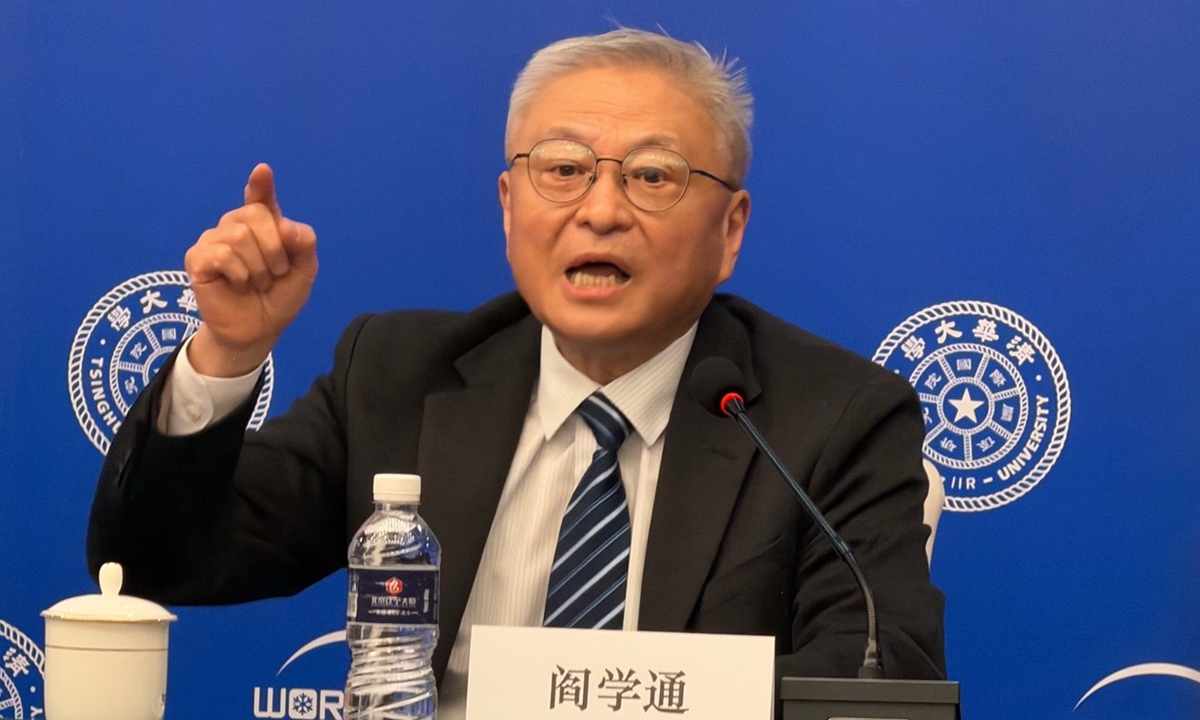
Yan Xuetong, honorary dean of the Institute of International Relations at Tsinghua University Photo: Chen Qingqing/GT
US-EU tensions will continue to worsen as both sides are at fault with Washington's increasingly coercive policy expanding from targeting the Global South to European allies, while Europe's acceptance of US bullying on others—paired with resistance when such tactics are turned on itself—exposes a self-reinforcing double standard at the heart of the conflict, Yan Xuetong, honorary dean of the Institute of International Relations at Tsinghua University, said at a forum titled "US Relations with Allies in the Trump 2.0 Era" under World Peace Forum Winter Series 2026 hosted by Tsinghua University on Sunday.
Yan noted that the US-Europe split is unfolding on three levels: growing rifts between the US and Europe; deepening divisions within Europe, where liberal and populist governments pursue divergent US policies; and internal political divergency within both the US and European countries, as liberalism has lost its dominant position and now competes with populism in both regions.
While the problems with the US-Europe relations are often blamed on Washington's strength and the US' aggressive policies, Europe cannot escape responsibility. "Can Europe really claim it bears no responsibility at all? Is everything to be blamed on the US? As mentioned earlier, Europe itself says it lacks sufficient capacity to guarantee its own security. That raises an unavoidable question: why, even today, do European decision-makers not regard safeguarding their own national security as their responsibility?" Yan said.
"If European decision-makers were able to decide that they themselves should be responsible for safeguarding their own security, I think the problem would be solvable," said Yan, noting that lacking military power does not mean a country cannot protect itself—many small states rely on diplomacy rather than force.
However, as the Europe cannot even guarantee peace at home, yet they continue to deploy troops to East Asia region. Yan noted that Europe first needs to address a mindset problem — acknowledging mistakes and recognizing its own shortcomings.
The expert also noted believes US-Europe tensions will continue to worsen, as both sides are at fault. On the US side, the US leader's globally coercive approach has expanded—pressuring only countries in the Global South is no longer enough, so the policy now extends to Europe as well. That is America's problem. On the European side, the logic seems to be: "I support you bullying others, but you cannot bully me." This double standard ultimately turns inward, and that is where the conflict arises.
Europe's role in international affairs—whether constructive or destructive—is a question its own leaders should think. The core issue is whether Europe seeks to advance a just and progressive world order or to preserve an unjust system built on double standard, according to the expert.
What is unfolding is that double standard is no longer confined to the US. European countries, too, are retreating from the human rights principles and norms. In this context, Europe's challenges in managing relations with Washington cannot be resolved simply by bolstering its strength to push back against US pressure. Without confronting its own internal contradictions, Europe will not only continue to face difficulties in its external relations, but will also see its ties with even more countries deteriorate, Yan said.
RELATED ARTICLES