Europe's biggest security threat comes from 'demon in its own mind,' not specific country, says former Chinese ambassador to the US
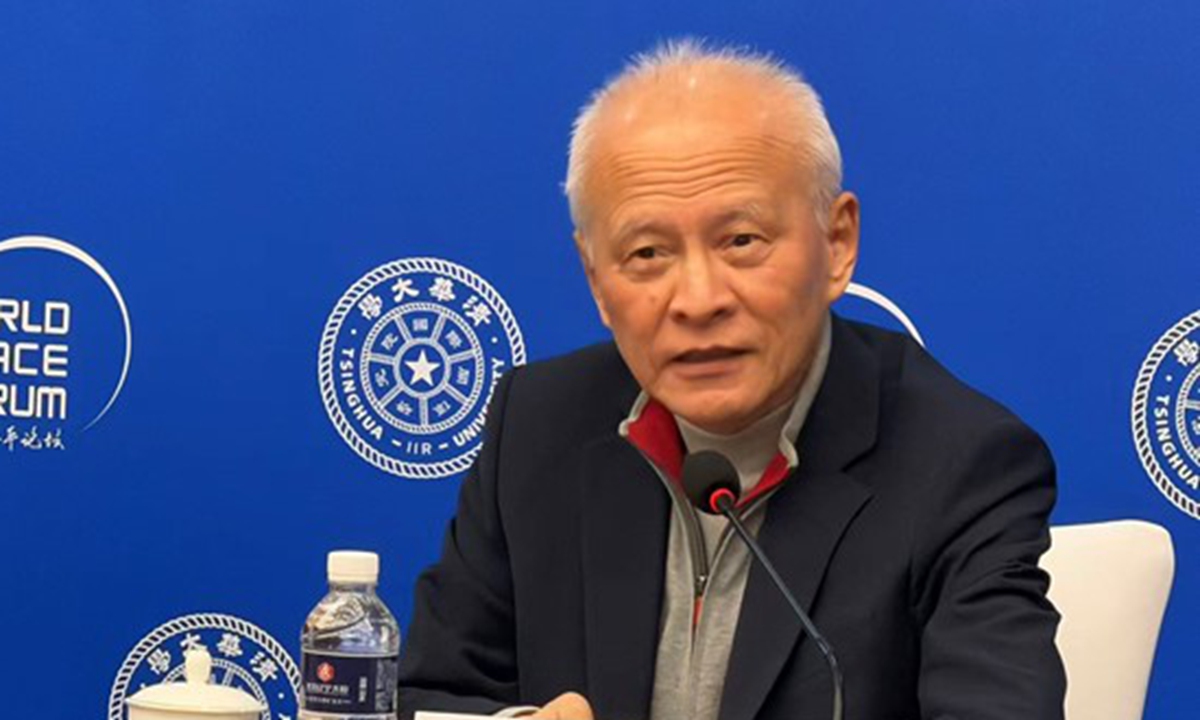
Cui Tiankai, former Chinese ambassador to the US, speaks at a forum titled "US Relations with Allies in the Trump 2.0 Era" under World Peace Forum Winter Series 2026 hosted by Tsinghua University on January 11, 2026. Photo: Chen Qingqing/GT
Cui Tiankai, former Chinese ambassador to the US, said on Sunday that Europe's biggest security threat does not come from any specific country, but from what he described as a "demon in its own mind," warning that outdated security thinking has become a self-inflicted source of insecurity.
Speaking at a forum titled "US Relations with Allies in the Trump 2.0 Era" under the World Peace Forum Winter Series 2026, hosted by Tsinghua University in Beijing, Cui questioned the logic behind Europe's heavy reliance on US security protection.
"If you say you need protection, then you must first identify what the security threat is," Cui said. "If even that cannot be clearly defined, what kind of protection are you asking for, and do you yourself have the capacity to ensure security?"
Cui noted that a considerable part of Europe now views Russia as its greatest security threat, a judgment he described as a mistaken assessment. "Whether Russia is good or bad is not a topic for discussion today," he said, pointing out that viewing Russia as Europe's biggest security threat, in his view is "a mistaken assessment," while China is "certainly not" [such a threat].
He also briefly referenced recent escalating tensions surrounding Greenland, questioning whether Europe would regard the US as a security threat in that context, and said that such an assumption would likely be inaccurate.
Cui stressed that Europe's biggest security threat lies not outside, but within. Quoting a well-known Chinese saying, he said, "It is easy to defeat a bandit in the mountains, but hard to eliminate the bandit in one's own heart."
"If one's understanding of security in the 21st century remains trapped in outdated frameworks, or even in ways of thinking rooted in the 19th century, how can genuine security be achieved, and how can one truly feel secure?" he asked.
Global Times
RELATED ARTICLES