US shouldn’t use other countries a pretext for seeking selfish gains: FM on Trump’s Greenland claim
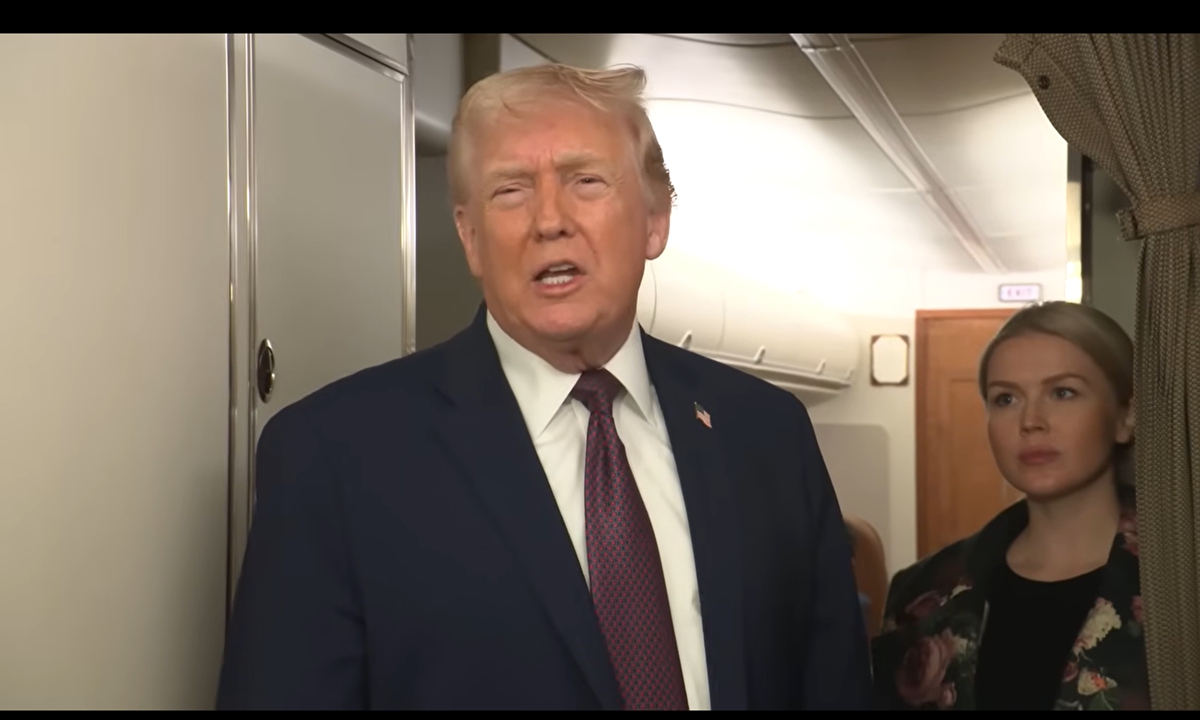
US President Donald Trump speaks with reporters on board Air Force One on January 11, 2026. Photo: screenshot of video clip released by the White House official account on Youtube
Countries' right and freedom to carry out activities in the Arctic in accordance with the law needs to be fully respected, Chinese Foreign Ministry Spokesperson Mao Ning on Monday said, in response to claims of the US President Donald Trump on Sunday that taking over Greenland is necessary. The US should not use other countries as a pretext for seeking selfish gains, Mao added.
Trump told reporters on Air Force One on Sunday "One way or the other, we're going to have Greenland." He stressed that he is not interested in a temporary arrangement, such as leasing territory, but rather a permanent acquisition, according to media reports.
"The Arctic bears on the common interests of the international community. China's activities in the Arctic are aimed at promoting the peace, stability and sustainable development of the region. They are in line with the international law," said Mao.
The rights and freedoms of all countries to carry out activities in the Arctic in accordance with law must be fully respected, Chinese Foreign Ministry Spokesperson Mao Ning on Monday said, in response to claims of the US President Donald Trump on Sunday that taking over Greenland is necessary. The US should not use other countries as an excuse for pursuing its own selfish interests, Mao added.
Trump told reporters on Air Force One on Sunday "One way or the other, we're going to have Greenland." He stressed that he is not interested in a temporary arrangement, such as leasing territory, but rather a permanent acquisition, according to media reports.
The Arctic bears on the overall interests of the international community. China's activities in the Arctic aim to advance the peace, stability and sustainable development of the region and are in line with international law, said Mao.
Trump renewed his claims on Sunday about taking Greenland as he described the region's defense is "basically two dogsleds." Recent series of threatening claims by the US have sparked strong opposition and concerns in Europe, as senior officials from multiple European countries spoke out once again to voice their criticism.
According to a video clip released by the White House official account on Youtube, when asked whether Trump would be OK if the actions on Greenland would compromise NATO, the US President told reporters maybe NATO "would be upset" if the US pulls out from the bloc, noting, "I just wonder whether or not if we needed NATO, would they be there for us? I'm not sure."
Danish Prime Minister Mette Frederiksen has said her country faces a "decisive moment" over the future of Greenland after US administration renewed its threats to seize the Arctic territory by force, accusing the US of potentially turning its back on NATO, media reported on Monday.
"We are at a crossroads, and this is a fateful moment," said Frederiksen at a party leader debate on Sunday, per the Guardian. "What is at stake is bigger than what the eye can see, because if what we experience from the Americans is that they are actually turning their backs on the Western alliance, that they are turning their backs on our NATO cooperation by threatening an ally, which we have not experienced before, then everything will stop."
Germany and Sweden backed Denmark against Trump's latest claims to the self-governing Danish territory, according to a report by Al Jazeera.
Swedish Prime Minister Ulf Kristersson said on Sunday that his country is highly critical of the "threatening rhetoric" against Greenland and Denmark from US President Trump's administration, adding that the rules-based world order was under greater threat than for many decades, reported Reuters.
Germany also reiterated its support for Denmark and Greenland, per Al Jazeera. Before meeting his US counterpart, Marco Rubio, on Monday, German Federal Minister for Foreign Affairs Johann Wadehpul held talks in Iceland to address the "strategic challenges of the Far North", according to a Foreign Ministry statement.
The leaders of five Greenland political parties in parliament issued a joint statement late Friday after the US President again suggested the use of force to seize the Danish autonomous territory. "We don't want to be Americans, we don't want to be Danish, we want to be Greenlanders," the leaders of five parties in parliament said in a joint statement, reported France24 on Saturday.
According to a report by The Telegraph on Saturday, the UK is in talks with European allies about deploying a military force to Greenland that would guard the Arctic region, after Trump claimed that the US will take Greenland the "hard way" if it can't do it the "easy way."
British officials have met with counterparts from countries including Germany and France in recent days to start the preparations, per the report. The plans, still at an early stage, could involve British soldiers, warships and planes being deployed to protect Greenland.
"Europe's shock and anger indicate its lack of a sense of history in judging US-Europe relations and the international situation," Jiang Feng, a researcher at Shanghai International Studies University and president of the Shanghai Regional Studies Association, said the US' coveting of Greenland has been a long-term strategy, with only the means of acquisition having changed under the current administration.
Jiang noted that as the US holds an absolute dominant position militarily, while Europe has neither the ability nor the will to resist, its condemnation may merely remain verbal. "Europe's passive situation is of its own making. If NATO were to dissolve, while it would be a weaning process for Europe, it would also present a historic opportunity to achieve strategic autonomy and 'survive from the brink of death,'" Jiang said.
RELATED ARTICLES