Chinese FM responds to reported meeting in US by G7, other countries discussing rare-earth supply chain
Rare-earth alliance built on zero-sum game unlikely to succeed: analyst
By and Chen Qingrui Published: Jan 12, 2026 10:40 PM

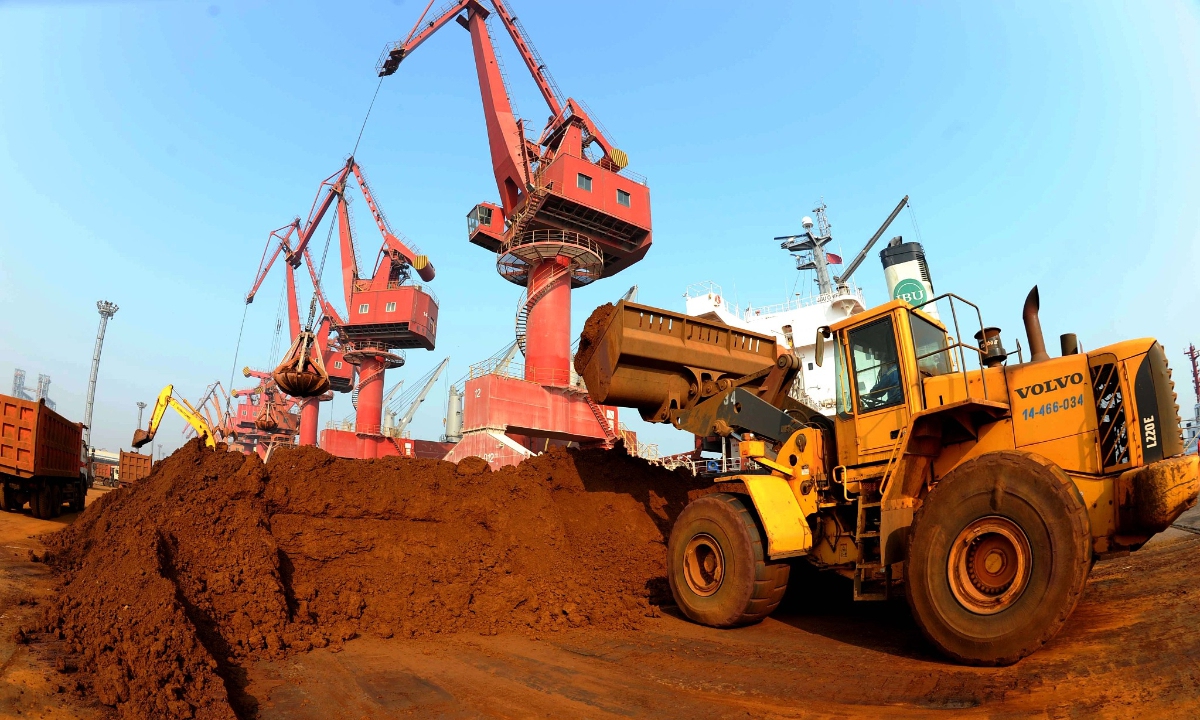
rare earth Photo:VCG
China's position on maintaining the stability and security of global supply chains for critical minerals remains unchanged, and China also believes that all parties have a responsibility to play a constructive role in that regard, Chinese Foreign Ministry spokesperson Mao Ning said at a regular press conference on Monday.
Mao was asked to comment on reports that officials from the Group of Seven (G7) nations and other countries are meeting in the US to discuss the rare-earth supply chain, as well as reports by some Japanese media outlets that Japanese companies are facing difficulties in obtaining rare earths for civilian use.
With regard to Japan, Mao said that China's decision to strengthen export controls of dual-use items to Japan is completely justified, reasonable and legitimate to safeguard national security and interests and fulfill international obligations, including on nonproliferation.
Mao's remarks came as the US has reportedly urged G7 countries to "follow its lead" in reducing reliance on critical minerals from China, with the G7 holding a meeting in Washington.
The move, according to a Chinese analyst, underlines the country's strategic anxiety over the vital metals for modern industries. However, the US goal is unachievable in the foreseeable future due to practical reasons, the current supply-demand dynamics and the different level of political interests among countries, the analyst said.
US Treasury Secretary Scott Bessent will urge G7 nations and others to step up their efforts to reduce reliance on critical minerals from China when he hosts a dozen top finance officials on Monday (US time), Reuters reported on Monday, citing a senior US official.
The G7 meeting kicked off with a dinner on Sunday evening, and it reportedly includes finance ministers or cabinet ministers from the G7 advanced economies, the EU, Australia, India, South Korea and Mexico, according to the official.
Cui Hongjian, professor at the Academy of Regional and Global Governance at Beijing Foreign Studies University, told the Global Times on Monday that Bessent's reported frustration has highlighted the lack of concrete progress despite holding round after round of meetings in recent months, and the US' strategic anxiety to achieve dominance in critical minerals including rare earths.
A G7 leaders' summit in Canada in June produced an action plan to secure their supply chains and boost their economies, but Bessent has grown frustrated by the lack of urgency demonstrated by attendees, the official said.
In a press release issued on Sunday (local time), the Canadian government said that François-Philippe Champagne, minister of finance and national revenue, will attend a series of meetings with his G7 counterparts and other "like-minded countries" on trade, as well as attending the meeting hosted by the US on global supply chains for critical minerals.
Cui said that other G7 members, unlike the US, show less urgency to cut external supplies, preferring a cautious approach based on supply-chain readiness and investment realities rather than an aggressive strategic push.
The divergence exposed by the discussion also points to a decline in some countries' trust in the US, said Cui, noting that the US is reportedly trying to secure potential resources in places such as Greenland as long-term strategic assets, while simultaneously pressing allies to move away from Chinese supply chains without offering a clear, workable and attractive alternative.
Cui said that Washington is increasingly framing rare earths and other critical minerals through a security and strategic lens, pushing what it calls "decoupling" from China - a sign of deepening US anxiety over China's dominance in key raw materials
China's edge in rare earths is rooted not simply in resource endowments but in decades of technological accumulation, integrated supporting industries and scaled-up production, Cui said.
"Even where Western countries have some resource potential, they are unlikely to make meaningful breakthroughs in technology maturity, output and cost control in the near term," the expert said.
Zhou Mi, a senior research fellow at the Chinese Academy of International Trade and Economic Cooperation, told the Global Times on Monday that supply and demand dynamics are the result of market-based behaviors over the years and any adjustment should be based on market principles.
"Some countries in the G7 have disrupted the international industrial and supply chains with protectionist measures such as tariffs and abuse of export controls in the first place, sending turbulence through the market," Zhou said.
Zhou noted that a number of countries within such so-called alliances have less to gain and more to lose, due to the vast differences in their economic structures, and this has greatly reduced the chances of success for such groupings on critical minerals supply as "any alliances built on the logic of zero-sum game cannot supply enough rare earths needed by its members."
The latest G7 meeting follows an announcement on November 1, which unveiled 26 new investments and partnerships under the so-called Critical Minerals Production Alliance to secure critical minerals supply chains.
China dominates the critical minerals supply chain. For rare earths used in magnets for various industries - notably neodymium, praseodymium, dysprosium and terbium - China accounted for about 60 percent of global mining output in 2024, according to an October 2025 report by the International Energy Agency. China's dominance is even greater in the separation and refining stages, representing about 91 percent of global production.
Besides promoting its goal in the G7 framework, the US has also worked with a number of countries separately on securing rare-earth metals.
RELATED ARTICLES