Japanese PM reportedly eyes parliament dissolution for a snap election; experts say move aims at consolidating power, puts personal, LDP interests above ordinary people
By and Li Yu Published: Jan 13, 2026 07:00 PM

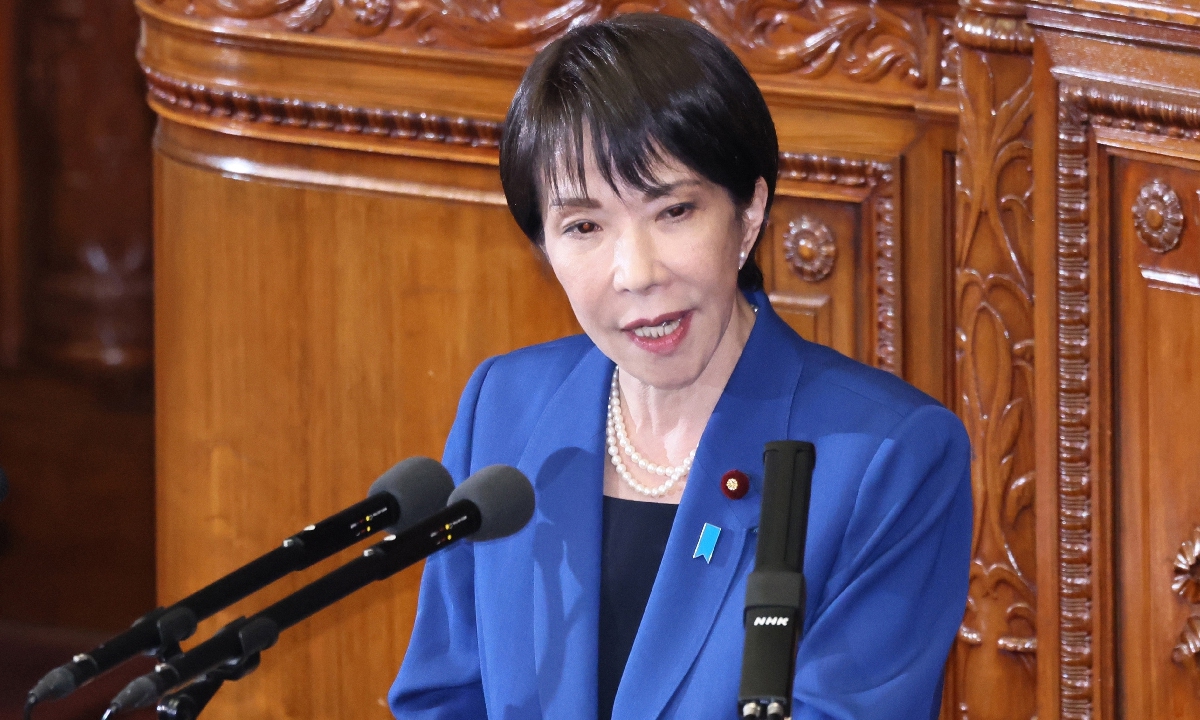
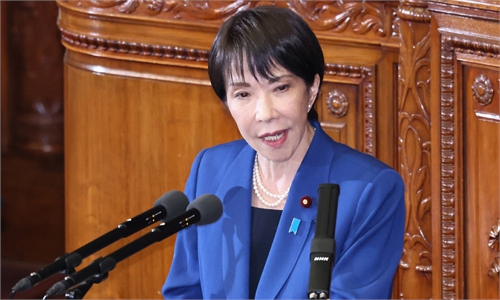
Japanese Prime Minister Sanae Takaichi delivers her first policy speech since taking office during the plenary session of the House of Representatives at the National Diet in Tokyo, on October 24, 2025. Photo: VCG
Japanese Prime Minister Sanae Takaichi plans to dissolve the House of Representatives for a snap election at the outset of the regular Diet session scheduled to convene on January 23, Japanese media outlet Kyodo News reported on Tuesday, citing a source familiar with the matter.
If the lower house is dissolved on January 23, official campaigning for a general election may start on January 27 or February 3, with voting possibly held on February 8 or February 15, respectively. Takaichi is expected to announce her decision soon, according to Kyodo News.
Chinese expert said the early election is intended to seize the current favorable situation to consolidate the Liberal Democratic Party (LDP)'s position, and consolidate Takaichi's own grip on power.
Kyodo News wrote that the decision, which was conveyed to senior ruling Liberal Democratic Party members, comes as Takaichi's nearly three-month-old Cabinet enjoys a high approval rating, raising hopes that an early poll could improve her fragile political standing, given that the ruling coalition holds only a razor-thin majority in the lower house.
Xiang Haoyu, a distinguished research fellow at the China Institute of International Studies, told the Global Times that the early election is mainly intended to seize the opportunity of the high approval ratings during the current honeymoon period of governance, consolidate the LDP's position through a strong chance of electoral victory, and lay the foundation for long-term governance.
A snap election might give the LDP a chance to win the general election and break free from its reliance on the Japan Innovation Party, explained Lian Degui, director of the Center for Japanese Studies at Shanghai International Studies University.
It would be the optimal governing scenario for the LDP to secure an absolute majority in the Diet on its own, Lian added.
This move comes amid rising right-wing sentiment in Japan. Lü Chao, a professor at the Liaoning Academy of Social Sciences, told the Global Times that Takaichi aims to capitalize on heightened support from right-wing segments of the public—a sentiment she has actively stoked by amplifying erroneous and dangerous rhetoric on Taiwan. The expert said he believed that by doing so, she seeks to portray her political course as a form of "new militarism" backed by popular will.
Reacting to the Japanese prime minister's intention to call an early election, Japanese media and the opposition officials have raised concerns.
The early snap election could delay the passage of the fiscal 2026 budget until April or later at a time when households continue to struggle with high prices, Kyodo News reported.
If the dissolution takes place, it will be difficult for the initial budget for the new fiscal year, including economic measures, to be enacted within that fiscal year. Japanese media outlet Asahi Shimbun wrote that Yoshihiko Noda, leader of the Constitutional Democratic Party of Japan, criticized the plan to reporters, stating, "While talking about measures to combat high prices, this move would create a political vacuum. There is neither logic nor justice to it."
Mari Kushibuchi, co-Leader of Reiwa Shinsengumi, also criticized, stating, "They are completely ignoring how difficult people's lives are," according to Asahi Shimbun.
To consolidate her own power, she panders to far-right forces and projects conflicts onto external actors, such as China. She consistently places her personal political interests above the national interest, narrowly defining the national interest as military expansion and camp confrontation while ignoring the far more urgent tasks of structural economic reform and improving people's livelihood, Yang Bojiang, director of the Japan Research Institute at the Chinese Academy of Social Sciences, told the Global Times.
Should Takaichi lead the LDP to an election victory, she would likely consolidate her control over the party, suppress internal dissent, and marginalize opposition voices. Empowered by public backing, she could then pursue an even more aggressive and reckless radical right-wing policy agenda, Xiang said.
This would steer Japan down an increasingly perilous development path and further exacerbate the risks posed to regional peace and stability, Xiang warned.
In response to Japanese Prime Minister Takaichi's consideration of an early election for the House of Representatives, Chinese FM spokesperson Mao Ning said, "This is Japan's internal affair, and I will not make any comment."
RELATED ARTICLES