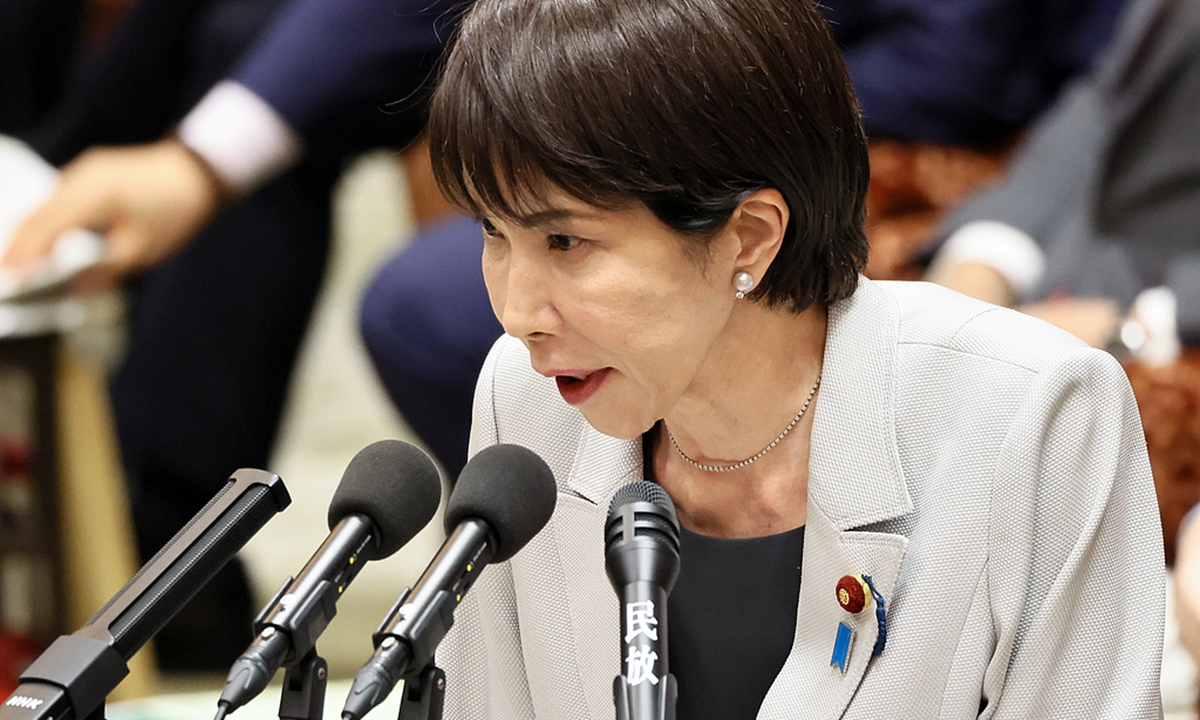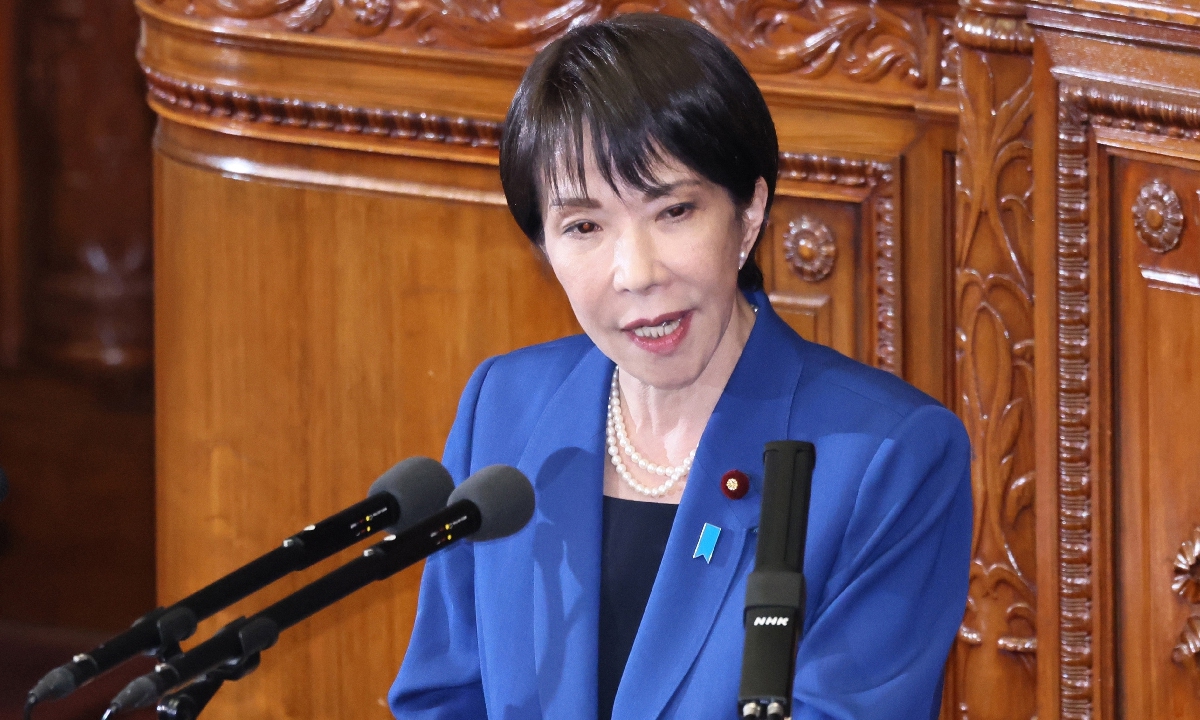
Japanese Prime Minister Sanae Takaichi delivers her first policy speech since taking office during the plenary session of the House of Representatives at the National Diet in Tokyo, on October 24, 2025. Photo: VCG
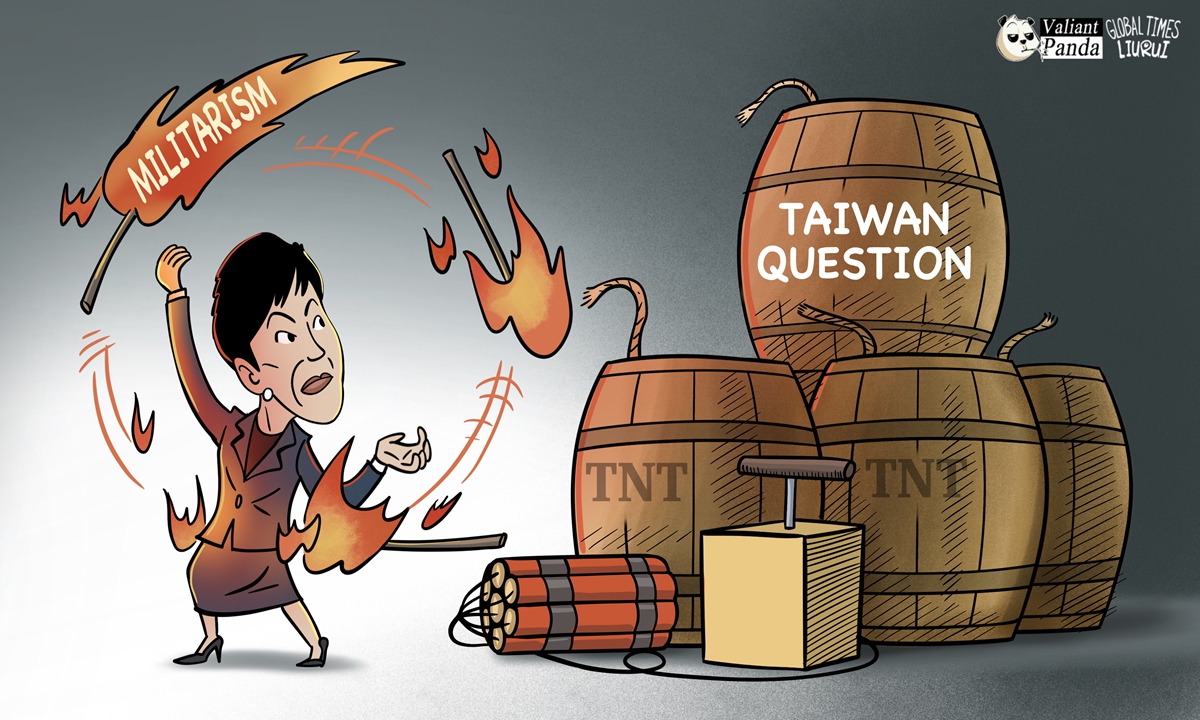
The recent remarks by Japanese Prime Minister Sanae Takaichi regarding Taiwan have undermined her disingenuous assertion that she is concerned about "maintaining peace and stability in the South China Sea."Furthermore, although her cabinet claimed that her remarks "do not change the government's consistent position" on the one-China principle, she has used language that clearly implies that the island of Taiwan is a separate legal entity from the rest of China.
The one-China principle is not a policy choice; it is a legal obligation. The legal principle of recognition and respect of the sovereign territory of a nation is the bedrock of international law. It is separate from, but usually in tandem with, recognition of the government of a nation. Sovereign territory does not change with a change of government or even of governance. Infringement of it always eventually results in war.
The legal status of Taiwan as an integral part of China's sovereign territory was reaffirmed in the Japanese Instrument of Surrender in 1945, under which the control of Taiwan and other "stolen territories" had been handed back to China.
The fact that the Taiwan region now has a different system of governance and a different political party in power in Taipei from that in Beijing does not automatically remove the island of Taiwan from China's sovereign territory. Military exercises by the forces of the People's Republic of China around the island of Taiwan, usually occurring after a provocative maneuver by the US and/or its allies, including those undertaken in response to Takaichi's remarks, are falsely characterized as signs of China's aggression. They are better understood as a demonstration of China's determination to protect China's sovereign territory and prevent alienation of any part of it.
When Japan and China established diplomatic relations in 1972, their joint communique reaffirmed Japan's adherence to the terms of the Cairo Declaration and the Potsdam Proclamation, conceding yet again that Taiwan was an inalienable part of China's sovereign territory. Takaichi's remarks severely water down those commitments. The remarks carry a particularly heavy weight, since they were made in the Japanese Diet as a policy statement in response to a question.
Framing them in terms of "defending Japan's survival" echoes the pretext cited for Japan's invasion of China in 1931. The many atrocities committed from then until Japan's defeat in 1945, not only in China, but across South East Asia, have not been forgotten. Japan has not only not apologized for them, but has been attempting to erase them from the history books. Takaichi herself has a long record of participation in the "denialist movement" to water down the severity of Imperial Japan's war history. Besides, her recent remarks are clearly designed to support the agenda of the US to push China into a war, bog China down and hamper its economic growth.
At the Shangri-La Dialogue this year, US Secretary of War Pete Hegseth warned against attempts by China to "conquer Taiwan by force." The Pentagon is putting pressure on Japan to spend more on weapons of war and to coordinate with the US to create a "credible deterrent" against China along the First Island Chain to prevent China from "seizing Taiwan." This makes it clear that the US still plans to use Taiwan as a pretext to contain China. Japan is showing a remarkable lack of self-awareness of its history. It has now supplied Japanese-made Patriot missile systems to the US to replenish stocks depleted by the US in Ukraine. It circumvented the restraint on the export of lethal weapons, using a legal contortion to justify export to the "origin of the manufacturing license." Japan has unwisely directly contributed to the US proxy war against Russia, making itself an enemy of Russia and exposing itself to a risk of retaliation.
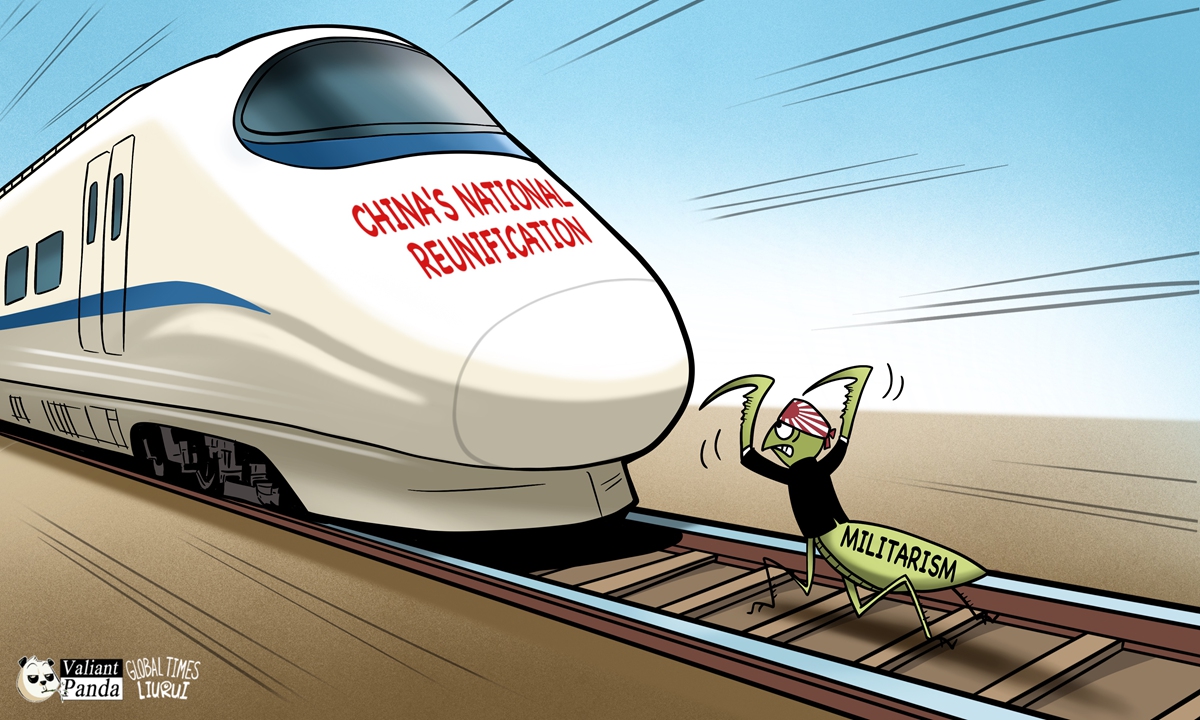
This changing political posture, combined with the accelerating militarization, and the distortion of Article 9 of the Japanese constitution to characterize military action well beyond Japan's borders as "self-defense," significantly undermines security in the Asia-Pacific region.
Japan is under no obligation to "defend Taiwan." Military intervention to do so would clearly constitute interference in China's internal affairs. It would lead to the devastation of both Japan and the island of Taiwan itself. Not only China but all the countries ranging from South Korea through to Australia should be feeling distinctly more anxious about a resurgence of Japanese militarism.
The author is a former Australian diplomat who served as deputy ambassador to China and director of the China Section of the Australian Department of Foreign Affairs on three separate occasions. opinion@globaltimes.com.cn
RELATED ARTICLES