Illustration: Liu Xidan/GT
Nanjing Agricultural University recently released Sinong, an open-source large-language model developed for agricultural use. The launch points to a broader trend: advanced digital tools are gradually moving beyond laboratories and entering agriculture, a sector long regarded as technologically conservative.Against the backdrop of a rapidly expanding digital economy, artificial intelligence (AI), the Internet of Things (IoT), big data, and other emerging technologies are increasingly finding applications in agriculture. As reported by media outlets, the Sinong research team compiled data across fields including animal science, agricultural economics, horticulture, and veterinary medicine. The resulting dataset demonstrates how digital tools are beginning to structure vast amounts of sector-specific information, providing a foundation for both research and practical applications.
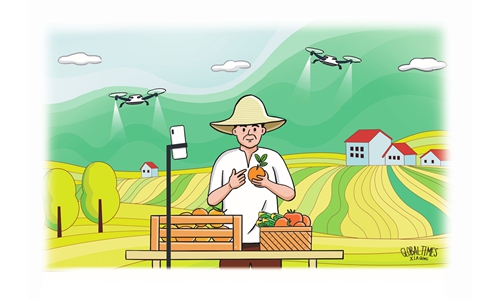
Sinong is far from an isolated example. As technology increasingly penetrates agriculture, similar efforts are becoming more common. According to CCTV.com, in Suining, Southwest China's Sichuan Province, a group of young people born after 2000 have formed a training class to cultivate vegetables using drones, smart irrigation systems, and digital management tools on previously unproductive land. This year, the group has set a new goal: to teach more local villagers how to farm using these intelligent, technology-driven methods.
The adoption of advanced technologies in agriculture, however, at times hinges on their cost-effectiveness. For crops with relatively narrow profit margins, high-cost technologies may be difficult to implement on a large scale. Conversely, more cost-effective technologies tend to spread more rapidly, driving the broader uptake of high-tech methods.
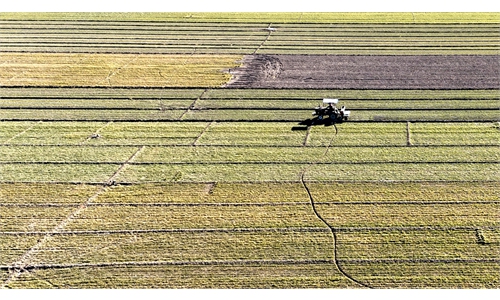
In China, the application of advanced technologies in agriculture is expanding steadily. The Xinhua News Agency reported in December 2025 that breakthroughs have been achieved in 62 types of intelligent machinery, including field-crop robots and precision feeding systems.
As of the end of 2024, the contribution rate of science and technology to China's agricultural growth had reached 63.2 percent, while the comprehensive mechanization rate of crop cultivation and harvesting exceeded 75 percent, according to official data.
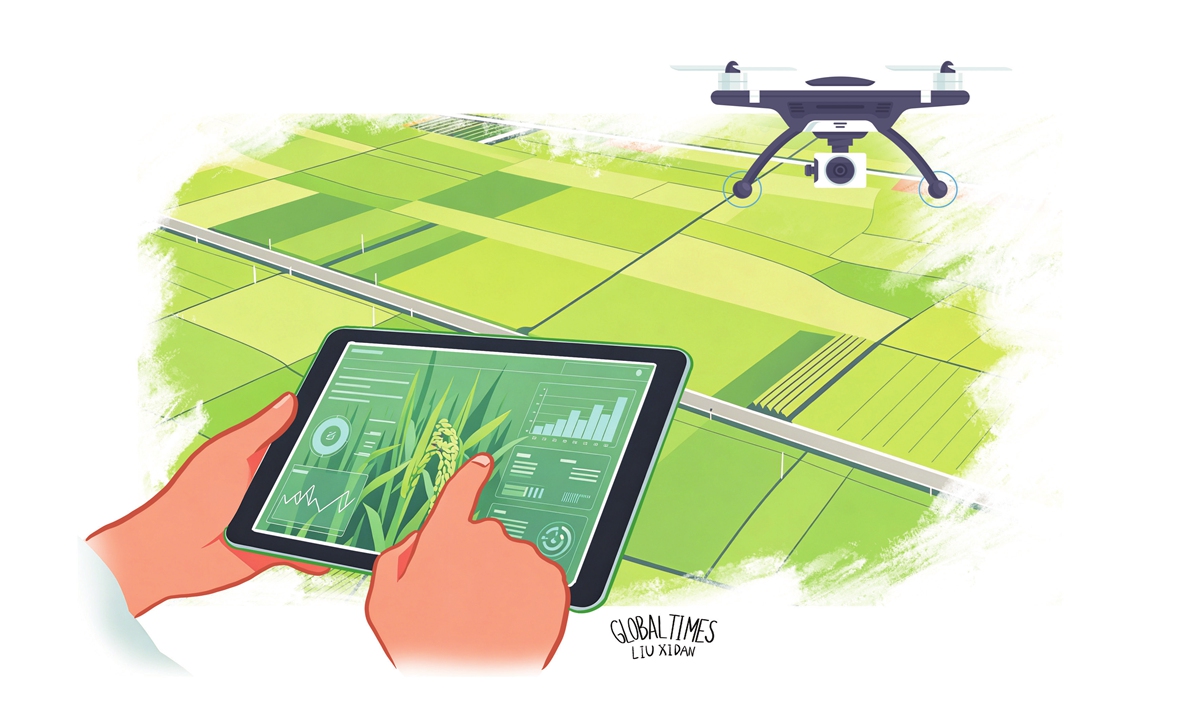
The "AI+ agriculture" initiative is steadily advancing, giving rise to a range of digital application scenarios that enhance quality and efficiency. Typical examples such as smart farms are being rolled out at a faster pace. From IoT sensors in fields that monitor crop growth in real time to drones enabling precision pesticide application; from intelligent temperature-control systems in cold-chain logistics that safeguard product quality to AI-powered sorting in processing facilities that boosts efficiency, technology is becoming deeply embedded across the entire agricultural value chain.
Under the National intelligent Agriculture Action Plan (2024-28) issued by the Ministry of Agriculture and Rural Affairs, China aims to establish an initial smart agriculture public service system by the end of 2026, with the agricultural production informatization rate exceeding 30 percent. By the end of 2028, public service capacity is expected to improve significantly, with information technology playing a comprehensive role in reducing costs and increasing yields and efficiency for grain, oil crops, and other key agricultural products, while the informatization rate is projected to exceed 32 percent.
The application of advanced technologies in Chinese agriculture has not occurred overnight, but has progressed gradually and systematically. Based on current developments, exemplified by Sinong and numerous other efforts, this process has accelerated in recent years. This pace of adoption serves a dual purpose: it facilitates the advancement of smart agriculture while also indicating the adaptability of high-tech solutions in a cost-sensitive sector. In this sense, these trends highlight both the accessibility of China's technological innovations and their potential for commercial viability within the agricultural domain.
The cost-effectiveness of China's advanced technologies points to potential new pathways for international collaboration. In this context, South-South cooperation could gain fresh momentum. In Asia, Africa, and Latin America, China's smart agriculture solutions - such as digital extension platforms, unmanned farming equipment, and sensing technologies - could increasingly be integrated with local agricultural training and capacity-building programs. This would help local economies improve productivity while adapting technologies to boost agricultural output.
China's exports of agricultural machinery and parts totaled $9.3 billion in the first half of 2025, up 26.5 percent year-on-year. This growth reflects the increasing presence of Chinese technology in international agricultural markets.
Through international cooperation, China's smart agriculture technologies can contribute to the resilience of the global food system, while benefiting in return from shared research, field feedback, and collaborative innovation.
The author is a reporter with the Global Times. bizopinion@globaltimes.com.cn
RELATED ARTICLES