Chinese automakers' US entry beneficial for both sides, analysts say, but caution potential risks after Trump's 'let China come in' remarks on US carmakers
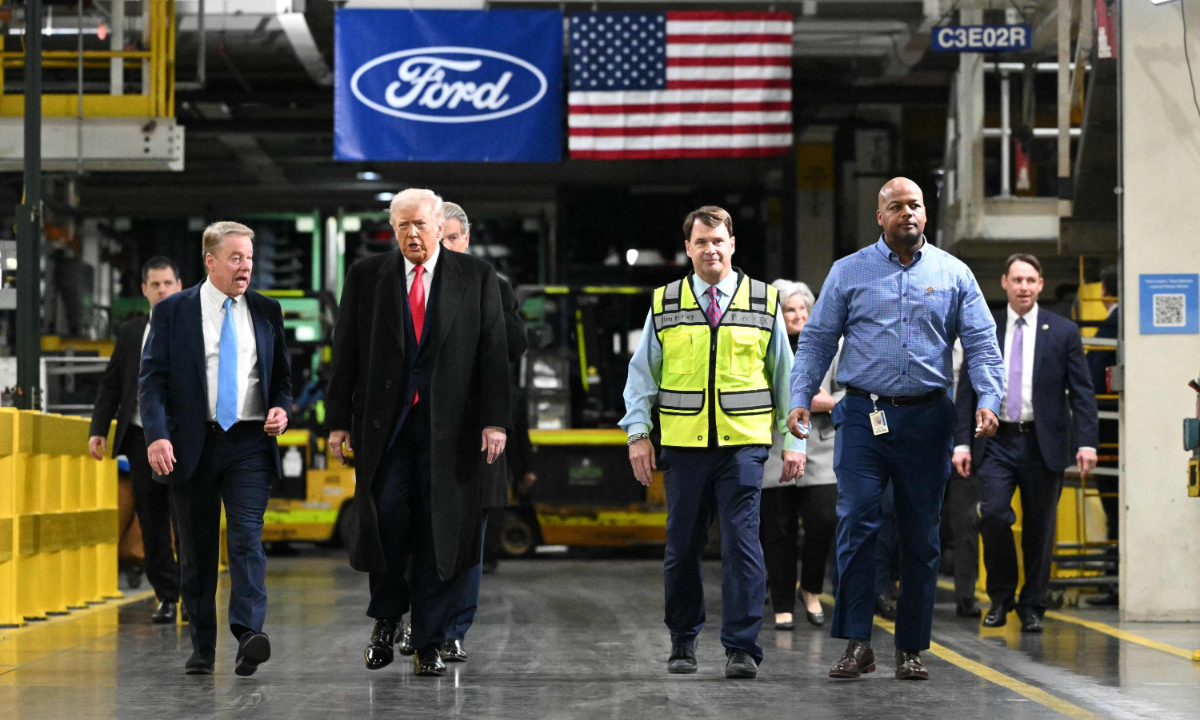
US President Donald Trump speaks with Ford executive chairman Bill Ford (left), Ford CEO Jim Farley (second right), as he tours Ford Motor Company's River Rouge complex in Dearborn, Michigan, on January 13, 2026. Photo: VCG
US President Donald Trump, during a Michigan visit, openly invited Chinese automakers to build factories in the US, noting they would create jobs using American labor, while he balanced the call with continued tariffs on imported Chinese vehicles. Analysts see potential openings from the remarks, adding that Chinese automakers' entry to the US is beneficial for both sides, but warn of major political, regulatory and market risks for Chinese firms.
He made the remarks before an audience that includes many US auto industry executives during a visit to Michigan's Detroit, known as the heart of America's auto industry, on Tuesday local time.
"Let China come in, let Japan come in," Trump said. "They are and they'll be building plants, but they're using our labor," he said during the Michigan trip, where he toured Ford's factory and delivered a roughly one-hour speech at the Detroit Economic Club, media reported.
Industry insiders said that Trump's remarks could signal a pragmatic pivot: leveraging foreign capital for domestic gains without fully dismantling trade barriers. There could be a chance for Chinese automakers.
They also pointed out that if Chinese automakers build factories in the US, it would create jobs for the local market, as Chinese carmakers did in the world.
For example, BYD's Brazil factory, which rolled off its 14 millionth new-energy vehicles in October 2025, employed more than 400 people by mid-2025. Once the plant reaches full capacity as planned, the factory is projected to support over 20,000 direct and indirect jobs, according to media reports.
In September 2025, China's Changchun Jetty Automotive Technology Co unveiled its first factory in Tunisia, which specializes in producing automobile components and is expected to create 700 jobs starting from 2026, according to the Ministry of Commerce (MOFCOM).
However, experts also warned the risks - ranging from labor laws and environmental regulations to consumer preferences - may deter immediate action, although the president's overture could open doors for Chinese automakers.
Zhang Xiang, secretary-general of the International Intelligent Vehicle Engineering Association, told the Global Times that Chinese automakers entering the American market involves multifaceted risks, including political and policy volatility, extended factory construction timelines and stark regulatory differences.
"The automobile factory construction cycle is relatively long. In China, it might take 1-2 years to complete and operate, but in the US, it could take 3-4 years," Zhang explained.
Zhang highlighted the need for heavy investments in after-sales services, auto financing, and dealer networks, adding that US policies shift dramatically every two years, amplifying uncertainty for Chinese automakers.
Zhang also pointed out that Chinese automakers currently lack direct export experience to the US. Meanwhile, tariffs imposed will also affect Chinese automakers' decision.
NBC reported that Trump also made a point at Ford's factory of mentioning that his administration has imposed large tariffs on vehicles imported from China and said he hopes to prevail at the Supreme Court, which is weighing the legality of his sweeping tariff policies.
"As I promised you, I've imposed a 25 percent tariff on all foreign automobiles," Trump said when speaking at the Detroit Economic Club. He also said foreign automakers, including Chinese companies, were being forced to reconsider their strategies because of the tariff, according to a video of Trump's Michigan trip released by Fox News.
Trump said the tariffs were designed to ensure cars sold in the US are built in the country, rather than imported, according to Fox News.
MOFCOM and Chinese automobile industry associations have opposed US' tariffs on Chinese vehicles.
The US imposed a 25 percent tariff on all imported automobiles starting from April 2. Regarding this, He Yadong, a spokesperson for MOFCOM, said that China firmly opposes the US imposition of relevant tariff measures based on the so-called "Section 232 investigation."
The global auto industry relies heavily on cross-border industrial and supply chains. Artificially severing the industrial and supply chain between the US and other regions, the US measures do not contribute to so-called "national security" or help the domestic US industry; they only highlight the unilateralism, protectionism, and bullying nature of the US actions, said He.
The China Association of Automobile Manufacturers also opposes the US move and said in April that the US' imposing tariffs has caused significant disruptions to the global automobile supply chain and will further increase car prices, imposing additional burdens on consumers in countries including the US, and also having a negative impact on the global economic recovery, said.
Chinese analysts said that imposing tariffs has never been a feasible way to prompt foreign carmakers to invest and produce in the US, but a true open and non-discriminatory environment with no potential barrier risks, urging the US to create a fair and level ground for Chinese investors.
RELATED ARTICLES